









HubSpot and ActiveCampaign get compared a lot, and most of the comparisons online aren’t useful. Either the vendor wrote the page (predictable conclusion) or the writer ran the wrong apples-to-apples test (comparing HubSpot’s $890/month Pro plan against ActiveCampaign’s $15/month Starter, which tells you nothing).
Quick verdict: ActiveCampaign wins for solo operators, small e-commerce shops, and email-first SMBs under $15K average deal size that need powerful automation at a low contact-based price. HubSpot wins for B2B teams with 10+ people running marketing, sales, and service together, where one CRM and one data layer pays back the extra cost in a few months. The right answer almost always depends on whether you’re running email or running a revenue operation.
We’re Integrate IQ, a HubSpot Diamond Solutions Partner with custom integration accreditation. We’ve migrated teams from ActiveCampaign to HubSpot when their sales motion outgrew the email tool, and we’ve also told prospects the other direction is fine when their needs are genuinely email-first. This comparison covers what each platform actually does at the price points you’d actually pay, where each one wins honestly, and the signs you’ve outgrown ActiveCampaign if that’s the question driving you here.
Free estimator
Know what your HubSpot project costs before the first call.
Select your services and get a transparent price range in minutes. No sales call needed to get a number.
Firm quote after a free discovery call. Build estimate
HubSpot vs ActiveCampaign at a Glance
HubSpot is a customer platform built around Smart CRM, with marketing, sales, service, content, commerce, and operations Hubs sharing one data layer. It targets B2B teams that want their full revenue motion on one platform, with transparent seat-based and contact-tier pricing.
ActiveCampaign is an email-automation-first platform that grew into adjacent areas (basic CRM, landing pages, SMS, AI). It targets SMBs, e-commerce stores, and email-led marketing teams that want strong behavior-based automation at a contact-based price.
The core difference: HubSpot is a CRM that runs marketing automation. ActiveCampaign is marketing automation that runs a light CRM.
| Factor | HubSpot | ActiveCampaign |
| Best for | B2B teams of 10+ with sales motion | Solo to SMB email-first teams |
| Free tier | Yes (CRM); Marketing free is limited | No (14-day trial only) |
| Real entry price | Starter ~$20/seat/mo; Pro $890/mo for real automation | Plus $49/mo includes real automation |
| Pricing model | Seats + marketing contact tiers | Contact-based across all tiers |
| Core strength | Unified CRM + sales + service + marketing | Email automation depth at low cost |
| Core limitation | Real automation starts at Pro tier | Light on sales CRM, service, content |


Turn HubSpot Into A Real-Time SMS Engine with Message IQ
 Two-Way Conversations
 Shared Team Inbox
 Automation Triggers
 Advanced Reporting
 Compliance Tools
- 98% SMS read within 3 min
- 78% Buy from first responder
- 21× More likely to qualify

*MessageIQ is an IntegrateIQ product – built natively for HubSpot by the same team.
What HubSpot Is and Who It’s Built For
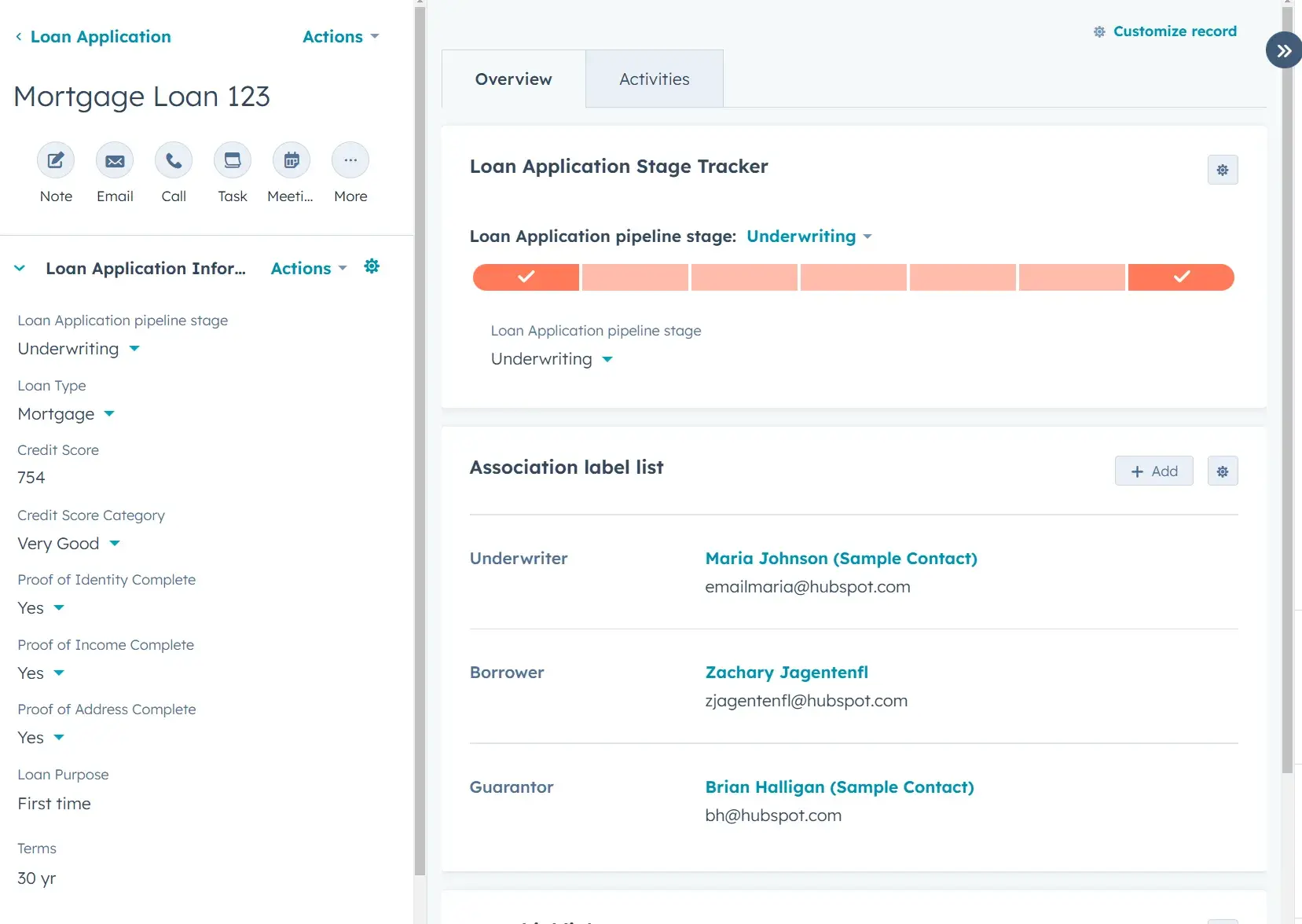
HubSpot started as an inbound marketing tool in 2006 and grew into a customer platform organized around six Hubs: Marketing, Sales, Service, Content, Operations, and Commerce. All of them sit on top of HubSpot Smart CRM, which is free.
For this comparison, Marketing Hub is the most direct counterpart to ActiveCampaign. It handles email campaigns, forms, landing pages, lead capture, workflows, lead scoring, ad management, social, and reporting. Sales Hub adds pipelines, deal stages, sequences, quotes, and forecasting. Service Hub adds tickets, customer portals, and SLAs. Every Hub shares the same contact, company, and deal records.
HubSpot is the right call when marketing, sales, and service need to share data without integration work. For a B2B team running outbound + inbound, multiple sales reps, customer success, and post-sale renewals, the unified architecture removes a stack of integrations and reduces the data-reconciliation tax.
The honest limitation: the Marketing Hub Starter tier ($20/seat) doesn’t include workflow automation or email sequences. You need Professional at $890/month for real automation, which is a meaningful step up. For solo operators or businesses that only need email automation, this is overkill.
What ActiveCampaign Is and Who It’s Built For
ActiveCampaign launched in 2003 as an email marketing tool and rebuilt itself around marketing automation in the 2010s. Today it offers four tiers (Starter, Plus, Pro, Enterprise) plus add-ons for enhanced CRM (Pipelines, Sales Engagement), SMS, transactional email, custom reporting, and WhatsApp.
The core product is the visual automation builder with 900+ pre-built automation recipes, multi-branch conditional logic, behavior-based triggers, and AI-powered features like predictive sending and content suggestions. ActiveCampaign excels at email-led marketing motions: behavioral nurture sequences, post-purchase flows, cart abandonment for e-commerce, and segmented broadcast campaigns.
ActiveCampaign is the right call for solo operators, small e-commerce stores, and SMBs whose primary need is email automation that reacts to user behavior. The contact-based pricing keeps costs low at small list sizes, and 900+ ready-made recipes let teams ship campaigns without building from scratch.
The honest limitation: ActiveCampaign’s Starter plan caps automations at five actions each, blocks landing pages, blocks A/B testing, and doesn’t include CRM features. Most teams running real campaigns end up on Plus ($49/month) within weeks of starting. The sales CRM is light unless you add the Pipelines and Sales Engagement add-ons, and service/content/commerce features mostly aren’t there.
Pricing: The Real Apples-to-Apples Comparison
Most comparison pages run a dishonest pricing match: HubSpot Pro at $890/month versus ActiveCampaign Starter at $15/month. That’s not a comparison, that’s a setup. Here’s how the pricing actually maps when you compare equivalent feature sets.
Entry-level: HubSpot Free CRM + Starter vs ActiveCampaign Starter
HubSpot’s free CRM is genuinely useful for contact and deal management without marketing automation. Marketing Hub Starter at $20 per seat per month adds email marketing and basic forms. ActiveCampaign Starter at $15/month for 1,000 contacts includes email automation and basic CRM but caps automations at five actions each, blocks landing pages, and blocks A/B testing.
Verdict: ActiveCampaign Starter wins for solo operators who need automation more than CRM. HubSpot wins for solo founders who need a real CRM more than email automation.
Real automation: HubSpot Professional vs ActiveCampaign Plus or Pro
This is where the comparison gets honest. HubSpot Marketing Hub Professional at $890/month per month (3 seats included) is where real marketing automation lives in HubSpot. There’s also a $3,000 onboarding fee at Pro tier. Year-one cost for a 5-person team on HubSpot Pro lands around $13,000 to $15,000 before contact overages.
ActiveCampaign Plus at $49/month for 1,000 contacts includes unlimited automation actions, landing pages, basic lead scoring, generative AI features, and integration breadth. ActiveCampaign Pro at $79/month (some sources cite $99 to $149 depending on plan changes) adds predictive sending, A/B testing in automations, advanced segmentation, attribution tracking, and conditional content. Year-one cost for a 5-person team on ActiveCampaign Plus with 10,000 contacts lands around $3,200 to $4,000.
Verdict: ActiveCampaign wins decisively on price for real automation. The gap is roughly $10,000 in year-one spend for a 5-person team.
Contact-based pricing scales fast
One caveat on ActiveCampaign: contact-based pricing climbs as your list grows. Starter goes from $15/month at 1,000 contacts to $125/month at 25,000. Plus scales from $49/month to roughly $349/month across the same range. Pro climbs even faster. At very high contact volumes, the gap with HubSpot narrows considerably.
Verdict overall: ActiveCampaign wins on price across the full range, but the margin shrinks at higher contact counts. HubSpot wins on what you get for the price once you factor in CRM, sales, service, and AI breadth.
Marketing Automation and Workflow Builder
Both platforms have strong workflow builders. The difference is what those workflows are designed to do.
ActiveCampaign’s automation builder is the core product. Workflows can be triggered by 45+ signals (engagement, behavior, purchases, custom events) and shaped with 50+ actions including conditional branching, wait steps, goal tracking, and split automations. The 900+ pre-built recipes give teams a head start. For email-led marketing, behavior-driven nurture sequences, and e-commerce flows like cart abandonment and post-purchase, ActiveCampaign’s depth at the price is hard to beat.
HubSpot’s workflows are powerful and built into the broader platform. Triggers span CRM record changes (a deal moves to a new stage, a contact’s lifecycle stage updates), marketing engagement, form fills, and custom property changes. The visual builder supports branching, delays, list segmentation, and custom code actions for builds that go beyond pre-built logic. Cross-Hub triggers let marketing workflows react to sales activity or service tickets without integration.
Verdict: ActiveCampaign wins on email-focused automation depth at low cost. HubSpot wins on workflows that span the full revenue motion. If your automations are mostly marketing-to-marketing, ActiveCampaign covers it. If your automations need to react to sales and service activity, HubSpot’s cross-Hub triggers do that natively.
Email Marketing Capabilities
ActiveCampaign is one of the strongest email marketing tools in its price range. The email builder includes 250+ templates, advanced conditional content blocks that show or hide based on contact data, AI-powered predictive sending that optimizes delivery time per contact, and split testing up to five variations with automatic winner selection. For email-first teams, the feature set at the Pro tier is genuinely deep.
HubSpot’s email marketing improved significantly in 2025-2026 with the AI Content Writer in Content Hub and embedded Breeze features. The drag-and-drop builder is intuitive and the personalization tokens draw from CRM data automatically. A/B testing and predictive analytics are Professional-tier features, which puts them behind a $890/month paywall.
Verdict: ActiveCampaign wins on email-specific capability at price. HubSpot wins when email is part of a broader, CRM-data-driven marketing motion. If email is 80% of your marketing, ActiveCampaign is the cheaper, deeper tool.
CRM and Sales Features
This is where the gap is widest in HubSpot’s favor.
HubSpot Smart CRM is included free with every plan. Contacts, companies, deals, custom objects, line items, products, and tickets all live in one place. Sales Hub adds pipeline management, deal stages with automation, sequences, quotes, forecasting, playbooks, call recording, and meeting scheduling. Service Hub layers tickets, customer portals, SLAs, and knowledge base on the same records.
ActiveCampaign includes a light marketing CRM at the base tier, with contact records, basic deal tracking, and tagging. Real sales CRM features (pipelines, sales engagement, sequences) come through the Pipelines and Sales Engagement add-ons. Even with those add-ons, the CRM is meaningfully lighter than HubSpot’s Sales Hub. Service features mostly aren’t there.
Verdict: HubSpot wins decisively. For any team running a real sales motion with multiple reps, deal stages, forecasting, and post-sale customer success, HubSpot covers the operational surface area ActiveCampaign doesn’t. ActiveCampaign’s CRM is enough for a solo operator tracking deals; it’s not enough for a 5+ person sales team.
Lead Scoring and Segmentation
Both platforms support lead scoring. The depth differs.
HubSpot supports manual lead scoring across tiers and predictive scoring at Enterprise. Score-based workflows route, segment, and trigger handoffs to sales. AI-driven scoring through Breeze landed in 2026 and narrowed the depth gap with enterprise platforms. Segmentation runs on full CRM data including custom objects, deal stages, and service interactions.
ActiveCampaign supports lead scoring from the Plus tier upward. Score-based automation triggers let you build behavior-driven scoring models that update in real time. AI-suggested segments surface high-value audiences automatically. For email-led nurture motions, the scoring depth is genuinely strong.
Verdict: HubSpot wins on raw depth and cross-Hub data access. ActiveCampaign wins on lead scoring access at low price tiers (available from $49/month vs HubSpot’s $890/month Professional or Enterprise predictive). For email-first nurture, both work well.
AI Features: Breeze vs Active Intelligence

HubSpot’s Breeze AI suite is embedded across the platform. Breeze Copilot drafts emails, builds workflows, and surfaces insights. Breeze Agents prospect, qualify, and engage leads. The AI Content Writer handles blogs and landing pages. Predictive lead and account scoring run natively. AEO (answer engine optimization) tooling helps content rank in AI search results. Because Breeze draws on full CRM data, it has more context than tools that only see email engagement.
ActiveCampaign’s Active Intelligence (recognized in 2026 AI Excellence Awards) focuses where its users need it most: predictive sending that optimizes delivery time per contact, AI-powered content suggestions, AI-suggested segments, and AI-generated automation recipes. The platform reportedly reduces campaign build times from 2.6 hours to 18 minutes for typical workflows. It’s a narrower AI footprint than Breeze, but more concentrated on what email marketers actually do.
Verdict: HubSpot wins on AI breadth across the full revenue motion. ActiveCampaign wins on AI features tuned specifically for email automation workflows. The right tool depends on whether you need AI helping marketing AND sales AND service, or just AI helping marketing.
Integrations and Ecosystem
HubSpot’s app marketplace has 2,000+ integrations across CRM, sales, ads, support, finance, and ops. Operations Hub adds programmable workflows and a custom code action for builds beyond pre-built connectors. The development model and partner ecosystem are deep.
ActiveCampaign offers 970+ integrations covering most common SMB and e-commerce tools. The Shopify, WooCommerce, and Stripe integrations are particularly strong. Salesforce integration is available on Pro and Enterprise tiers. The API is solid for custom builds.
As a HubSpot Diamond Solutions Partner, we’ve built custom integrations connecting HubSpot to 300+ platforms across CRM, ERP, accounting, field service, healthcare, finance, and recruiting. The native marketplace plus custom build options cover almost any operational scenario.
Verdict: HubSpot wins on breadth. ActiveCampaign wins on e-commerce-specific integration depth (Shopify and WooCommerce flows are particularly polished).
Reporting and Attribution
HubSpot ships with custom reports, interactive dashboards, multi-touch revenue attribution, and customer journey analytics natively. Because the CRM and marketing tools share one data layer, attribution works without integration gymnastics. Reports pull from the full funnel including sales activity and service tickets.
ActiveCampaign provides conversion tracking, attribution reporting on Pro and above, and engagement analytics. Custom Reports is an add-on with deeper dashboard capabilities. For email-focused reporting (open rates, click-through, automation performance, revenue attribution per campaign), the depth is sufficient.
Verdict: HubSpot wins on full-funnel attribution and cross-Hub reporting. ActiveCampaign covers email and marketing campaign attribution adequately, especially with Custom Reports.
Ease of Use and Onboarding
HubSpot scores about 4.5/5 on G2 for ease of use. The interface is approachable, in-app guidance is thorough, and HubSpot Academy provides free certifications that flatten the ramp. Most teams launch first campaigns within two to three weeks. Implementation at Pro tier includes a $3,000 onboarding fee paired with structured kickoff.
ActiveCampaign rates similarly on G2 (4.4/5 for both platforms) but the experience differs. The visual automation builder is intuitive once you understand the logic. The 900+ recipes give beginners a starting point. Some users report the interface feels denser than HubSpot’s, and the platform has a steeper learning curve for complex multi-branch automations. There’s no mandatory onboarding fee; training resources are included.
Verdict: HubSpot wins on accessibility for non-technical users and breadth of free training. ActiveCampaign wins on faster path to a running automation if you’re comfortable with workflow logic.
HubSpot vs ActiveCampaign: Side-by-Side Comparison
Quick reference across every dimension. The Winner column reflects the call we’d make for the typical B2B buyer evaluating both platforms at the right price match.
| Dimension | HubSpot | ActiveCampaign | Winner |
| Architecture | CRM + Marketing + Sales + Service unified | Email automation + light CRM | HubSpot for full revenue motion |
| Free tier | Yes (CRM) | No (14-day trial) | HubSpot |
| Entry price | Marketing Starter ~$20/seat | Starter $15/mo for 1K contacts | ActiveCampaign |
| Real automation entry | Pro at $890/mo | Plus at $49/mo | ActiveCampaign |
| Year-1 TCO (5 ppl, 10K contacts) | ~$13,000+ | ~$3,200 | ActiveCampaign |
| Workflow builder | Visual, cross-Hub triggers, custom code | Visual, 900+ recipes, multi-branch | Tie (different strengths) |
| Email features | Solid, A/B at Pro | 250+ templates, predictive sending, 5-variation A/B | ActiveCampaign at price |
| CRM and sales | Native Smart CRM, full Sales Hub | Light CRM; full sales is add-on | HubSpot |
| Service capability | Service Hub included | Mostly not there | HubSpot |
| Lead scoring | Standard + predictive at Enterprise | Available from Plus tier | Tie |
| AI features | Breeze across platform | Active Intelligence (email-focused) | HubSpot for breadth |
| Integrations | 2,000+ apps | 970+ apps | HubSpot |
| Reporting | Multi-touch attribution native | Email/campaign attribution from Pro | HubSpot |
| Ease of use | G2 4.5/5 | G2 4.4/5 | HubSpot (slight edge) |
When HubSpot Is the Better Choice
HubSpot is the right call for the following teams:
B2B teams with 10+ people running sales, marketing, and service together
If your operating model includes more than five sales reps, customer success, and a marketing function that needs to share data with both, HubSpot’s unified architecture removes the integration tax. We’ve helped teams cut data reconciliation work by 30% to 50% after consolidating onto HubSpot.
Companies where average deal size exceeds $15,000
HubSpot Pro’s $890/month price point pays for itself when deal sizes are large enough that a 1% lift in conversion or velocity covers the cost. For under-$15K deal sizes, the math gets harder and ActiveCampaign’s price advantage tends to win.
Organizations consolidating a fragmented stack
If you’re running a separate email tool, separate CRM, separate helpdesk, separate landing page builder, and separate reporting tool, HubSpot lets you consolidate into one platform with one contract. Total stack cost often drops after consolidation even though HubSpot’s headline price looks higher.
Teams planning to add Sales Hub or Service Hub within 12 months
If sales or service growth is on the roadmap, starting on HubSpot avoids a migration later. ActiveCampaign can run as the email tool today, but you’ll need a real CRM eventually, and consolidating then adds rework.
Inbound and content-led growth motions
HubSpot’s content tooling (CMS, blog, SEO, AEO, social, ads, forms, landing pages, AI content) is built for inbound. If your demand engine is content-first, you’ll use more of HubSpot’s surface area.
When ActiveCampaign Is the Better Choice
This section matters. Pretending ActiveCampaign never wins makes the rest of the comparison less credible. There are specific scenarios where ActiveCampaign is the correct answer.
Solo operators, freelancers, and very small teams
If you’re a one to three person operation focused on email-driven engagement, ActiveCampaign Plus at $49/month gives you real automation without paying for sales and service infrastructure you don’t need. The 900+ recipes mean you can ship campaigns the same week you sign up.
E-commerce stores running Shopify or WooCommerce
ActiveCampaign’s e-commerce automation depth (cart abandonment, post-purchase flows, product-block emails, repeat-purchase nurture) is hard to beat at its price. For DTC brands under $5M revenue, ActiveCampaign covers the marketing motion at a fraction of HubSpot’s cost.
Budget-constrained SMBs where $13,000+ year-one HubSpot spend is genuinely a stretch
If the difference between $3,200/year and $13,000/year materially affects your runway, the cheaper tool that does email automation well is the right call. We’d rather see a startup ship campaigns on ActiveCampaign Plus than buy HubSpot Pro and use 20% of it.
Email-first marketing teams where deep automation logic matters more than CRM depth
For some companies, the marketing motion is the operation. Behavior-triggered emails drive the funnel, the sales team is small, and CRM features are minimal. ActiveCampaign’s automation depth at low cost is genuinely better for this profile.
Signs You’ve Outgrown ActiveCampaign
Most teams that move from ActiveCampaign to HubSpot share a similar pattern. Here are the specific signals we see in our migration projects.
- Your sales team grew past 5 reps and ActiveCampaign’s light CRM can’t handle the pipeline complexity. Deal stages, forecasting, sequences, and rep activity tracking all start needing more than the add-ons provide.
- Average deal size grew and customer success became a function. ActiveCampaign doesn’t really do service or post-sale, so the team is bolting on Zendesk or Intercom and integrating manually.
- You’re paying for ActiveCampaign Pro plus Pipelines add-on plus Sales Engagement add-on plus Custom Reporting add-on and the bill is approaching HubSpot Pro pricing anyway, with less coverage.
- Marketing and sales are arguing about attribution because the email tool, the CRM, and the helpdesk see different versions of the same contact.
- Contact-based pricing has scaled the bill above $500/month and you’re hitting send-volume caps or feature limits that require another tier upgrade.
- You’re adding outbound prospecting, ABM motion, or account-based selling, and ActiveCampaign isn’t built for it.
Hitting two or more of these signals is usually the right time to evaluate HubSpot. Three or more and the migration math starts working strongly in HubSpot’s favor.
What Migrating from ActiveCampaign to HubSpot Looks Like
If you’ve decided HubSpot is the right move, here’s what we see in actual migration projects.
Typical timeline: 4 to 8 weeks from kickoff to go-live
ActiveCampaign-to-HubSpot migrations run faster than enterprise CRM migrations because the data structures are simpler. Small migrations (under 10K contacts, basic automations) can close in 4 weeks. Larger migrations with deep automation libraries, e-commerce data, and add-on tools can run 8 to 10 weeks.
What carries over cleanly
Contacts, custom fields, tags (which become HubSpot lists or properties), email engagement history, list memberships, and consent records migrate cleanly with proper field mapping. Standard email templates can usually be rebuilt in HubSpot’s drag-and-drop editor without losing functionality.
What needs to be rebuilt
- Automations rebuild as HubSpot workflows. ActiveCampaign’s recipe-based structure doesn’t map one-to-one; we translate the logic into HubSpot’s workflow canvas, often consolidating multiple ActiveCampaign automations into single cross-Hub workflows.
- Lead scoring rules rebuild in HubSpot’s scoring framework. The syntax differs but the underlying logic transfers.
- Predictive sending settings translate to HubSpot’s send time optimization on Pro and Enterprise tiers.
- E-commerce data and Shopify or WooCommerce integration get reconfigured through HubSpot’s native integrations or via custom builds. We’ve done this enough times to know the gotchas.
- Landing pages rebuild in HubSpot’s CMS. ActiveCampaign Pages don’t export cleanly, so we treat this as a rebuild with new design where it makes sense.
What typically improves post-migration
Three operational wins show up almost every time: marketing and sales work on one set of records (no more sync issues), reporting covers the full funnel instead of just email engagement, and AI features have access to far more context. Year-two spend often comes out close to year-one ActiveCampaign + add-on spend once contact-based price scaling is factored in.
See your 12-month revenue impact with HubSpot CRM
Enter your current numbers — visitors, leads, deal size — and get a personalized projection based on real HubSpot customer benchmarks.
Calculate My ROI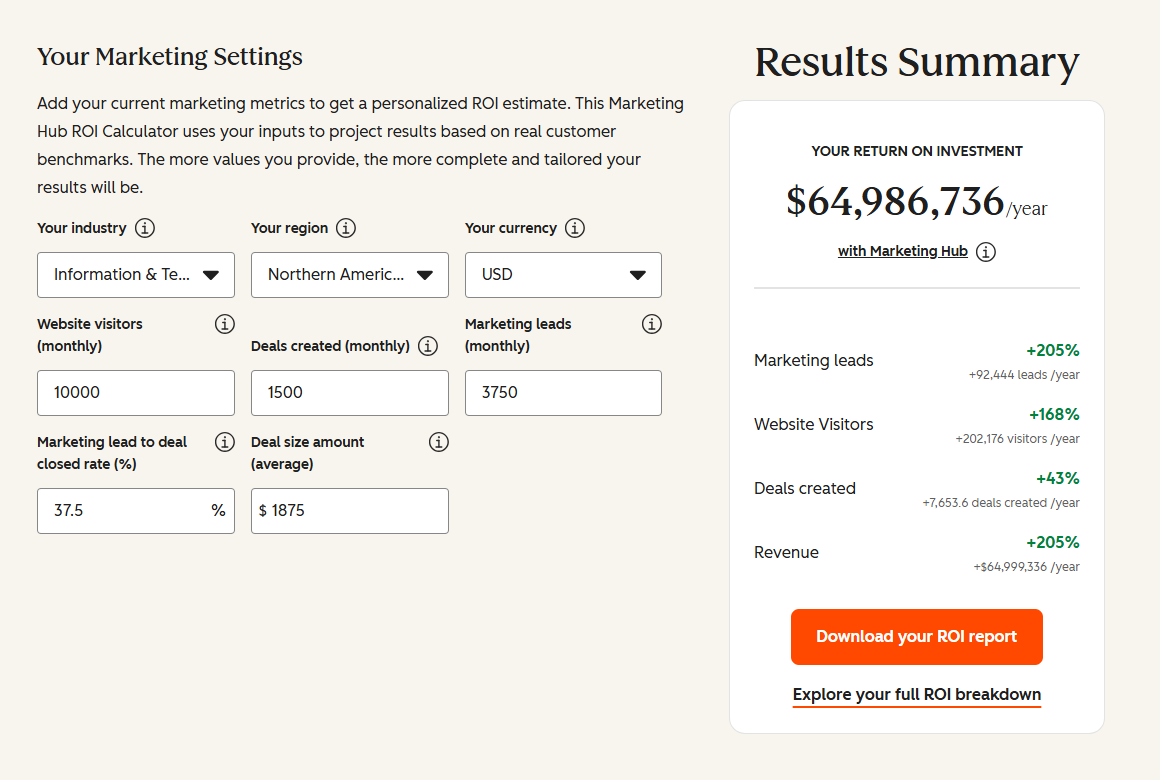
HubSpot vs ActiveCampaign: The Final Verdict
For most B2B teams with 10+ people, multiple sales reps, and an operating model that includes customer success, HubSpot is the right call. The unified architecture across marketing, sales, and service pays back the price difference within months, and the AI features get more useful as more data flows through one system.
For solo operators, small e-commerce stores, and email-first SMBs, ActiveCampaign genuinely wins. The automation depth at the Plus tier is hard to match anywhere else, and the contact-based pricing keeps costs predictable at small scale.
Three questions clarify which way to go:
- Do you have more than 5 sales reps or plan to within 12 months? If yes, HubSpot.
- Is your average deal size above $15,000? If yes, HubSpot. If no, ActiveCampaign is probably enough.
- Is email automation your primary marketing motion, or part of a broader funnel with sales and service touches? If email-only, ActiveCampaign. If broader funnel, HubSpot.

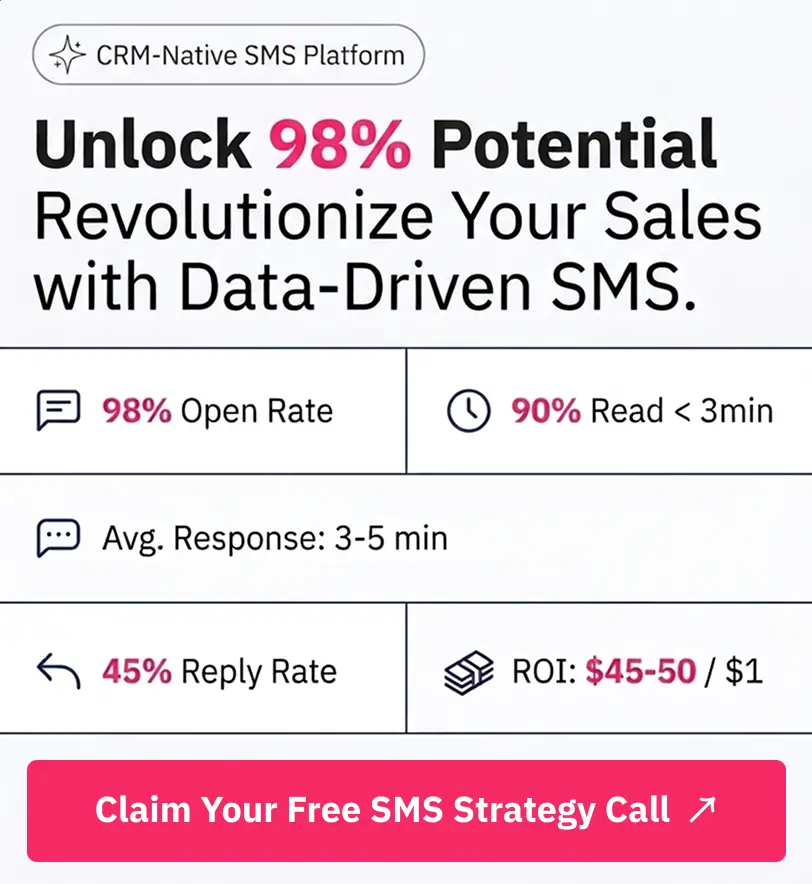
Table of Contents
- HubSpot vs ActiveCampaign at a Glance
- What HubSpot Is and Who It’s Built For
- What ActiveCampaign Is and Who It’s Built For
- Pricing: The Real Apples-to-Apples Comparison
- Marketing Automation and Workflow Builder
- Email Marketing Capabilities
- CRM and Sales Features
- Lead Scoring and Segmentation
- AI Features: Breeze vs Active Intelligence
- Integrations and Ecosystem
- Reporting and Attribution
- Ease of Use and Onboarding
- HubSpot vs ActiveCampaign: Side-by-Side Comparison
- When HubSpot Is the Better Choice
- When ActiveCampaign Is the Better Choice
- Signs You’ve Outgrown ActiveCampaign
- What Migrating from ActiveCampaign to HubSpot Looks Like
- HubSpot vs ActiveCampaign: The Final Verdict