












If you’re choosing between HubSpot and Monday CRM, the short answer is this: HubSpot wins for most B2B teams that need a real CRM as the foundation of their revenue motion. Monday CRM wins for project-led service businesses, agencies, and cross-functional teams where deals naturally flow into client project work and project management is the bigger function.
These two tools share the word “CRM” in their category, but they don’t share the same DNA. HubSpot is a customer platform built around the CRM, with native marketing, sales, service, and operations layers. Monday CRM is a Work OS that added a CRM module on top of its existing project management foundation. That difference shows up in every dimension we’ll cover below.
We’re Integrate IQ, a HubSpot Diamond Solutions Partner. We’ve helped clients evaluate both platforms, migrate between them, and integrate Monday with HubSpot for teams that decided to keep both. This comparison comes from real implementation work, not a feature list scrape.

Free estimator
Know what your HubSpot project costs before the first call.
Select your services and get a transparent price range in minutes. No sales call needed to get a number.
Firm quote after a free discovery call. Build estimate
HubSpot vs Monday CRM at a Glance
HubSpot is an AI-powered customer platform serving more than 278,000 companies. The Smart CRM sits at the foundation, with Sales, Marketing, Service, Content, and Operations Hubs sharing one database. Monday CRM is part of the broader monday.com Work OS ecosystem (245,000+ active users) and provides customizable boards for managing leads, deals, and customer projects.
Quick comparison
| Dimension | HubSpot | Monday CRM |
| Best for | B2B teams blending sales, marketing, and service on one platform | Agencies and project-led teams where deals flow into delivery boards |
| Starting price (annual) | Free; Starter $15/seat; Pro $100/seat | Basic $12/seat; Standard $17/seat; Pro $28/seat (3-seat min) |
| Free tier | Yes, full Smart CRM | Free plan exists for monday work management; CRM has 14-day trial only |
| Core strength | Native CRM with marketing, sales, and service in one database | Visual board flexibility for cross-functional workflows |
| Core limitation | Cost ramps at Pro tier | CRM depth is shallower than purpose-built CRMs; no native marketing or service |
What HubSpot Does Well (and Where It Doesn’t)
HubSpot started as inbound marketing software in 2006 and grew into a full customer platform over 18 years. The Smart CRM sits at the center, and every Hub builds on top of that shared database. That architecture is the difference.
The six Hubs:
- Sales Hub: pipelines, deals, sequences, calling, forecasting, AI prioritization via Breeze
- Marketing Hub: email campaigns, landing pages, forms, paid ads, automation
- Service Hub: tickets, knowledge base, customer portal, SLA management
- Content Hub: CMS, blog, landing pages, AI content generation
- Data Hub (formerly Operations Hub): data sync, programmable automation, data quality
- Commerce Hub: quotes, payments, subscriptions, invoicing
HubSpot’s strength is unification. A marketing-sourced lead, a sales-stage deal, a closed-won customer, and a support ticket all sit on the same contact and company records. That makes attribution, lifecycle reporting, and cross-team handoffs work without sync overhead.
The honest limitation: cost. Sales Hub Professional is $100 per seat per month plus a mandatory $1,500 onboarding fee. Marketing Hub Professional starts at $890 per month with $3,000 onboarding. Teams that need a full Pro tier across multiple Hubs can land at $2,500-$5,000+ per month base before adding seats. The platform’s depth justifies the cost when teams use it. When they don’t, it feels expensive.

Turn HubSpot Into A Real-Time SMS Engine with Message IQ
 Two-Way Conversations
 Shared Team Inbox
 Automation Triggers
 Advanced Reporting
 Compliance Tools
- 98% SMS read within 3 min
- 78% Buy from first responder
- 21× More likely to qualify

*MessageIQ is an IntegrateIQ product – built natively for HubSpot by the same team.
What Monday CRM Does Well (and Where It Doesn’t)
monday.com launched in 2014 as a Work OS, designed to manage projects, processes, and team collaboration through customizable boards. Monday CRM is one of four products in the suite (alongside Work Management, Dev, and Service), and it applies that board-based flexibility to leads, deals, and customer relationships.
The strength shows up in flexibility. Every CRM board is fully customizable. Columns can be statuses, dates, formulas, files, dropdowns, or 30+ other types. You can build a deal pipeline, then build an onboarding board next to it that pulls from the same contact records, then build a project delivery board that flows from there. For agencies, consultancies, and service businesses where the deal closing is just the start of customer work, that fluidity is genuinely useful.
Monday CRM’s 2026 pricing runs across four tiers:
- Basic: $12 per seat per month (annual)
- Standard: $17 per seat per month (annual), the real entry point for most teams
- Pro: $28 per seat per month (annual), which added email sequences in March 2026
- Ultimate (formerly Enterprise): custom pricing
- Three-seat minimum on all paid tiers; bucket pricing in multiples of 5 above 5 seats
Monday CRM added email sequences to the Pro tier in March 2026, closing one of its bigger gaps for sales teams. AI Sidekick (lite on Standard/Pro, plus on Ultimate) handles task summaries, automation suggestions, and basic AI assistance.
The honest limitation: Monday CRM’s depth lags behind purpose-built CRMs. There’s no native marketing automation. There’s no native helpdesk (Monday Service is a separate product, starting around €31 per seat per month). Reporting is flexible but board-based, which means cross-functional revenue attribution requires manual setup that HubSpot delivers natively. The bucket pricing also catches teams off guard. A 7-person team must purchase 10 seats. That inflates real per-user cost by 40%.

The Fundamental Difference: CRM vs Work OS
Most HubSpot vs Monday comparisons gloss over this distinction, but it shapes every other answer in the comparison.
HubSpot is a CRM platform. The data model centers on contacts, companies, deals, and tickets as first-class objects. Every workflow, automation, report, and integration assumes that data structure. The platform optimizes for the customer record being the center of gravity.
Monday CRM is a CRM layer on top of a Work OS. The data model centers on items inside boards. Contacts, deals, and customers are board items, structurally similar to tasks, projects, or any other item type. The platform optimizes for cross-functional workflow flexibility.
Why this matters in practice: if you ask both platforms “show me total revenue from inbound-sourced leads who converted in Q3, segmented by industry,” HubSpot answers it natively because the data model treats marketing source, deal value, lifecycle stage, and industry as standard properties. Monday CRM can answer it, but you’re building it from board columns and formulas, and the answer changes if someone restructures the underlying boards.
Monday CRM’s flexibility becomes a strength when the workflow doesn’t fit a standard CRM mold. Agencies running deals into project boards. Service businesses tracking client onboarding through delivery. Teams where ops and sales overlap deeply. In those cases, Monday CRM lets the structure follow the work.
Pricing Comparison: HubSpot Wins on Free Tier, Monday on Per-Seat at Scale
The headline price comparison favors Monday CRM. A 10-person sales team on Monday CRM Standard ($17/seat) pays $204 per month. The same team on HubSpot Sales Hub Pro ($100/seat) pays $1,000 per month plus a $1,500 onboarding fee. That’s a real gap.
The complete picture is more nuanced. A few factors flip the math:
Hidden costs to know
- Monday CRM’s three-seat minimum and bucket pricing. A 7-person team pays for 10 Standard seats ($170/month minimum), not 7. A 12-person team pays for 15.
- Monday CRM lacks native marketing and service. Teams that need email marketing, landing pages, or helpdesk pay for separate tools (Mailchimp, Webflow, Zendesk) on top. Total stack cost often catches up to HubSpot Pro at 10+ seats.
- HubSpot’s free tier is genuinely useful. Teams of 1-3 people running early-stage operations can run real workflows on the free CRM. Monday CRM’s free tier is limited to a 14-day trial.
- HubSpot Pro and Enterprise carry mandatory onboarding ($1,500 and $3,500). Monday CRM has no equivalent fee, though Enterprise/Ultimate negotiations often include implementation support.
- Monday CRM Pro added email sequences in 2026, but high-volume sales engagement still benefits from purpose-built tools layered on top.
Verdict on pricing: Monday CRM wins on raw seat cost. HubSpot wins on free tier value and on total cost when you account for tools that come bundled inside Marketing Hub, Service Hub, and Operations Hub.
Sales Features: HubSpot Wins on Depth, Monday on Visual Flexibility
HubSpot’s sales features are CRM-native and built specifically for sales motions. Pipelines with stage automation, deal forecasting, sequences with task creation and call reminders, sales playbooks, conversation intelligence, and AI prioritization through Breeze. Sales reps work inside a workspace designed for their job.
Monday CRM’s sales features are board-native. The pipeline is a board with deal stages as columns. Custom fields drop into board columns. Sequences (added at Pro in 2026) automate multi-step email outreach. AI Sidekick surfaces deal insights. The visual flexibility is unmatched. Reps can build dashboards, kanban views, calendar views, and timeline views from the same data without touching admin settings.
Where HubSpot pulls ahead: depth of automation, sequence sophistication (HubSpot has had sequences since 2017), forecasting accuracy, and AI prioritization. Where Monday pulls ahead: visual customization, ease of cross-functional layout, and the natural tie-in to project delivery boards.
Verdict: HubSpot wins for pure sales depth. Monday wins for teams whose sales work is structurally tied to project delivery.
Marketing Features: HubSpot Decisively Wins
Monday CRM has no native marketing automation product. There’s no native email marketing, no landing pages, no forms layer beyond basic data capture, no ad management, and no marketing attribution layer. Teams that need real marketing operations either run a separate platform (Mailchimp, ActiveCampaign, ConvertKit) or use monday work management to coordinate marketing tasks while the actual sending happens elsewhere.
HubSpot Marketing Hub provides native email campaigns, landing pages, forms, lead scoring, paid ad management, and full attribution. Marketing-sourced contacts flow directly into the same database as deals and tickets, which makes campaign-to-revenue reporting work without integration overhead.
Verdict: HubSpot wins decisively. If marketing automation is a real requirement, Monday CRM doesn’t compete in this dimension.
Service Features: HubSpot Wins, but Monday Has a Different Angle
HubSpot Service Hub provides native ticketing, knowledge base, customer portal, SLA management, and customer feedback tools. All of it lives on the same contact and company records as Sales Hub and Marketing Hub. A support agent picking up a ticket sees deal history, marketing engagement, and full customer context.
Monday CRM has no native helpdesk. Teams that need ticketing buy monday Service as a separate product (Standard from around €31/seat/month) or use a third-party helpdesk like Zendesk or Freshdesk.
Where Monday’s Work OS philosophy shows a real strength: post-sale customer work. When a deal closes in HubSpot Sales Hub, the natural next step is a service ticket, an onboarding sequence, or a renewal task. When a deal closes in Monday CRM, the natural next step is a delivery board, an onboarding workflow, or a client project. For agencies and service businesses where the post-sale work is project-shaped rather than ticket-shaped, Monday’s architecture is genuinely better.
Verdict: HubSpot wins for traditional customer service workflows. Monday wins for project-shaped post-sale work, especially in agencies and consultancies.
Reporting and Analytics: HubSpot for Cross-Functional Revenue, Monday for Workflow Visibility
HubSpot’s reporting is purpose-built for revenue analysis. Multi-touch attribution connects marketing campaigns to closed deals. Lifecycle reports track contacts from first touch to retention. Cross-Hub reports compare marketing-sourced vs sales-sourced pipeline. Forecast reports predict revenue based on deal stage probability. Custom reports at Professional and above let RevOps build whatever the team needs without exporting to a BI tool.
Monday CRM’s reporting is dashboard-based and highly flexible. Charts pull from any board column. Formula columns calculate budgets, weighted forecasts, or custom metrics. Cross-board dashboards combine sales, project, and ops data into one view. The visual customization is excellent.
The trade-off: Monday’s reports are flexible but require manual setup. HubSpot’s reports are CRM-native and ship pre-built. For teams that want to see weighted pipeline, conversion rates by source, and rep performance without configuration work, HubSpot delivers it natively.
Verdict: HubSpot wins for revenue and lifecycle reporting. Monday wins for cross-functional operational dashboards.
Ease of Use and Customization: Monday Wins on Setup, HubSpot Wins on Data Model Depth
Monday CRM is genuinely easy to set up. Teams typically get to a functional pipeline within a day. The drag-and-drop board builder, the column-level customization, and the visual UX all reduce the learning curve. Reps adopt it without training.
HubSpot Sales Hub takes longer to configure properly. Setting up lifecycle stages, deal pipelines, custom properties, automation, and reports takes 2-4 weeks for a team without prior HubSpot experience. We deliver full HubSpot setups in eight weeks from kickoff to launch using a defined process. Without that process, the platform can feel overwhelming.
Where HubSpot pulls back ahead: depth of customization. Monday’s flexibility is surface-level (boards, columns, views). HubSpot’s customization is data-model level (custom objects in Enterprise, custom workflow logic, HubL templating, programmable automation in Operations Hub Pro+). For teams that need to model complex relationships or extend automation beyond standard triggers, HubSpot delivers more.
Verdict: Monday wins for setup speed and visual flexibility. HubSpot wins for data-model depth and enterprise-grade customization.
Integrations and Ecosystem
HubSpot’s App Marketplace lists more than 1,500 native integrations. Monday’s marketplace lists around 200, with broader Zapier coverage to fill gaps.
Both platforms cover the major productivity tools (Slack, Google Workspace, Zoom, Microsoft 365), the major email platforms, and the major data sources. The depth difference shows up at the edges. HubSpot’s marketing-adjacent integrations (LinkedIn Ads, Facebook Ads, Eventbrite, webinar platforms) are deeper because those use cases live inside Marketing Hub natively. HubSpot’s enterprise integrations (Salesforce, NetSuite, Dynamics 365, SAP) are more mature because the ecosystem partners building them are larger.
Monday’s integrations skew toward project management and collaboration tools. Tight Slack, Microsoft Teams, and Google Workspace integration. Native Zoom integration for meeting management. Strong file storage integrations (Dropbox, Box, Google Drive).
As a HubSpot Diamond Solutions Partner with custom integration accreditation, we’ve connected HubSpot to more than 300 platforms across our client base. Some use native marketplace apps. Many are custom builds for systems without native connectors. The infrastructure to support that depth is more developed in the HubSpot ecosystem.
Verdict: HubSpot wins on breadth and native depth. Monday’s ecosystem is sufficient for cross-functional team workflows.
HubSpot vs Monday CRM: Side-by-Side Comparison
| Dimension | HubSpot | Monday CRM | Winner |
| Pricing (per seat/mo) | Free, $15, $100, $150 | $12, $17, $28, custom (3-seat min) | Monday (per seat); HubSpot (free) |
| Sales features | Sequences, AI, custom objects, forecasting | Board pipelines, sequences (Pro), AI Sidekick | HubSpot |
| Marketing | Native Marketing Hub | None native | HubSpot |
| Service | Native Service Hub | None native (separate Monday Service product) | HubSpot |
| Reporting | Cross-Hub revenue attribution | Flexible board-based dashboards | HubSpot (revenue); Monday (ops) |
| Ease of use | Learning curve at full scope | Productive in a day | Monday |
| Customization | Custom objects, HubL, workflows | Boards, columns, formulas | HubSpot (data model); Monday (UI) |
| Integrations | 1,500+ native | 200+ native, Zapier-heavy | HubSpot |
| Project management | Limited (Service Hub projects) | Native, deeply customizable | Monday |
When HubSpot Is the Better Choice
1. Sales, marketing, and service share customer data
If you need attribution from marketing campaign to closed deal, lifecycle reporting from first touch to retention, or a unified customer record across functions, HubSpot is the only platform of these two that delivers it natively. Monday CRM can’t replicate that without bolting on multiple separate tools.
2. You’re a B2B sales team with marketing operations
Inbound-led companies, content-driven teams, and paid acquisition operations need marketing automation tied to the CRM. HubSpot Marketing Hub delivers that natively. Monday CRM teams running real marketing pay for a second platform.
3. You’re scaling past 25 sales seats with a RevOps function
Once a team has dedicated RevOps or a CRM admin, HubSpot’s deeper data model, custom objects, and workflow capabilities pay back. The platform supports complex pipeline structures, multi-product orgs, and enterprise-grade governance that Monday CRM doesn’t reach.
4. You need enterprise-grade reporting
If your reporting requirements include multi-touch attribution, weighted forecast accuracy, source-of-pipeline analysis, or sales rep performance dashboards delivered without configuration, HubSpot ships them pre-built. Monday CRM can build those reports, but the construction is manual and the maintenance overhead is real.
5. Your tech stack will consolidate over the next 18 months
Teams that currently run separate tools for CRM, email marketing, helpdesk, and analytics often find HubSpot’s all-in-one model lowers total cost when you account for the four or five tools it replaces. Monday CRM doesn’t replace marketing or service tools.
When Monday CRM Is the Better Choice
Monday CRM is genuinely the better pick in these scenarios. We say this as a HubSpot partner. A vendor comparison page that pretends the competitor never wins isn’t credible.
1. You’re an agency or consultancy where deals flow into project work
This is Monday CRM’s strongest scenario. When a deal closes, the natural next step is a project board, a client onboarding flow, or a delivery timeline. Monday lets the same data structure carry the work from prospect to delivery without forcing a handoff between tools. We’ve seen agencies of 8-30 people run their entire revenue + delivery motion on Monday CRM + Monday Work Management without ever needing a CRM-first system.
2. You’re already running monday Work Management and want CRM consistency
If your operations, marketing, or product teams already live in monday Work Management, adding Monday CRM gives sales the same UX and the same data structure. Cross-functional reporting becomes natural. The alternative (HubSpot for sales + Monday for ops) means two platforms with sync overhead.
3. Project management is the bigger function than sales
For service businesses, internal ops teams, or PMO-led organizations where sales is downstream of operational work, Monday’s Work OS model fits the actual work better than a CRM-first platform. A purpose-built CRM is overkill for a team where the deal pipeline is one board out of fifty.
What Migrating from Monday CRM to HubSpot Looks Like
Most of the migrations we run from Monday CRM to HubSpot happen when a team outgrows the Work OS model. Sales pipelines complexity grows, marketing operations expand, and the reporting requirements outpace what board-based dashboards can deliver.
Data objects that move
- Contact and company records map cleanly. Monday CRM’s contact boards translate to HubSpot Contacts and Companies.
- Deal records and pipeline stages map to HubSpot Deals. Stage-by-stage history requires careful field mapping but transfers.
- Custom column data converts to HubSpot custom properties. Most column types have direct equivalents (text, dropdown, date, formula).
- Activities and notes transfer with their parent records.
What typically requires rebuilding
- Board structures don’t translate. Monday’s flexible board model has no direct HubSpot equivalent. We map the underlying data and rebuild the views inside HubSpot’s standard objects.
- Automations rebuild from scratch. Monday automations are board-bound; HubSpot workflows operate at the object level.
- Dashboards rebuild inside HubSpot’s reporting tool. Monday’s chart widgets don’t have direct HubSpot equivalents.
- Cross-board relationships become custom objects or association mappings inside HubSpot Enterprise.
Monday-specific gotchas we’ve seen
- Monday’s flexible item types create messy data when migrated. We deduplicate and consolidate at the audit stage.
- Items that live on multiple boards (a deal that’s also on a delivery board) need to be modeled as HubSpot Deals + custom objects or association labels.
- Subitem hierarchies don’t map directly. We rebuild as line items, custom objects, or activity records depending on the use case.
Our typical Monday-to-HubSpot migration runs eight weeks from kickoff to go-live. That includes data audit, field mapping, automation rebuild, integration setup, and team training. Our 98.5% client retention rate reflects how those migrations hold up post-launch.
See your 12-month revenue impact with HubSpot CRM
Enter your current numbers — visitors, leads, deal size — and get a personalized projection based on real HubSpot customer benchmarks.
Calculate My ROI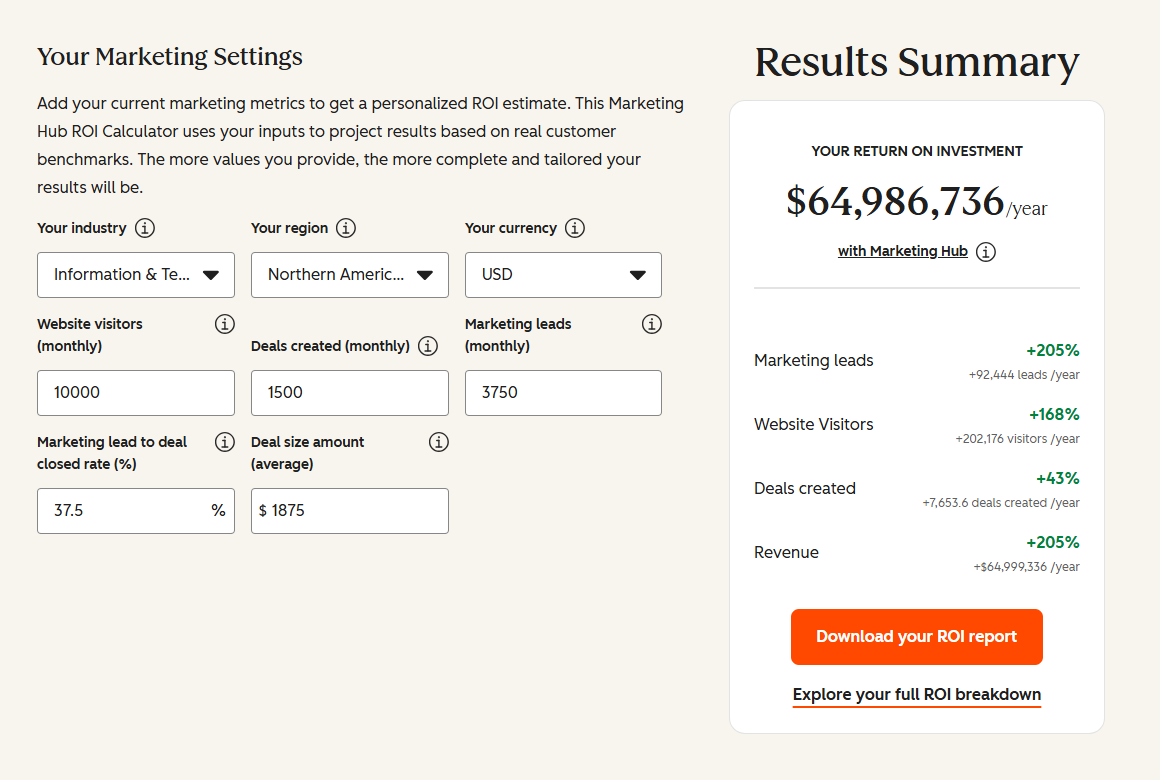
HubSpot vs Monday CRM: The Final Verdict
HubSpot is the better pick for B2B teams where the CRM is the system of record and the revenue motion involves marketing, sales, and service together. The free tier is the most generous in the category. The native depth across Hubs lowers total cost of ownership for teams running a real GTM stack.
Monday CRM is the better pick for agencies, consultancies, and project-led teams where deals flow into delivery work and operational flexibility matters more than CRM-native depth. The board-based UX, the cross-functional flexibility, and the tie-in to monday Work Management all serve those teams genuinely well.
If you’re still on the fence, ask yourself three questions:
- Does post-sale work look like project delivery (boards, milestones, deliverables) or like customer service (tickets, knowledge base, support)? If project delivery, lean Monday. If customer service, lean HubSpot.
- Do you need marketing automation tied to the CRM? If yes, HubSpot. Monday CRM doesn’t compete in this dimension.
- Is your team already living in monday Work Management, or already running marketing tools you’d want consolidated? The existing stack tells you a lot.

Table of Contents
- HubSpot vs Monday CRM at a Glance
- What HubSpot Does Well (and Where It Doesn’t)
- What Monday CRM Does Well (and Where It Doesn’t)
- The Fundamental Difference: CRM vs Work OS
- Pricing Comparison: HubSpot Wins on Free Tier, Monday on Per-Seat at Scale
- Sales Features: HubSpot Wins on Depth, Monday on Visual Flexibility
- Marketing Features: HubSpot Decisively Wins
- Service Features: HubSpot Wins, but Monday Has a Different Angle
- Reporting and Analytics: HubSpot for Cross-Functional Revenue, Monday for Workflow Visibility
- Ease of Use and Customization: Monday Wins on Setup, HubSpot Wins on Data Model Depth
- Integrations and Ecosystem
- HubSpot vs Monday CRM: Side-by-Side Comparison
- When HubSpot Is the Better Choice
- When Monday CRM Is the Better Choice
- What Migrating from Monday CRM to HubSpot Looks Like
- HubSpot vs Monday CRM: The Final Verdict