

HubSpot vs Klaviyo is one of the more confusing comparisons in marketing software because the two platforms aren’t really direct competitors. HubSpot is a customer platform built around CRM, with marketing, sales, and service running on shared data. Klaviyo is an e-commerce customer data platform built around purchase behavior, with email and SMS as the activation layer. They overlap on email marketing and stop overlapping fast after that.
Quick verdict, split by business model. If you’re a pure DTC e-commerce brand on Shopify or WooCommerce, Klaviyo wins. Its Shopify integration, predictive customer lifetime value, browse abandonment triggers, and 80+ pre-built e-commerce flows are deeper than anything HubSpot offers. If you’re a B2B company, SaaS, service business, or agency with a sales team, HubSpot wins. The CRM, deal pipeline, sales automation, and full-funnel attribution cover ground Klaviyo doesn’t try to cover. If you’re a hybrid brand running DTC plus wholesale, B2B accounts, or a sales team, you’ll probably end up running both, and that’s a legitimate answer.
We’re Integrate IQ, a HubSpot Diamond Solutions Partner with custom integration accreditation. We’ve migrated teams between HubSpot, Klaviyo, and combined stacks. We’ve integrated HubSpot into 300+ tools including Shopify and WooCommerce, and we’ve helped hybrid brands run Klaviyo + HubSpot as a unified stack where each platform handles what it’s best at. This comparison covers what each platform actually does, where each one wins honestly, and how to think about the “use both” scenario that most comparison pages skip.
Free estimator
Know what your HubSpot project costs before the first call.
Select your services and get a transparent price range in minutes. No sales call needed to get a number.
Firm quote after a free discovery call. Build estimate
HubSpot vs Klaviyo at a Glance
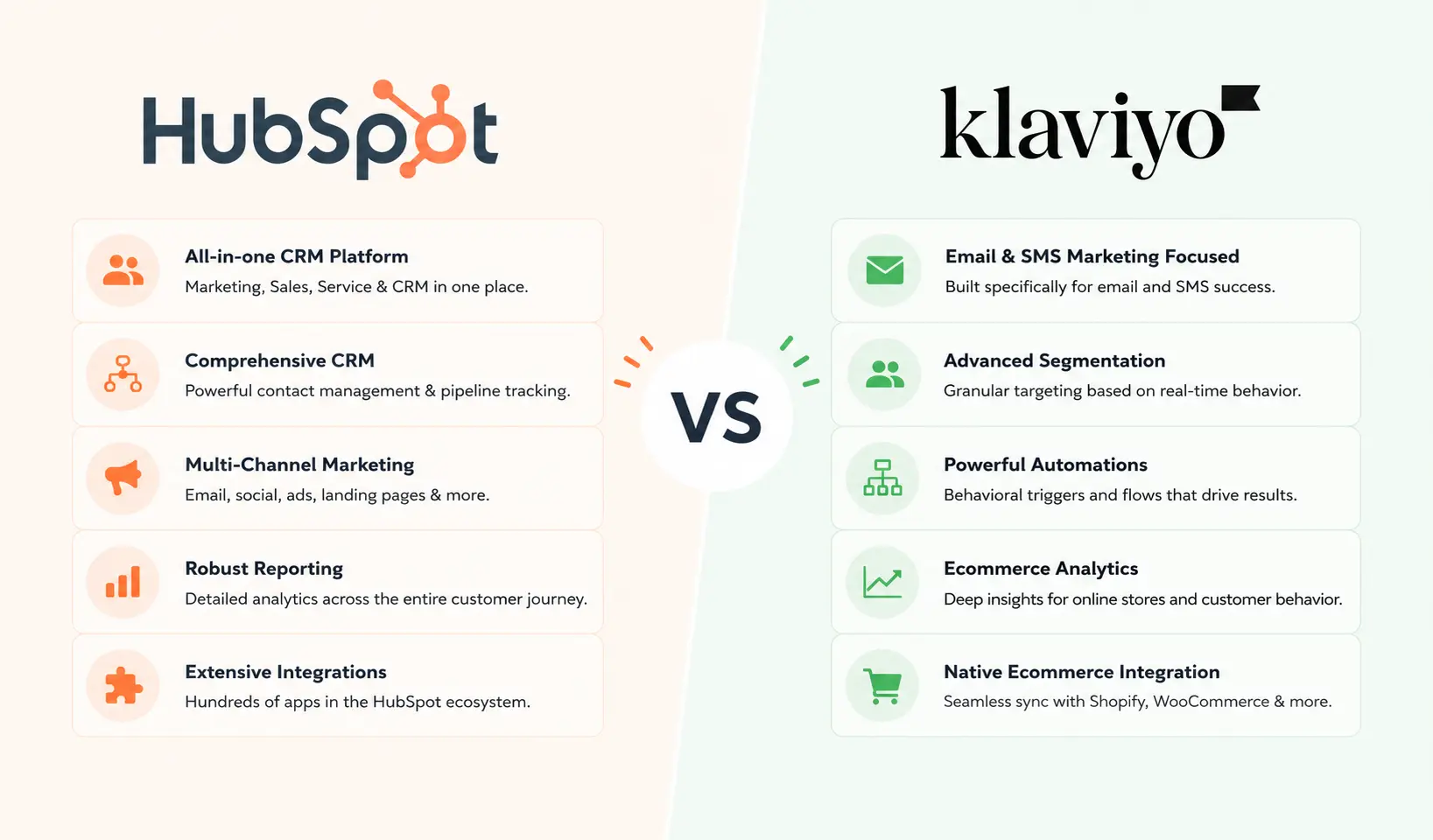
HubSpot is a customer platform organized around Smart CRM, with Marketing, Sales, Service, Content, Operations and Commerce Hubs sharing one data layer. It targets B2B teams, service businesses, and hybrid brands that need marketing, sales, and service running on one set of records.
Klaviyo is an e-commerce customer data platform with email, SMS, mobile push, and reviews built on top. It targets DTC e-commerce brands on Shopify, WooCommerce, BigCommerce, and other major commerce platforms. The platform reads real-time product, order, and behavior data from your store and activates it through marketing channels.
The core difference: HubSpot is a CRM that runs marketing. Klaviyo is an e-commerce data platform that runs email and SMS.
| Factor | HubSpot | Klaviyo |
| Best for | B2B, SaaS, hybrid brands | Pure DTC e-commerce |
| Free tier | Free CRM (1M contacts) | Free up to 250 profiles, 500 emails/mo |
| Real automation entry | Marketing Hub Pro $890/mo | Email plan $20/mo at 251-500 profiles |
| CRM included | Yes, native Smart CRM | No, customer profiles only |
| Core strength | Unified CRM + marketing + sales + service | Deepest Shopify integration, predictive CLV |
| Core limitation | Surface-level e-commerce integration | Not a CRM, no sales pipeline |
What HubSpot Is and Who It’s Built For
HubSpot launched in 2006 as an inbound marketing platform and grew into a customer platform organized around six Hubs: Marketing, Sales, Service, Content, Operations, and Commerce. All of them sit on top of HubSpot Smart CRM, which is included free.
HubSpot’s strength is unified data across the full revenue motion. Marketing campaigns can trigger sales workflows. Service tickets can trigger marketing follow-ups. Reporting pulls from one timeline that covers every contact touch from first website visit through renewal. AI features (Breeze Copilot, Breeze Agents, predictive lead scoring) have full context because they read the same data the rest of the platform sees.
HubSpot is the right call for B2B companies, SaaS, service businesses, agencies, and any organization where sales pipeline management, customer success, and content marketing are core to the operating model. The platform isn’t built for e-commerce as its primary use case, and that shows in the Shopify integration depth.
The honest limitation for this comparison: HubSpot’s Shopify and WooCommerce integrations are functional, but they’re surface-level compared to Klaviyo. You can sync contacts and basic order data. You don’t get real-time product catalog sync, native browse abandonment tracking, or predictive customer lifetime value natively. For pure DTC brands, that gap matters.

Turn HubSpot Into A Real-Time SMS Engine with Message IQ
 Two-Way Conversations
 Shared Team Inbox
 Automation Triggers
 Advanced Reporting
 Compliance Tools
- 98% SMS read within 3 min
- 78% Buy from first responder
- 21× More likely to qualify

*MessageIQ is an IntegrateIQ product – built natively for HubSpot by the same team.
What Klaviyo Is and Who It’s Built For
Klaviyo started as an e-commerce email tool and rebuilt itself into a full customer data platform for online stores. The platform IPO’d in September 2023 (NYSE: KVYO) and has continued to expand into SMS, mobile push, reviews, customer self-service (Customer Hub), and AI-driven helpdesk.
The core product is the customer profile: a real-time record of every interaction a shopper has with your store, including purchases, browsing behavior, email engagement, SMS responses, and review history. Klaviyo ingests high-volume event data from Shopify, WooCommerce, BigCommerce, and other commerce platforms, then activates it instantly through email and SMS flows.
Klaviyo is the right call for DTC e-commerce brands where shopping behavior drives the marketing motion. The pre-built flows (abandoned cart, browse abandonment, post-purchase, win-back, replenishment) are tuned for store use cases and save hours of setup. Predictive analytics (expected next order date, customer lifetime value, churn risk) come standard on the Email plan.
The honest limitation: Klaviyo isn’t a CRM. There’s no deal pipeline, no sales forecasting, no task management, no B2B sales process tracking. Customer profiles are rich with marketing data but light on sales context. For B2B companies, agencies, or any business with a sales team running deals through stages, Klaviyo doesn’t cover the operational ground a CRM does.
The Fundamental Difference: B2B Platform vs E-Commerce CDP
Most comparison articles miss the architectural difference. Here’s the practical version.
HubSpot organizes around contacts, companies, and deals. The data model is built for businesses that sell to other businesses (or to consumers via considered purchases with sales involvement). Workflows trigger off deal stage changes, lifecycle stage progression, and form submissions. The platform assumes a relationship-driven sales motion.
Klaviyo organizes around customer profiles and events. The data model is built for businesses where shoppers make repeat purchase decisions based on product fit, price, and timing. Flows trigger off events: viewed product, added to cart, placed order, time since last purchase. The platform assumes a transaction-driven repeat-purchase motion.
This architectural difference shows up in every dimension that follows. The right platform depends almost entirely on which model fits your business.
E-Commerce Integration Depth: Shopify, WooCommerce, BigCommerce
This is where Klaviyo wins decisively, and it’s not close.
Klaviyo’s Shopify integration syncs in real time. Product catalog data flows continuously, so abandoned cart emails reference the actual item the shopper viewed. Browse abandonment triggers fire when someone views a product without adding to cart. Order data updates customer profiles instantly, which means post-purchase flows reference the exact product purchased, suggest related items, and time win-back campaigns based on predicted next purchase. The same depth applies to WooCommerce, BigCommerce, and other supported platforms.
HubSpot’s Shopify integration is functional but surface-level. You can sync contacts and basic order data. You can build workflows that trigger off Shopify events like order placed or customer created. What you don’t get natively: real-time product catalog sync, native browse abandonment trigger, predictive CLV based on purchase history, or 80+ pre-built e-commerce flows ready to go. For brands where store revenue depends on these mechanics, the gap is real.
Verdict: Klaviyo wins. If e-commerce email and SMS are central to how your business generates revenue, Klaviyo’s integration depth justifies the platform on its own.
CRM and Sales Features
This is where HubSpot wins decisively, and it’s also not close.
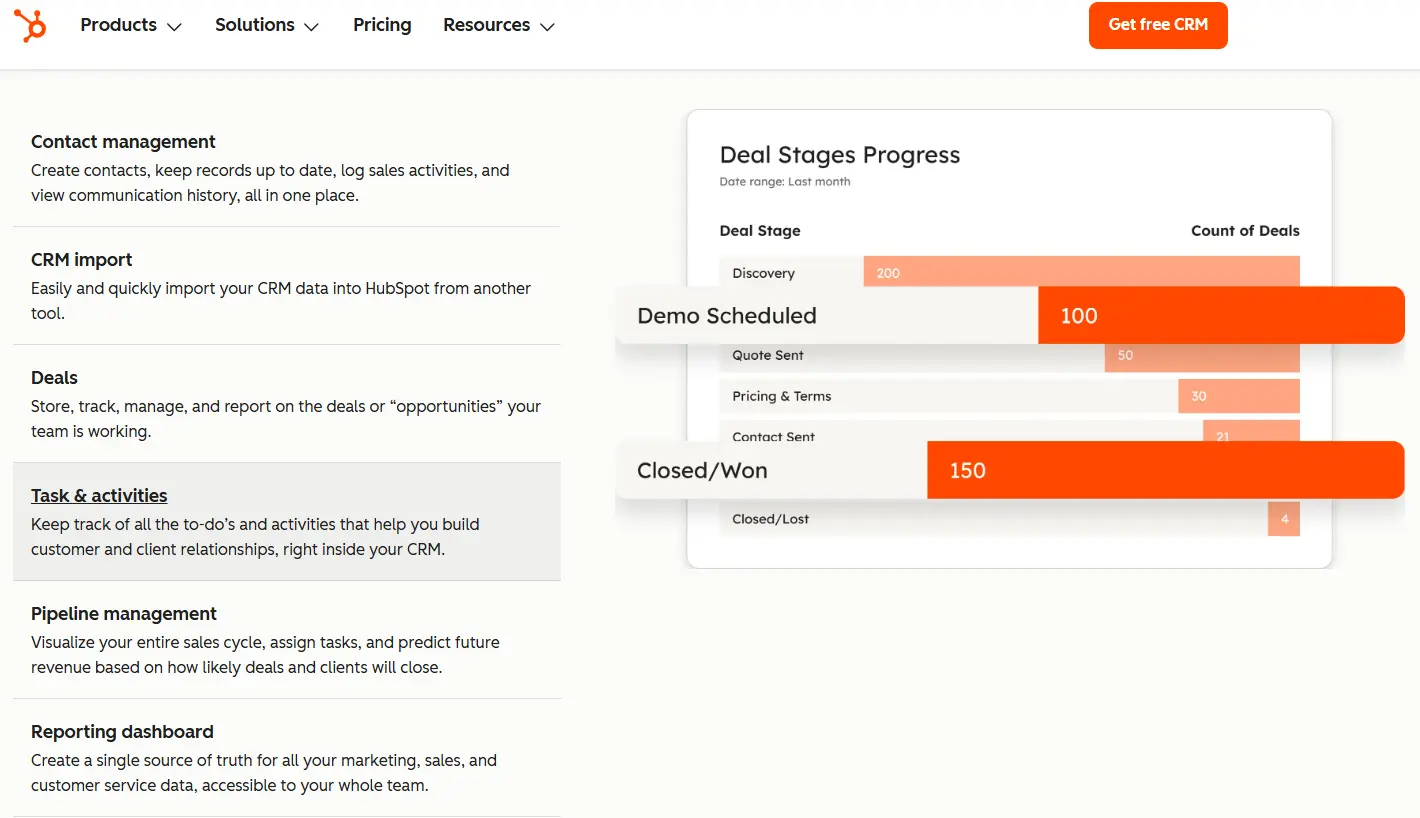
HubSpot Smart CRM is included free with every plan. Contacts, companies, deals, custom objects, line items, products, and tickets all live in one place. Sales Hub adds pipeline management, deal stages with automation, sequences, quotes, forecasting, playbooks, call recording, and meeting scheduling. Service Hub layers tickets, customer portals, SLAs, and knowledge base on the same records. For any team running a real sales motion, this is core infrastructure.
Klaviyo doesn’t have a CRM. The customer profiles store rich marketing data: purchase history, browsing behavior, email and SMS engagement, predictive analytics. They don’t store deal pipelines, sales stages, rep activity, forecasting data, or task management. For a B2B company tracking a sales process with multiple reps and considered purchases, Klaviyo doesn’t cover the operational surface area.
Verdict: HubSpot wins. If you have a sales team, wholesale accounts, B2B deal tracking, or customer success management, you need a CRM. Klaviyo isn’t one, and the platform doesn’t pretend to be.
Email Marketing and Automation
Both platforms send email well. The depth and orientation differ.
Klaviyo’s email is built for e-commerce volume and behavior. The flow builder supports conditional branching, time delays, A/B splits, and 45+ trigger types tied to product, order, and behavior events. The 80+ pre-built flows give DTC brands a working library on day one. Predictive sending optimizes delivery time per recipient. Dynamic product blocks pull real-time product data into emails. Personalization runs on the full profile including purchase history and predicted metrics.
HubSpot’s email lives inside Marketing Hub and integrates natively with CRM data. The drag-and-drop builder is intuitive. Personalization tokens draw from any contact, company, or deal property. Workflows span the full revenue motion: marketing emails can trigger off deal stage changes, service tickets, lifecycle stage updates. AI tools through Breeze help draft email copy and build automation logic. Real automation requires Professional at $890/month.
Verdict: Klaviyo wins for e-commerce email depth at the price point. HubSpot wins for email that’s part of a broader marketing motion connected to sales and service. The right tool depends on whether email is your primary revenue channel or one channel among several.
SMS and Omnichannel Messaging
Klaviyo’s SMS is native and tightly integrated with email. The Email + SMS plan starts at $35/month for 251-500 profiles and 1,250 SMS credits. SMS uses a credit-based system, with rates that vary by country and message type. Smart sending prevents over-messaging across channels. Mobile push notifications are included on Email + SMS. For DTC brands running cart abandonment SMS, shipping notifications, or back-in-stock alerts, the omnichannel orchestration works natively.
HubSpot supports SMS through native integrations and third-party tools, but it’s not a core channel built into Marketing Hub the way email is. For B2B teams where SMS is a sales-rep tool (texting prospects, scheduling demos), this works fine through Sales Hub or partner integrations. For e-commerce SMS marketing at volume, it’s a meaningful gap.
Verdict: Klaviyo wins for marketing SMS, especially e-commerce. HubSpot covers sales SMS adequately but isn’t designed for high-volume marketing texts.
Predictive Analytics and Segmentation
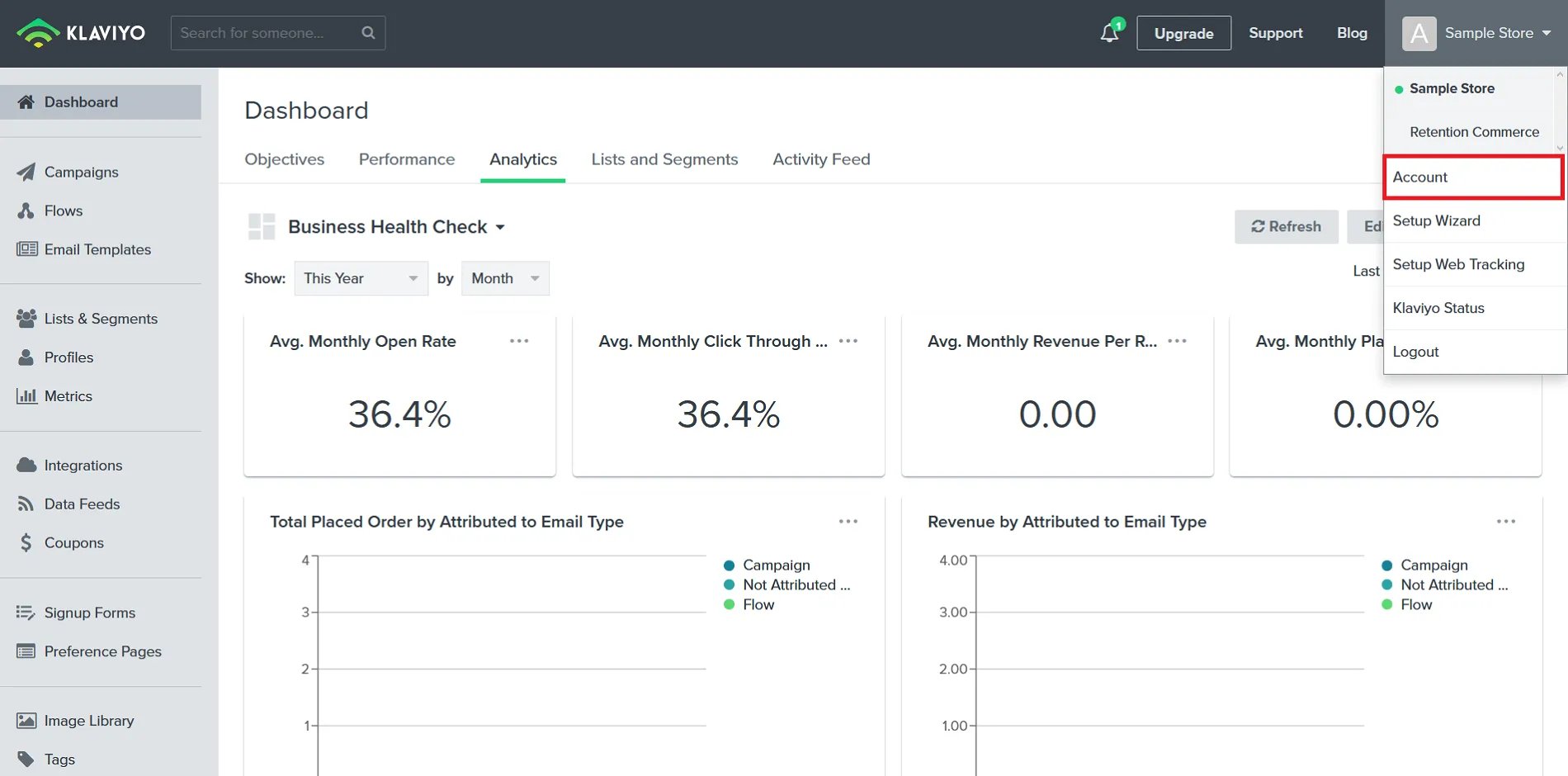
Klaviyo’s predictive analytics are built into customer profiles on the Email plan and above. Expected date of next order, predicted customer lifetime value, churn risk, and average order value all calculate automatically from store data. Segments built on these metrics update in real time. AI-suggested segments surface high-value audiences. For e-commerce, the depth at the price is hard to match.
HubSpot offers predictive lead scoring at the Enterprise tier and AI-driven segmentation through Breeze across the platform. The predictive features are tuned for B2B lead qualification (who’s most likely to convert) rather than DTC purchase prediction (when will this customer buy again). Manual segmentation on contact properties, deal data, and behavior is deep, and the cross-Hub data access is wider than Klaviyo’s.
Verdict: Klaviyo wins for e-commerce predictive analytics (CLV, next order, churn). HubSpot wins for B2B-style predictive scoring and broader segmentation surface. Each platform’s predictions are tuned to the business model it’s built for.
Pricing: Two Different Models
The pricing models work differently enough that you can’t run a single apples-to-apples comparison. Here’s how they actually map.
Free tiers
HubSpot’s free CRM is generous (up to 1 million contacts) but limited on the marketing side. You get basic email, forms, and contact management. Real automation isn’t there.
Klaviyo’s free plan covers 250 active profiles and 500 monthly email sends, plus 150 SMS credits. You get the full feature set at low volume, including flows, segmentation, and predictive analytics. Small Shopify stores can run real campaigns on the free tier indefinitely.
Mid-tier real automation
HubSpot Marketing Hub Professional at $890/month (3 seats included) is where serious automation lives. There’s a $1,500 to $3,000 onboarding fee at Pro tier. Year-one cost for a 5-person team lands around $13,000 before contact overages.
Klaviyo Email at 5,000 contacts costs roughly $100/month. At 10,000 contacts, $130 to $150/month. At 50,000 contacts, $720/month. Email + SMS adds roughly $15 to $35/month for the SMS layer plus credit usage. No mandatory onboarding fee. Year-one cost for a 10,000-contact DTC brand on Email + SMS lands around $2,000.
Enterprise scale
HubSpot Marketing Hub Enterprise starts at $3,600/month with custom contact tier pricing. Klaviyo’s enterprise tier (Klaviyo One) becomes mandatory once monthly spend exceeds $10,000 and adds a 20% premium on top of standard usage. Below that, enterprise customers negotiate custom contracts.
Note on Klaviyo billing changes: in February 2025, Klaviyo shifted to active profile billing instead of email-volume billing. You now pay based on all subscribed profiles, not just contacts you actively message. Many stores saw bills climb after the change. List hygiene matters more under the new model.
Verdict: Klaviyo wins on cost for DTC e-commerce at most contact volumes. HubSpot’s pricing pays off when one platform replaces a stack (separate CRM, separate email tool, separate helpdesk, separate landing page builder, separate sales engagement tool).
AI Features: Breeze vs Marketing Agent
HubSpot’s Breeze AI suite sits across the entire platform. Breeze Copilot drafts emails, builds workflows, and surfaces insights. Breeze Agents prospect, qualify, and engage leads. The AI Content Writer handles blogs and landing pages. Predictive lead and account scoring run natively. AEO (answer engine optimization) tools help content rank in AI search results. Because Breeze draws on full CRM data including sales and service, it has more context than tools that only see email engagement.
Klaviyo’s AI is concentrated on what e-commerce marketers actually do. The Marketing Agent generates campaigns and flows. AI-suggested segments surface high-value audiences. AI-generated content tailors copy to specific segments. Predictive analytics (CLV, churn, next order) run natively on the Email plan. Customer Agent (separate add-on at $140/month) brings AI into customer support across email, chat, SMS, and WhatsApp.
Verdict: Tie, with caveats. HubSpot wins on AI breadth across marketing, sales, and service. Klaviyo wins on AI tuned specifically for e-commerce marketing and customer engagement. The right tool depends on whether you need AI across the full revenue motion or AI tuned for store-driven marketing.
Reporting and Attribution
HubSpot ships with custom reports, multi-touch revenue attribution across the full funnel, and customer journey analytics. Because CRM, marketing, and service share one data layer, attribution works without integration gymnastics. For B2B teams tracking which marketing touches influence eventual deal closure across multi-month sales cycles, the depth is genuine.
Klaviyo’s reporting is concentrated on revenue per flow, revenue per campaign, and revenue per segment. You can see exactly which emails and SMS messages drove which orders. Predictive analytics layer on top: CLV per segment, churn risk by cohort, expected revenue per profile. For DTC brands optimizing on revenue per recipient, the attribution model is tight and immediate.
Verdict: Tie, with scope differences. HubSpot covers full-funnel attribution including sales. Klaviyo covers e-commerce revenue attribution including SMS and flows. Each is the right model for its business type.
HubSpot vs Klaviyo: Side-by-Side Comparison
Quick reference across every dimension. The Winner column reflects the call we’d make for the buyer the platform was built to serve.
| Dimension | HubSpot | Klaviyo | Winner |
| Built for | B2B, SaaS, service, hybrid brands | DTC e-commerce | Depends on business model |
| Architecture | CRM + marketing + sales + service | E-commerce CDP + email/SMS | Different by design |
| Free tier | Free CRM, 1M contacts | 250 profiles, 500 emails/mo | Both generous |
| Real automation entry | Pro $890/mo + onboarding fee | Email $20/mo at 251-500 profiles | Klaviyo for cost |
| E-commerce integration | Surface-level Shopify sync | Real-time, deepest Shopify integration | Klaviyo |
| CRM and sales | Native Smart CRM, full Sales Hub | No CRM | HubSpot |
| Pre-built flows | Standard workflow templates | 80+ pre-built e-commerce flows | Klaviyo for e-commerce |
| Predictive analytics | Lead scoring at Enterprise | CLV, churn, next order built-in | Klaviyo for e-commerce |
| SMS marketing | Via integrations | Native, credit-based, omnichannel | Klaviyo |
| B2B marketing | Full inbound, AEO, ABM | Not built for B2B | HubSpot |
| Content / CMS | Content Hub, blog, landing pages | Basic forms only | HubSpot |
| AI features | Breeze across full platform | Marketing Agent, Customer Agent | Tie |
| Attribution | Multi-touch full-funnel | Revenue per flow/campaign | Tie (different scope) |
| Service capability | Native Service Hub | Customer Hub + Helpdesk add-ons | HubSpot |
When HubSpot Is the Better Choice
HubSpot is the right call for the following teams:
B2B companies, SaaS, service businesses, and agencies
If you sell to other businesses, run a sales team, and track deals through stages, HubSpot is the answer. Klaviyo doesn’t have a CRM and isn’t built for relationship-driven sales motions. We see B2B founders pick Klaviyo for the email tool and regret it within 6 months.
Hybrid brands with DTC plus wholesale or B2B accounts
If you sell direct to consumers AND have wholesale accounts, retail partners, or B2B sales reps, HubSpot’s CRM handles the sales side that Klaviyo can’t. Many hybrid brands run both platforms (Klaviyo for DTC marketing, HubSpot for B2B), and we’ll cover that scenario in a moment.
Content-led growth businesses
HubSpot’s content tooling (CMS, blog, SEO, AEO, social, ads, landing pages, AI content) is built for inbound marketing. If your demand engine is content-first and the buyer journey involves considered research, HubSpot covers it. Klaviyo’s content capabilities are limited to basic signup forms.
Teams consolidating a fragmented stack
If you’re running a separate CRM, separate email tool, separate helpdesk, separate landing page builder, and separate reporting tool, HubSpot lets you consolidate into one platform. Total cost often drops after consolidation even though HubSpot’s headline price looks higher.
When Klaviyo Is the Better Choice
This section matters. Pretending HubSpot beats Klaviyo for pure DTC e-commerce would destroy the credibility of everything else on this page. Klaviyo genuinely wins for specific buyers.
Pure DTC e-commerce brands on Shopify, WooCommerce, BigCommerce, or Square
If your business is selling products online to consumers through a major e-commerce platform, Klaviyo is the right call. The real-time product catalog sync, browse abandonment trigger, 80+ pre-built flows, and predictive customer lifetime value are tuned for exactly this scenario.
Stores where lifecycle email and SMS drive primary revenue
If cart abandonment, post-purchase, win-back, and replenishment flows generate 25%+ of your email revenue (which is typical for mature DTC brands), Klaviyo’s depth at the price covers it. Most stores see automation cover the platform cost within months.
Brands without a sales team or B2B motion
If your business doesn’t involve sales reps, deal pipelines, wholesale accounts, or B2B customers, you don’t need a CRM. Klaviyo’s customer profiles cover the marketing-relevant data, and you avoid paying for HubSpot Sales Hub capability you wouldn’t use.
Solo founders, small e-commerce teams, and bootstrapped brands
Klaviyo’s free tier and low-volume pricing let new DTC brands run real marketing without committing $13,000 in year-one HubSpot spend. The platform scales with the business through contact tiers, and the free tier is genuinely useful below 250 profiles.
When to Use Both Klaviyo and HubSpot
This is the answer most comparison pages dodge. For hybrid brands, the right call is often “both,” and we want to spell out what that actually looks like.
Who should consider running both
- Brands with DTC e-commerce plus wholesale, B2B accounts, or a sales team.
- Companies growing from DTC into omnichannel (retail partners, marketplace expansion, B2B SaaS arm).
- Subscription DTC brands where customer success and retention need CRM-level relationship tracking.
- Brands hitting Klaviyo’s ceiling on B2B-style operations (rep activity, account management, service tickets) while still needing Klaviyo’s e-commerce depth.
How the workloads split
Klaviyo handles the DTC marketing motion: e-commerce email, SMS, browse abandonment, cart abandonment, post-purchase flows, predictive CLV, customer profile enrichment from store behavior. HubSpot handles the CRM motion: B2B / wholesale accounts, deal pipeline, sales rep activity, service tickets, content marketing, attribution across the full funnel.
Customer data flows between them through integration. Shopify orders sync into HubSpot CRM as deals or transactions, Klaviyo customer profiles stay current with HubSpot contact updates, and reporting can pull from both systems through HubSpot’s data warehouse capabilities or a separate BI tool.
What we handle on this kind of build
We’ve built Klaviyo + HubSpot integrations for hybrid brands where each platform stays in its lane and data flows cleanly. The integration usually includes bi-directional contact sync, Shopify order data flowing into HubSpot for B2B context, customer success workflows in HubSpot triggered by Klaviyo lifecycle stage changes, and consolidated reporting that covers both DTC and B2B revenue. Typical delivery is 4 to 8 weeks depending on the complexity of the integration.
If you’re a hybrid brand currently running both platforms manually (exporting CSVs, duplicating customer data, reporting from two sources), this is the cleanup we do.
Migration Scenarios: Rare but Real
Unlike HubSpot vs Marketo or HubSpot vs ActiveCampaign, the HubSpot vs Klaviyo comparison rarely results in a direct migration. The two platforms serve different motions, so the typical “switch” looks different from a CRM migration. Here are the realistic scenarios.
Scenario 1: B2B founder picked Klaviyo and needs to switch to HubSpot
This is the most common migration request we see. A founder picks Klaviyo for the email tool, realizes 6 to 12 months in that there’s no CRM, sales team activity isn’t tracked, and the platform doesn’t support the B2B motion. We migrate contacts, email engagement history, and consent records into HubSpot. The marketing flows rebuild as HubSpot workflows. Typical timeline: 4 to 6 weeks.
Scenario 2: Hybrid brand consolidating onto HubSpot
Less common but real. A hybrid brand decides the B2B motion outweighs the DTC motion and consolidates onto HubSpot, accepting some loss on e-commerce email depth in exchange for one unified platform. We migrate Klaviyo data into HubSpot and rebuild the e-commerce flows using HubSpot’s workflow builder plus a deeper Shopify integration (often a custom build). Typical timeline: 6 to 10 weeks.
Scenario 3: DTC brand adding HubSpot alongside Klaviyo
This is the most common scenario for growing brands. Klaviyo stays as the marketing engine for DTC. HubSpot comes in for B2B / wholesale CRM, customer success, content marketing, and consolidated reporting. We build the integration that lets each platform handle its lane while data stays consistent. Typical timeline: 4 to 8 weeks.
Each migration is a forensic data project. Customer profiles in Klaviyo carry years of behavioral context (purchase history, engagement scores, predicted values) that has real revenue implications. We preserve that context end-to-end rather than dropping it during migration.
See your 12-month revenue impact with HubSpot CRM
Enter your current numbers — visitors, leads, deal size — and get a personalized projection based on real HubSpot customer benchmarks.
Calculate My ROI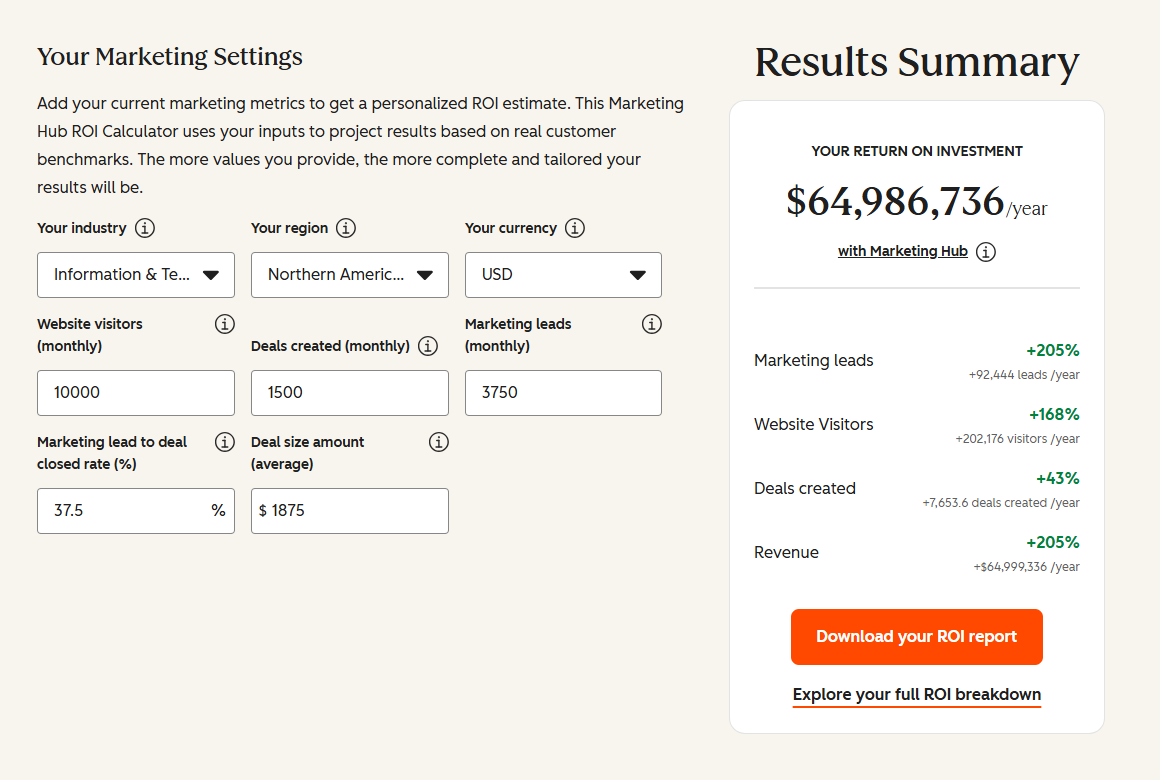
HubSpot vs Klaviyo: The Final Verdict
The verdict depends almost entirely on business model, and pretending otherwise wastes everyone’s time.
Pure DTC e-commerce brands should pick Klaviyo. The Shopify integration depth, predictive analytics, e-commerce flows, and contact-based pricing are tuned for exactly this use case. HubSpot doesn’t try to compete here and shouldn’t.
B2B companies, SaaS, service businesses, and agencies should pick HubSpot. The CRM, sales pipeline, service hub, and full-funnel attribution cover the operational ground Klaviyo doesn’t try to cover. Klaviyo for a B2B company is a wrong-tool decision.
Hybrid brands should usually run both. Klaviyo for the DTC marketing motion, HubSpot for CRM, sales, service, and content. The integration is straightforward when done right, and each platform stays in the lane it’s strongest in.
Three questions clarify the answer:
- Is your primary revenue source DTC e-commerce through Shopify, WooCommerce, or similar? If yes and you don’t have a sales team, Klaviyo.
- Do you have a sales team, B2B accounts, wholesale partners, or customer success function? If yes, HubSpot.
- Do you have both DTC volume AND a sales/B2B motion? If yes, both, with the right integration.

Table of Contents
- HubSpot vs Klaviyo at a Glance
- What HubSpot Is and Who It’s Built For
- What Klaviyo Is and Who It’s Built For
- The Fundamental Difference: B2B Platform vs E-Commerce CDP
- E-Commerce Integration Depth: Shopify, WooCommerce, BigCommerce
- CRM and Sales Features
- Email Marketing and Automation
- SMS and Omnichannel Messaging
- Predictive Analytics and Segmentation
- Pricing: Two Different Models
- AI Features: Breeze vs Marketing Agent
- Reporting and Attribution
- HubSpot vs Klaviyo: Side-by-Side Comparison
- When HubSpot Is the Better Choice
- When Klaviyo Is the Better Choice
- When to Use Both Klaviyo and HubSpot
- Migration Scenarios: Rare but Real
- HubSpot vs Klaviyo: The Final Verdict