









If HubSpot and Insightly are on your list, you’re asking a more specific question than most CRM comparisons give you credit for. You’re not just picking a tool for sales. You have to choose between a CRM that treats project delivery as a top priority and an all-in-one growth platform. There is a real difference in architecture, and it matters.
After moving clients from Insightly to HubSpot and connecting both platforms to more than 300 other tools, we think HubSpot is the best choice for most growing teams.
The marketing automation, support infrastructure, and integration ecosystem are not even close. But Insightly is better for consulting firms, agencies, and IT services companies that have a strict line between closing sales and delivering projects. HubSpot doesn’t have a built-in way to do that Opportunity-to-Project handoff.
This article compares HubSpot and Insightly in terms of price, sales features, marketing, project management, integrations, support, and what it looks like to move from one to the other. We’ll pick the best one in each area, even if that means Insightly wins.
Free estimator
Know what your HubSpot project costs before the first call.
Select your services and get a transparent price range in minutes. No sales call needed to get a number.
Firm quote after a free discovery call. Build estimate
HubSpot vs Insightly at a Glance
HubSpot is a single database that has everything you need for CRM, marketing automation, sales engagement, customer service, and content management. It began as a marketing tool in 2006, and the company built its CRM on that foundation.
This means that email campaigns, lead nurturing, and attribution reporting are all built-in features, not extras. As a HubSpot Diamond Solutions Partner, we’ve seen it grow from 5-person startups to 500-seat enterprise rollouts without having to switch platforms.
Insightly started in 2009 as a CRM that worked well with Google Workspace and was built with sales in mind instead of marketing. Its main feature, even today, is that it sees project management as a core CRM function, not just a tool you add on. Unbounce, the landing page platform, now owns it. This shows that they are investing in the marketing layer, but it also means that the product roadmap isn’t just based on CRM.
| HubSpot | Insightly | |
|---|---|---|
| Founded | 2006 (marketing-first) | 2009 (sales/Google Workspace-first) |
| Core identity | All-in-one CRM + Marketing + Sales + Service | CRM + Native Project Management |
| Free tier | Yes,unlimited users, up to 1M contacts | Yes ,2 users, 2,500 records |
| Starting paid price | ~$9–$20/seat/month (Starter) | $29/user/month (Plus) |
| Marketing automation | Included in core platform | Separate product (Insightly Marketing) |
| Project management | Requires 3rd-party tool (Asana, Monday) | Native , Opportunity-to-Project handoff |
| App integrations | 2,000+ native marketplace apps | ~200 pre-built; AppConnect ($249+/mo) |
| Best for | Marketing-led teams, B2B SMB to mid-market | Professional services, consulting, agencies |
Pricing: What You Actually Pay
The list price is the end of most comparison pages. That’s where the analysis for both tools goes wrong.
The four levels of Insightly are: Free (2 users, 2,500 records), Plus ($29/user/month), Professional ($49/user/month), and Enterprise ($99/user/month).
But here’s the catch: if you really need workflow automation, lead routing, and reporting that goes beyond basic dashboards, you need to be on the Professional plan at the very least. The Plus plan is basically a contact database with a view of the pipeline. For any real sales team, Insightly’s starting price is $49 per user per month.
Next, include the costs that aren’t obvious. Insightly Marketing is a separate product that costs $99 per month and is needed for email campaigns, lead scoring, or journey automation. The Professional Marketing plan for 10,000 contacts costs $599 a month, which is $7,188 a year more than the CRM cost for a team of 10 people. And Insightly’s App Connect integration platform, which they call their “open system,” costs $249 a month plus a $3,000 setup fee that you have to pay. This number isn’t very big on their own pricing page.
There is a catch in HubSpot’s pricing structure: the jump from Starter ($9–$20/seat/month) to Professional ($90/seat/month) is ten times as much, which can surprise teams that are growing. If you’re starting with Starter and want to automate things, plan for it early.
That being said, HubSpot’s free tier, which includes unlimited users, 1 million contacts, and basic CRM, is very helpful for small teams that want to make sure the software is a good fit before they pay for it.
For a team of ten: Before AppConnect, Insightly Professional CRM and Professional Marketing cost about $13,068 a year. HubSpot Sales Hub Professional for 10 seats costs about $10,800 a year, and that includes marketing automation.

Turn HubSpot Into A Real-Time SMS Engine with Message IQ
 Two-Way Conversations
 Shared Team Inbox
 Automation Triggers
 Advanced Reporting
 Compliance Tools
- 98% SMS read within 3 min
- 78% Buy from first responder
- 21× More likely to qualify

*MessageIQ is an IntegrateIQ product – built natively for HubSpot by the same team.
Sales Features: Pipeline, Automation, and What’s Actually Included
Both platforms do a good job of handling the basics, like deal pipelines, managing contacts, keeping track of activities, tracking emails, and making basic reports. They differ in how they allow access to automation and how they limit features.
At the Starter level, HubSpot includes automation of workflows. The Starter Sales Hub has email sequences, which are automated follow-up schedules that most sales teams use every day.
The Plus plan for Insightly does not include email sequences at all. Professional is the only version that lets you route leads and automate workflows. That means that a salesperson at an Insightly Plus company that costs $29 a month is doing work by hand that HubSpot does automatically for $9 to $20 a month.
When an opportunity reaches “Closed Won,” the Insightly team can turn it into a Project right away, bringing over linked contacts, organizations, custom fields, and task templates. This is Insightly’s best sales feature. We’ll go into more detail about that in the project management section. HubSpot is clearly the best for sales automation depth, with features like sequences, AI prospecting, deal scoring, and forecasting.
Marketing Features: Built-In vs Bolted On
Marketing automation is the main focus of HubSpot’s whole product. Your CRM contacts are in the same database as your email campaigns, landing pages, SEO tools, social publishing, lead scoring, and attribution reporting. On Tuesday, the sales rep can see that a lead opened an email on Monday. No need to integrate. No delay in data. HubSpot’s structural advantage is that marketing actions and CRM data are very closely linked.
Insightly Marketing is a real product that works. It has journey builders, lead scoring, and landing pages, but it costs extra. That might work for a team that only needs to send out basic email campaigns. The separate-database architecture makes it hard for Insightly to automatically use marketing behavior to guide sales workflows.
One real flaw in HubSpot that should be mentioned is that if you use it for marketing and then take part of your workflow out of the ecosystem (for example, moving your landing pages to Webflow or your email to another tool), your reporting stops working. HubSpot works best when it handles everything. That’s a real trade-off for teams that want their tools to be flexible.
Project Management: The One Area Where Insightly Wins
Let’s give Insightly its due credit here. The Opportunity-to-Project handoff is not a trick. You can turn a deal into a Project right away when it closes in Insightly. All of the linked contacts, organizations, custom fields, and task templates move over on their own. There are no “wait, what did they promise the client?” moments or having to re-enter information by hand. The delivery team picks up right where sales left off.
This is a real operational problem for a consulting firm, an IT services company, or a marketing agency. The time between closing a sale and starting a project is when relationships with clients start to break down. Insightly closes that gap on its own.
This isn’t something HubSpot does. Sales Hub handles deals until they close, and that’s where HubSpot’s built-in project thinking stops. Teams that need to manage projects after a sale with HubSpot are adding Asana, Monday, or a similar tool and creating an integration to share deal data. That’s a real cost and a real gap in the workflow that Insightly fixes.
If your business model includes a set delivery phase after each sale, such as onboarding, implementation, or project work, Insightly’s architecture is a better fit for you. HubSpot is the better platform overall if your workflow ends when a deal is closed or close to renewal.
Reporting & Analytics
The fact that HubSpot has all your data in one place is what makes its reporting better. In the same system, you can see your sales pipeline, the performance of your email campaigns, which marketing touch led to the close, the number of service tickets, and your revenue analytics. You can make your own dashboards that pull data from different Hubs on Professional and higher. HubSpot charges a lot more for that cross-functional reporting.
Insightly’s reports are good for keeping track of projects and customers, such as pipeline progress, deal stages, project milestones, and activity history. The custom report builder on Professional and Enterprise lets you do a lot of different things. But the ceiling is lower than HubSpot’s, especially for teams that want to link marketing spending to closed sales.
Integrations & Ecosystem: The Real Cost of “Open”
Insightly says that its system is open, while HubSpot’s is closed. That way of thinking needs to be looked at closely.
There are more than 2,000 apps in HubSpot’s App Marketplace. Salesforce, Slack, Stripe, Jira, QuickBooks, Zoom, and hundreds of other apps can be installed with just one click and come with native connectors. We can say with confidence that as a team that has connected HubSpot to more than 300 platforms and syncs 55 million fields every day across client stacks: The story of how HubSpot works with other programs is very strong.
Insightly has about 200 integrations that are ready to use. They suggest AppConnect, their own integration middleware, for more connections. It costs $249 a month and has a $3,000 setup fee that must be paid. The “open system” benefit of Insightly costs more than $6,000 a year before you even start making a custom workflow. That’s not nothing. It’s not true that HubSpot is closed and that you have to spend money on marketing.
HubSpot’s native ecosystem is easier and cheaper to connect than Insightly’s AppConnect model for teams that already have a complicated tech stack.
Customer Support: A Real Differentiator
HubSpot’s support gets better as you pay: all paid plans have live chat, and Professional and Enterprise plans can call at any time. HubSpot also has one of the best self-service learning systems in B2B SaaS. This includes HubSpot Academy, a full knowledge base, and a busy community.
The support story for Insightly is by far the worst part of the company. You can get help over the phone from 9 AM to 4 PM Pacific time, Monday through Friday. You can get premium support, which gives you faster response times and personalized training, for an extra $1,500 or more per year on top of your subscription. The most common complaint about Insightly on G2, Capterra, and Reddit is that their support is slow.
Reviews from 2024 to 2026 say that it takes 3 to 5 days to fix a ticket, and some say that simple bugs stay broken for weeks. You can’t have that in a CRM that your sales process depends on.
When HubSpot Is the Right Call
Marketing-led B2B teams
HubSpot was made from the ground up to work with inbound content, email campaigns, or paid acquisition at the start of your pipeline. There is one database that holds all of the information for marketing attribution, lead scoring, and CRM contact history. You would need to pay extra for a separate marketing product for Insightly.
Growing SMBs scaling past 10 people
HubSpot’s free tier is a good place for real teams to start. The path from free to Starter to Professional to Enterprise is a real way to grow without having to change platforms. We moved clients from three different CRMs to HubSpot because it was the only one they didn’t outgrow. We are a HubSpot Diamond Solutions Partner and have a 98.5% client retention rate. We’ve also seen this scale in action.
Teams that already use 5+ third-party tools
HubSpot’s App Marketplace connects all of your apps, including Slack, Salesforce data feeds, QuickBooks, Stripe, and Jira, with your CRM. To make those same connections, Insightly’s App Connect costs $249 a month and has a $3,000 setup fee. The numbers don’t work out in Insightly’s favor for stacks that need a lot of integration.
See your 12-month revenue impact with HubSpot CRM
Enter your current numbers — visitors, leads, deal size — and get a personalized projection based on real HubSpot customer benchmarks.
Calculate My ROI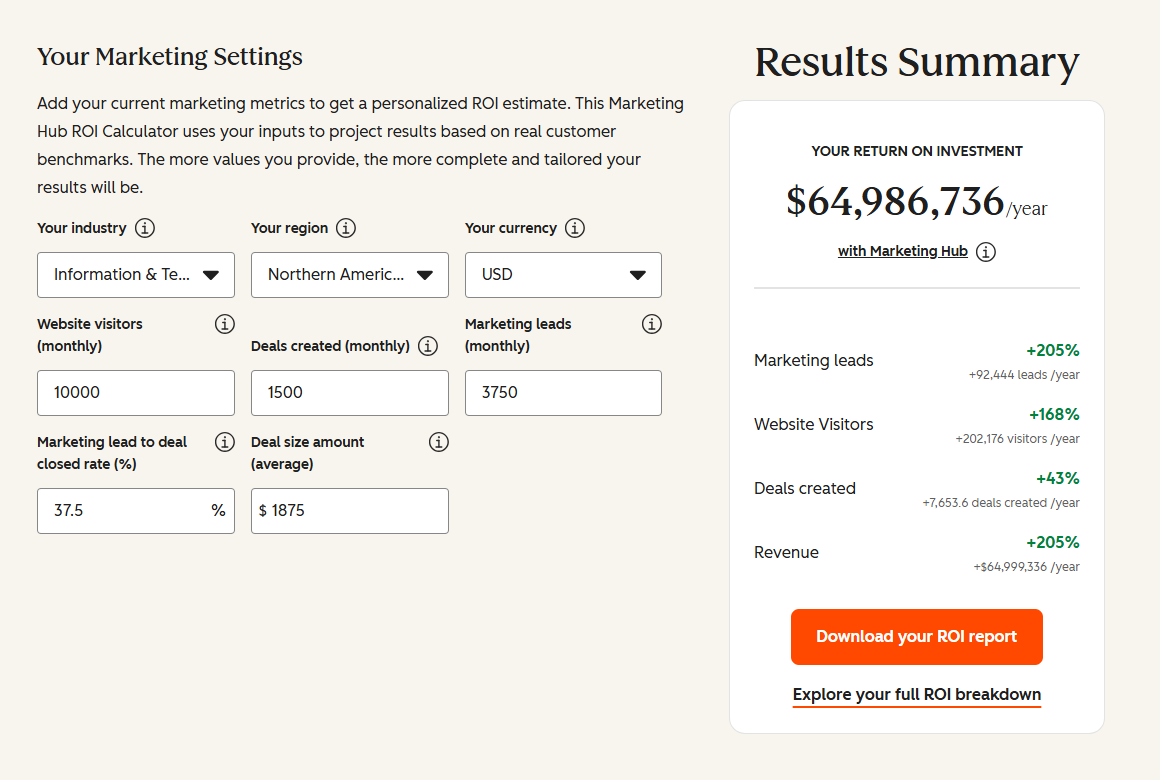
When Insightly Is the Right Call
Consulting firms and agencies with a sales-to-delivery handoff
The Opportunity-to-Project conversion is Insightly’s most well-known feature, and it’s really helpful for businesses that have a set delivery phase after every close. If your team gives a closed deal to a project manager, implementation team, or onboarding team and you’re losing track of things during that handoff, Insightly fixes that problem without needing a third-party tool.
Very small teams that don’t need marketing automation
Insightly is a good option for a sales team of 2 to 5 people who need a solid pipeline and project tracking without the extra work that comes with HubSpot’s larger platform. The free plan lets up to two people use it. That’s a good place to start for a solo founder or a small team that wants to test out early sales processes.
What Migrating from Insightly to HubSpot Looks Like
This is what the move from Insightly to HubSpot really means, not the pretty version.
What moves cleanly
With the right field mapping, contacts, companies, deals, activities, notes, and emails move over well. Insightly’s custom fields are the same as HubSpot’s custom properties. The important thing is to write them down before the migration starts, not after.
What requires planning
The main problem with Insightly is its Project records. There is no “Project” object built into HubSpot. Before migration day, your team needs to decide if Projects will turn into Tickets (Service Hub), Custom Objects, or Deals in a different pipeline. There is no one right answer; it depends on how your team uses Projects. If you get this wrong, you’ll have to make the decision again during migration.
HubSpot Workflows are built from Insightly’s workflow automations, which include lead routing, task creation triggers, and stage-change actions. The logic works, but it’s not an automatic copy. Someone needs to map the triggers and test each workflow again. This is also true for custom reports.
Timeline and process
It usually takes 8 weeks to move from Insightly to HubSpot, with a specialist taking care of the data mapping, object decisions, workflow rebuilds, and integration reconnections. We move more than 20 billion records every year, and we’ve done the Insightly-to-HubSpot path before.
The pre-migration data audit always takes the most time, not the migration itself.
Check out our guide on how to avoid making common mistakes when moving your CRM: https://integrateiq.com/blogs/stop-crm-migration-mistakes-before-they-start-a-practical-playbook/
HubSpot vs Insightly: The Final Verdict
For most teams that are growing, HubSpot is the best CRM. With over 2,000 integrations, marketing automation, great customer support, and the ability to grow from free to Enterprise, this is the safest and most flexible platform for most B2B businesses.
Insightly is the best CRM for a certain type of buyer: professional services firms, agencies, and consulting firms whose sales process goes straight into the delivery phase. Insightly’s built-in project management takes care of a type of operational friction that HubSpot can’t match without add-ons. This is especially useful if your team closes a deal and then manages a project, implementation, or onboarding process as part of fulfillment.
If you’re still not sure, ask yourself these three questions. First, does your team use marketing automation to get leads, or do you get leads in a different way? Second, does your team handle a project after every sale? Third, do you need to link your CRM to five or more other tools in your stack? Your answers will lead you to one platform pretty quickly.

Table of Contents
- HubSpot vs Insightly at a Glance
- Pricing: What You Actually Pay
- Sales Features: Pipeline, Automation, and What’s Actually Included
- Marketing Features: Built-In vs Bolted On
- Project Management: The One Area Where Insightly Wins
- Reporting & Analytics
- Integrations & Ecosystem: The Real Cost of “Open”
- Customer Support: A Real Differentiator
- When HubSpot Is the Right Call
- When Insightly Is the Right Call