

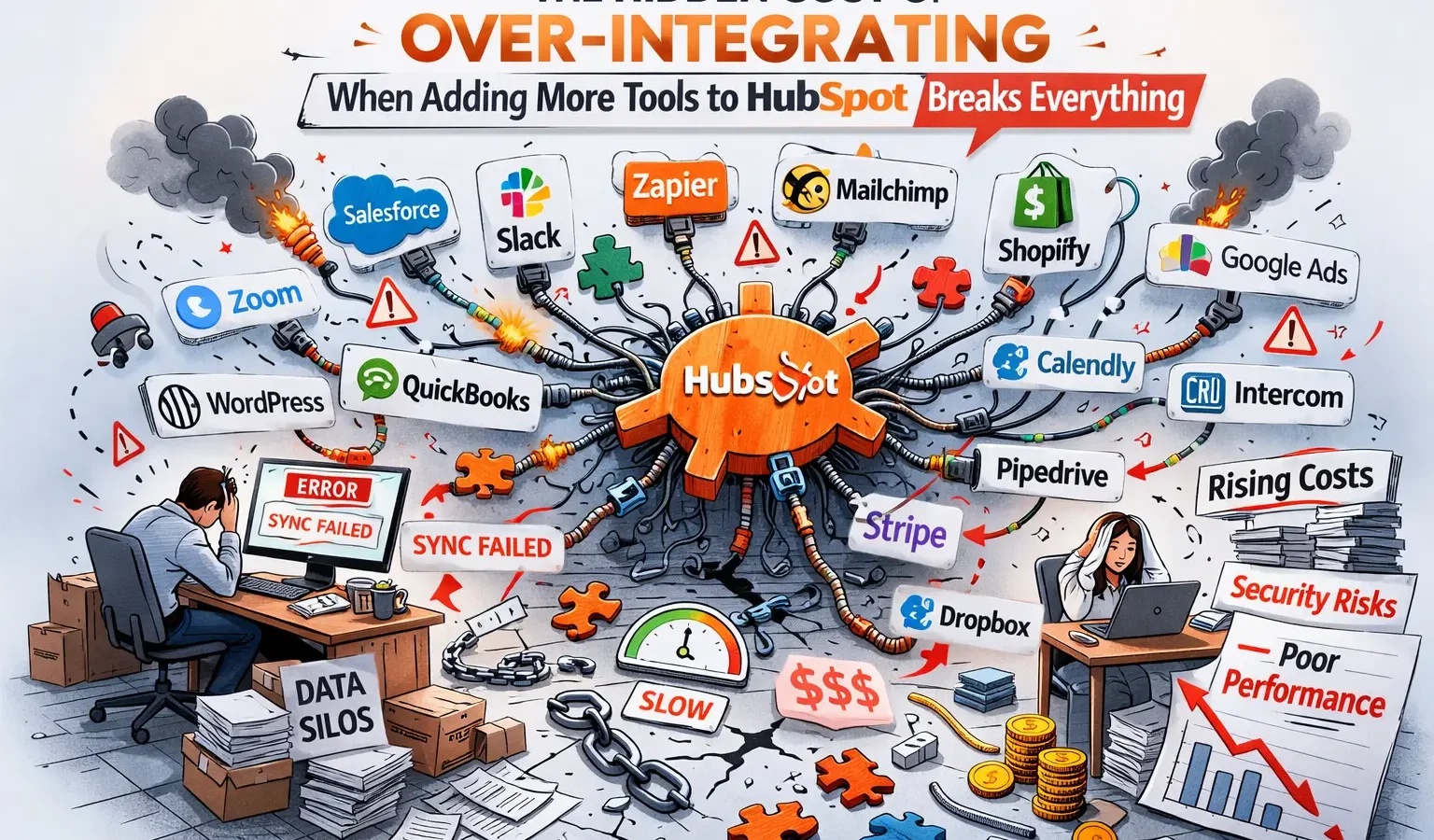
Here’s something that happens all the time, and nobody ever plans for it: a company implements HubSpot. It works. They’re happy. So they start adding integrations. One with their ERP. One with their data warehouse. One with their accounting software. One with their customer support tool. One with their e-signature platform. One with their project management tool.
Each integration makes sense individually. Each one solves a specific problem. “We need this data in HubSpot,” they say. “Let’s add an integration.” And individually, yes, that’s reasonable. But collectively? They’re building a house of cards that’s about to come crashing down.
We’ve been managing 16 billion-plus records across 275+ platform integrations for years. We’ve watched this play out hundreds of times. Companies don’t realize until they’re six months in and their data is corrupt, their workflows are broken, and their HubSpot instance is so complex that nobody even knows what’s integrated with what anymore. At that point, they’re paying us six figures to untangle something that cost $200 to set up.
Here’s the ironic part: we’re an integration company. We sell custom integrations. We profit when you integrate things. And we’re going to tell you to integrate less. That’s how you know we’re serious about this.
The logic is simple: our business thrives when we help clients solve real problems. The ones with over-integrated stacks are suffering from real problems. But those problems usually stem from having too many integrations, not too few. We could recommend building more integrations, and we’d make more money. But we’d be solving the symptom, not the disease. The better long-term play is helping companies rationalize their stacks first, then building the right integrations after that.
Why Tech Stacks Silently Collapse Under Their Own Weight
The problem with over-integration isn’t obvious at first. It compounds.
Let’s say you integrate your ERP with HubSpot. Orders sync into HubSpot. Great. Then you integrate your data warehouse, which pulls data from HubSpot to analyze it. Fine. Then you integrate your accounting software because you need invoice data to sync. Still okay. Then you add Zapier to handle some edge cases that the native integrations don’t cover. Now you have four systems moving data around.
Here’s where it breaks: what happens when the ERP goes down for maintenance? The accounting software stops getting data. Or what happens when you need to change the way orders map to HubSpot deal stages? You have to update four different systems. Or what happens when you realize the data warehouse has been getting corrupted data for three months because a field mapping was wrong? Now you have to re-process three months of analysis.
Each integration adds a dependency. Each dependency is a failure point. The more failure points you have, the more failures you get. At some point, the system is so interconnected that a single change breaks six other things.
And here’s the worst part: nobody planned for it. The company didn’t do a tech stack architecture exercise. They just kept adding integrations as business needs came up. Now they have a Frankenstein system that nobody fully understands, and fixing it requires the person who set up each integration (who probably doesn’t work there anymore).
What separates healthy companies from chaotic ones isn’t the number of integrations, it’s the intentionality. When you’re implementing integrations without a plan, each new integration adds risk exponentially. The first integration adds dependency on one system. The second adds dependencies on two systems plus the interaction between them. The tenth integration adds dependencies on ten systems plus exponentially more interaction patterns that could break.
The Data Quality Spiral: When Integrations Create More Problems Than They Solve
Over-integration is one of the fastest ways to destroy data quality.
Think about what happens when data is flowing in multiple directions. Your ERP sends customer data to HubSpot. Your data warehouse pulls customer data from HubSpot. A Zapier automation pushes modifications back to the ERP. Now the same customer record is being updated from three different sources. What happens when they disagree?
One system says the customer name is “Acme Corporation.” Another says “ACME CORP.” A third says “Acme Corp.” Which one wins? If you don’t have a super clear rule for this (and most companies don’t), you get all three. Or worse, you get them fighting each other constantly, with the “correct” value changing every time an integration runs.
The practical impact: your data is unreliable. Reports show different numbers depending on when they run. Your sales team doesn’t trust HubSpot anymore. Your finance team can’t close books because the numbers don’t match. Your operations team spends time every week fixing data inconsistencies instead of doing anything valuable.
Most companies don’t realize that preventing bad data is way cheaper than fixing it. A single integration with clear rules and data governance is worth ten integrations without governance. But companies usually go the opposite direction: they add integrations without thinking about governance, and then they pay six figures trying to fix the mess.
The real problem is that data quality issues compound. When your data is clean, people trust it. When people trust it, they use it. When they use it, the system is actually valuable. But when your data is corrupted, people stop trusting it. When they stop trusting it, they create workarounds. When they create workarounds, your system becomes irrelevant. This is how over-integrated stacks end up basically abandoned by the people who should be using them.
The Hidden Costs That Make Over-Integration Ridiculously Expensive
When a company has a massively over-integrated stack, they don’t realize how much they’re actually paying for it.
There’s the direct cost: Zapier subscriptions, native integration fees, custom integration maintenance. That’s usually $2,000-$10,000 per month depending on complexity.
Then there’s the indirect cost: the person (or people) who manage all this. Monitoring integrations, fixing broken syncs, troubleshooting data inconsistencies, updating workflows when systems change. That’s $50,000-$150,000 per year in salary for someone who exists only because your stack is too complex.
Then there’s the lost productivity cost: every time an integration breaks or data gets corrupted, your team spends time fixing it instead of doing actual work. That sales rep who can’t trust HubSpot data might be entering data into a spreadsheet instead of relying on HubSpot. That finance person who can’t close books on time is missing strategic work they should be doing. Multiply that across a team of 20 or 50 people, and you’re losing hundreds of thousands of dollars in productivity.
And then there’s the cleanup cost: eventually, a company realizes they’ve built something unmaintainable, and they need to bring someone in to refactor the whole thing. That’s where we come in. And that’s usually $50,000-$200,000 to untangle.
So a company that thought they were saving money by adding cheap integrations has actually spent $200,000+ to fix the problem. And that’s a company that got lucky. We’ve seen companies spend over a million dollars to clean up over-integrated systems.
One client we worked with had built 18 integrations over three years. When they did an audit, they found that only 6 were actually being actively used. Seven were partially used but duplicated functionality with other systems. And five were completely abandoned but still running, occasionally corrupting data or creating false alerts. The cleanup took six months and cost them over $400,000 in consulting fees. They could’ve invested that money in building five really solid, well-documented, well-monitored integrations and been in a much better position.
The Right Way to Think About Integration: Quality Over Quantity
Here’s what we tell our clients: before you add an integration, ask yourself three questions.
First: Do we actually need this data in this system right now? Not eventually. Not for a “nice to have.” Right now. A lot of integrations are built “just in case,” which means they create complexity for problems that might never show up.
Second: What’s the data quality impact? When this integration runs, will it create dependencies that could corrupt other data? What happens if this system goes down? What happens if the data format changes? If you can’t confidently answer those questions, the integration isn’t ready.
Third: How will this be maintained? If the person who built this integration leaves the company in six months, will someone else be able to fix it? Does it have monitoring? Does it have documentation? If the answer is “probably not,” then you’re setting up a future disaster.
Here’s what actually separates companies with healthy tech stacks from companies with chaotic ones: intentionality. Companies with good stacks make integration decisions deliberately. They do architecture planning. They have governance. They say “no” to integrations that don’t fit the architecture. Companies with bad stacks just add integrations whenever something comes up, and then they deal with the chaos later.
The boring truth: a well-planned tech stack with five carefully chosen integrations will outperform a chaotic stack with twenty cheap integrations every time. Speed to implement is cheap. Stability is expensive. Choose expensive.
Think about it from a business perspective. Building integrations quickly looks good on a quarterly roadmap. But a chaotic system actually slows down progress because people spend time fixing it instead of using it. One solid integration that works reliably is worth ten integrations that create more work than they solve. The companies that are growing fastest aren’t the ones with the most integrations. They’re the ones with the most reliable data and the clearest visibility into their business.
When Over-Integration Happens (And How to Fix It)
Maybe you’re reading this and you’re already over-integrated. You’ve got ten integrations. You don’t know where all the data is flowing. You have data quality problems. Welcome to the club. Here’s how to fix it without starting from scratch.
Step one: Map your current state. Document every integration you have. How often does it run? What data does it move? Where does it come from and where does it go? Who maintains it? If you can’t answer these questions, you’ve got a bigger problem than we’re talking about.
Step two: Identify the broken pieces. Which integrations are creating data quality problems? Which ones are redundant? Which ones haven’t been touched in two years but are still running? Prioritize fixing the ones that are causing actual damage.
Step three: Consolidate where possible. Do you have two integrations that could be combined into one? Can you simplify the data flow? Can you remove integrations that were set up “just in case” but are never actually used?
Step four: Implement governance. Make it official policy that new integrations need approval. Make it policy that integrations are documented and monitored. Make it policy that integration changes don’t happen without testing. None of this is sexy, but it prevents chaos.
The key: you’re not trying to rip out all your integrations. You’re trying to reduce complexity while keeping the integrations that are actually delivering value.
And here’s the beautiful part: most companies find that after they rationalize their integrations, they actually don’t need as many as they thought. They had redundant integrations solving the same problem. They had integrations running for use cases that never actually happened. They had integrations that made sense six months ago but don’t anymore because the business changed. Cleaning up those relationships actually makes the business simpler and faster, not more limited.
Frequently Asked Questions
How many integrations is too many?
There’s no magic number. We’ve seen companies with three integrations that are a mess, and companies with fifteen integrations that work beautifully. The difference is governance and architecture. That said, if you have more than 10 integrations and you can’t confidently describe how data flows through all of them, you’re probably over-integrated.
What’s the difference between a well-integrated stack and an over-integrated stack?
Well-integrated stacks have a clear architecture that someone designed intentionally. Data flows in predictable directions. There’s governance around what integrations are allowed. Documentation exists. Someone can explain why each integration exists. Over-integrated stacks are chaotic, with integrations that were added ad-hoc, data flowing in multiple directions, no governance, and nobody really understands the whole system.
If we’re over-integrated, do we need to blow everything up and start over?
Almost never. You can usually improve things significantly without ripping everything out. Consolidate redundant integrations. Remove ones that aren’t providing value. Fix data quality problems in the critical ones. Gradually introduce governance. It’s slower than starting fresh, but it’s way cheaper.
Should we use Zapier or build custom integrations?
Zapier is great for simple, one-directional data flows between systems. Custom integrations are better for complex, bidirectional flows, or for critical data that needs to be reliable. The mistake is using Zapier as the default for everything. Use the tool that matches the criticality and complexity of the integration, not the cheapest tool.
How do we prevent over-integration as we grow?
Build a tech stack governance process early. Require business cases for new integrations. Require documentation. Require testing before going live. Require monitoring after you go live. It sounds bureaucratic, but it’s way cheaper than the cleanup that over-integration requires.
The Irony of Being an Integration Company That Tells You to Integrate Less
We build integrations for a living. We benefit when companies need more integrations. But we benefit even more when companies come to us for help fixing over-integrated systems. And honestly, we’d rather just help people avoid the problem in the first place.
The real value of integration isn’t in how many systems you connect. It’s in connecting the right systems, the right way, with the right governance. A company with five well-designed integrations will run circles around a company with twenty chaotic ones. And they’ll spend way less money doing it.
So before you add that next integration, stop and ask yourself: do we actually need this right now? Or are we just adding complexity? Most of the time, the right answer is “let’s not.” Your future self will thank you.
The integration mindset should be this: integrations are tools for solving real business problems. Not everything is a business problem worth solving through integration. Sometimes the answer is to accept some manual work, or to accept that two systems won’t be perfectly synced. That’s actually the mature approach. The immature approach is integrating everything and dealing with the chaos that creates.
