


Duplicate records are one of the most common and costly problems in any CRM. This guide covers how HubSpot handles deduplication natively, what your team can do manually, which built-in tools are worth using, and which third-party solutions deliver the best results for companies serious about data quality.
Free estimator
Know what your HubSpot project costs before the first call.
Select your services and get a transparent price range in minutes. No sales call needed to get a number.
Connect HubSpot to your ERP, billing platform, or database field mapping, custom logic, and support included.
Pipelines, workflows, email templates, and reporting configured for how your team actually works.
Live, role-based sessions with recordings and written guides built around a custom plan for your team.
HubSpot Partner
Client retention
Platforms integrated
The Problem Most Teams Don’t Catch Until It’s Too Late
You run a report. The numbers look off. Sales says they’ve never talked to a contact your marketing team swears is a long-standing customer. Meanwhile, the same company shows up in your CRM four times under slightly different names.
Duplicate data isn’t just an inconvenience. It distorts your pipeline, inflates your contact counts, breaks automation sequences, and undermines the trust your teams place in the system. Once that trust erodes, people stop using the CRM the right way and the problem compounds.
Most companies don’t realize how serious their duplicate problem is until they’re trying to integrate HubSpot with another platform. That’s when the cracks become impossible to ignore.
This post walks through what HubSpot does to prevent duplicates in the first place, what your team should be doing manually, what tools HubSpot offers natively, and what third-party solutions are worth the investment.
How HubSpot Works to Prevent Duplicates From the Start
HubSpot uses email address as the primary unique identifier for contacts. When a new contact is created, either through a form submission, an import, or an integration, HubSpot checks whether a contact with that email already exists. If it does, HubSpot updates the existing record rather than creating a new one.
For companies, HubSpot uses domain name as the primary deduplication key. If a company record with that domain already exists, new data gets routed to the existing record.
This logic works well in clean, controlled environments. The challenge is that the real world is messier. People use multiple email addresses. Contacts get created manually without email addresses. Integrations push records from external systems with slightly different formatting. And imports don’t always get reviewed carefully before upload.
HubSpot’s built-in prevention is a solid foundation. It is not a complete solution.

Turn HubSpot Into A Real-Time SMS Engine with
Message IQ

Two-Way Conversations

Shared Team Inbox

Automation Triggers

Advanced Reporting

Compliance Tools
-
98%
SMS read within 3 min -
78%
Buy from first responder -
21×
More likely to qualify
3–5 min avg response
$45–$50 ROI / $1

*MessageIQ is an IntegrateIQ product – built natively for HubSpot by the same team.
Manual Deduplication: What Your Team Should Be Doing
Before reaching for tools, it helps to establish habits that reduce duplicates at the source.
Set data entry standards. If your team creates contacts manually, define a clear process. Always search for the contact first. Require an email address before saving. Agree on naming conventions for companies.
Review imports before they go live. Every bulk import is a potential duplicate event. Before uploading a list, deduplicate it externally. Remove records that already exist in your CRM. Map fields carefully so data lands in the right place.
Audit integrations at setup. Any time you connect HubSpot to another platform, understand how that system creates and pushes records. Does it send email addresses consistently? Does it create company records? Are there scenarios where it would create a new contact instead of updating an existing one? These questions should be answered before go-live, not after.
Train your team consistently. Duplicates are often the result of habits, not malice. A short training session on how HubSpot handles records and what causes duplicates can prevent thousands of bad records over time.
Manual discipline matters. Tools can clean up existing problems, but human habits determine how fast new ones accumulate.
HubSpot’s Built-In Deduplication Tools
HubSpot has invested meaningfully in native deduplication features, particularly at the Professional and Enterprise tiers.
Duplicate Management Tool
HubSpot’s native Duplicate Management tool, found under the actions menu of Contacts, Companies, and Deal segment views, identifies potential duplicate pairs and lets you review and merge them one by one. It uses a combination of matching logic including email address, name similarity, and phone number to surface likely duplicates.
The tool is straightforward to use. You review each suggested pair, decide which record is the primary, and merge. HubSpot consolidates associated activities, deals, and notes onto the winning record.
The limitation is scale. If you have a large database with thousands of potential duplicates, reviewing them one at a time is not realistic. The native tool works well for ongoing maintenance or smaller databases. It is not designed for large-scale remediation projects and it doesn’t catch everything.
Unique Property Enforcement
HubSpot allows you to mark custom properties as unique identifiers. This is particularly useful for companies using HubSpot alongside an ERP or field service platform that assigns its own customer IDs. By storing the external system ID as a unique property in HubSpot, you create a second layer of deduplication logic that can prevent duplicates during integration syncs.
This is an underused feature that provides real value when set up correctly.
List Segmentation and Filtering
While not a deduplication tool per se, HubSpot’s list and filtering capabilities help surface records with missing or inconsistent data. Building smart lists that flag contacts without email addresses, companies without domains, or records with obvious naming inconsistencies gives your team a targeted cleanup queue to work through.
Best-in-Class Third-Party Deduplication Tools
For companies with larger databases or more complex data environments, native HubSpot tools have real limits. Third-party solutions offer more automation, more matching logic, and more control.
Dedupely
Dedupely is one of the most widely used HubSpot-specific deduplication tools. It connects directly to HubSpot and scans your database for duplicate contacts, companies, and deals using customizable matching rules. You can match on email, name, phone, domain, or a combination of fields.
Dedupely allows bulk merging, which is the most significant advantage over HubSpot’s native tool. Instead of reviewing one pair at a time, you can review grouped clusters of duplicates and merge them in batches. It also supports auto-merge rules for high-confidence matches, which is valuable for ongoing maintenance.
It is well-suited for mid-market companies running periodic deduplication programs and for teams that want more control over matching logic than HubSpot provides natively.
Koalify
Koalify takes a more real-time approach. It monitors your HubSpot database for new duplicates as records are created and updated, rather than relying purely on scheduled scans. This makes it particularly useful for organizations with high-volume inbound lead flow or active integration pipelines that continuously push records into HubSpot.
The real-time detection capability means your team can catch duplicates quickly rather than letting them accumulate between cleanup sessions.
Clearbit Enrichment (now Breeze Intelligence in HubSpot)
While primarily an enrichment tool, Clearbit and its successor Breeze Intelligence help reduce duplicates indirectly by standardizing company data. When you enrich a company record with verified domain, industry, and firmographic data, it becomes easier to identify and merge records that represent the same organization but were created under different names.
Enrichment and deduplication work together. Cleaner, more complete data makes duplicate matching more accurate.
Insycle
Insycle is a broader data management platform that includes deduplication as one of its core features. Beyond merging duplicates, it handles data formatting, bulk editing, and field standardization. For companies that have both a duplicate problem and a data quality problem, Insycle can address both simultaneously.
Its matching logic is highly configurable, and it supports scheduled automation for ongoing cleanup. It requires more setup investment than Dedupely, but the return is higher for teams managing complex or messy databases.
The Right Cadence for Deduplication
Deduplication is not a one-time project. It is an ongoing practice. The right cadence depends on your data volume and the health of your existing database.
At initial CRM setup or migration: Run a full deduplication pass before you go live. This is non-negotiable. Migrating a dirty database into a new system just gives you a clean-looking version of the same problem.
After every significant import: Any time you bring in a bulk list, run a deduplication check against your existing database within 48 to 72 hours. Imports are one of the highest-risk events for duplicate creation.
Monthly maintenance for active databases: For most mid-market companies with active marketing and sales operations, a monthly deduplication review is a reasonable baseline. Use HubSpot’s native tool for spot-checking and a tool like Dedupely or Insycle for any larger cleanup needs.
Quarterly deep audits: Once per quarter, run a more thorough pass using smart lists to flag incomplete records and a deduplication tool to catch anything the monthly review missed. Pair this with a data quality review of your custom properties and segmentation logic.
After any new integration goes live: When you connect HubSpot to a new platform, the first 30 to 60 days are a high-risk window. Monitor closely for duplicate patterns from the new data source and adjust field mappings or deduplication rules if needed.
The goal is to make deduplication a routine, low-friction process rather than a crisis response. Teams that treat it as ongoing maintenance stay ahead of the problem. Teams that ignore it until something breaks spend significantly more time and effort fixing it.
A Note on Integration Architecture
If your HubSpot duplicates consistently trace back to a connected platform, such as a field service management system, ERP, or marketing automation tool, the deduplication problem is usually a symptom of a deeper integration design issue.
The question is not just how to merge existing duplicates. It is why the integration keeps creating them. Investigating the root cause, whether that is mismatched identifiers, missing email address fields, or poorly defined record creation logic, prevents the problem from recurring.
Getting the architecture right at the integration level is more durable than any deduplication tool.
Conclusion
Duplicate data is a solvable problem, but it requires a combination of prevention, process, and the right tools. HubSpot’s native capabilities give you a reasonable starting point. Manual habits and team training reduce the ongoing rate of new duplicates. Tools like Dedupely, Insycle, and Koalify extend what HubSpot can do natively, particularly for larger or more complex databases. And a consistent cadence, monthly reviews with quarterly deep audits, keeps the problem manageable over time.
Clean data is not glamorous work. But it is the foundation that everything else in your CRM depends on.
Is Your Deduplication Problem Actually an Integration Problem?
If your duplicates keep coming from a connected system, the fix may need to happen at the integration level, not the CRM level. We work with companies every day to design integrations that bring data into HubSpot cleanly. A short conversation can help you understand where your problem is actually coming from.
Reach out if you want a second set of eyes on your setup.
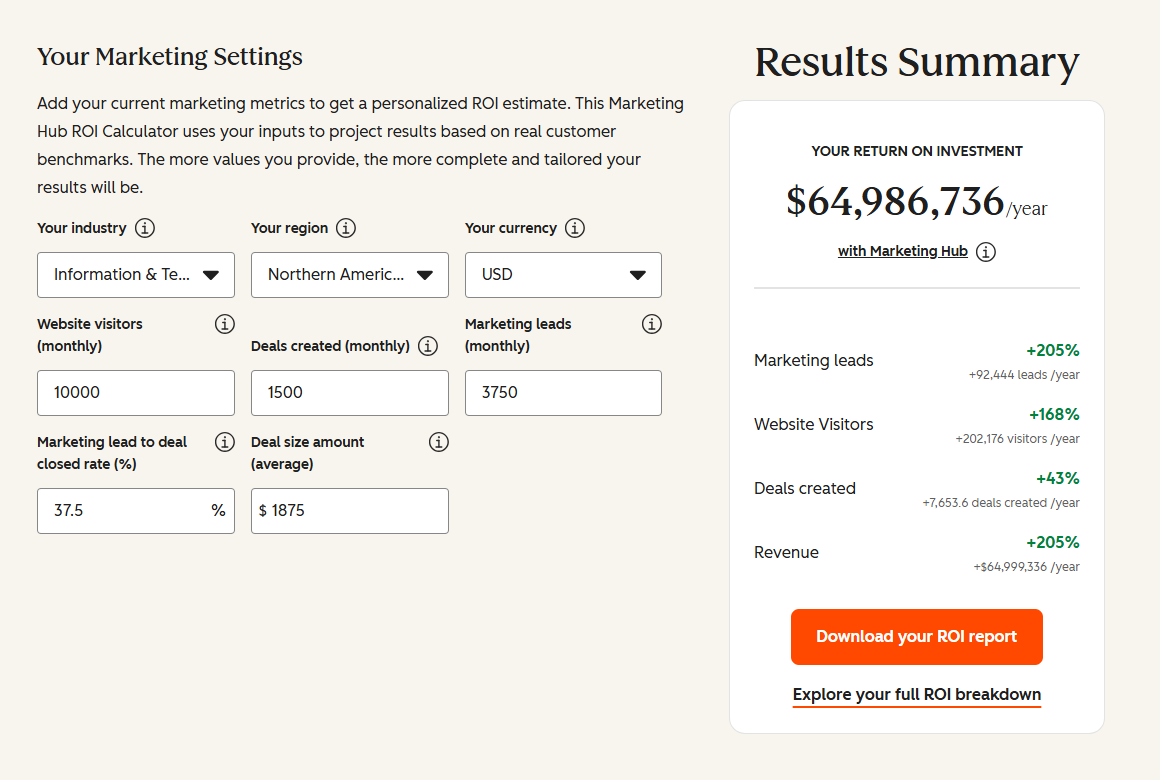
See your 12-month revenue impact with HubSpot CRM
Enter your current numbers — visitors, leads, deal size — and get a personalized projection based on real HubSpot customer benchmarks.
Frequently Asked Questions
How does HubSpot identify duplicate contacts?
HubSpot uses email address as the primary unique identifier for contacts. When a new contact is created through a form, import, or integration, HubSpot checks for an existing record with the same email. If a match is found, the existing record is updated rather than a new one created. For contacts without email addresses, HubSpot does not automatically prevent duplicates.
What is the best third-party tool for deduplicating HubSpot data?
Dedupely is one of the most popular and well-reviewed options specifically built for HubSpot. It supports bulk merging, custom matching rules, and auto-merge logic, which makes it more practical than HubSpot’s native tool for larger databases. Insycle is a strong alternative for teams that also need broader data quality management beyond just deduplication.
How often should you run a deduplication review in HubSpot?
Most mid-market companies benefit from a monthly deduplication check for ongoing maintenance, combined with a more thorough quarterly audit. You should also run a deduplication pass immediately after any bulk import and during the first 30 to 60 days after a new integration goes live.
Can you prevent duplicates from coming in through a HubSpot integration?
Yes, with the right integration design. Using unique property enforcement, ensuring the connected system sends consistent email addresses, and setting clear record creation logic in the integration can significantly reduce or eliminate duplicate creation. Duplicates that originate from integrations are often a sign of an architectural issue rather than a data entry problem.
What happens to associated data when you merge duplicate records in HubSpot?
When you merge two records in HubSpot, the system consolidates associated activities, notes, emails, deals, and tickets onto the primary record. You choose which record to keep as the primary, and the secondary record is permanently deleted. It is worth reviewing both records before merging to ensure you select the right primary.
Does HubSpot’s deduplication work for company records, not just contacts?
Yes. HubSpot deduplicates companies using domain name as the primary key. Its native Duplicate Management tool also surfaces potential company duplicates based on name and domain similarity. The same limitations apply as with contacts: scale is a challenge for native tools, and third-party solutions offer more automation for larger databases.
Start Cleaning Your HubSpot Data Today



Table of Contents
- The Problem Most Teams Don't Catch Until It's Too Late
- How HubSpot Works to Prevent Duplicates From the Start
- Manual Deduplication: What Your Team Should Be Doing
- HubSpot's Built-In Deduplication Tools
- Best-in-Class Third-Party Deduplication Tools
- The Right Cadence for Deduplication
- A Note on Integration Architecture
- Conclusion
- Is Your Deduplication Problem Actually an Integration Problem?
- Frequently Asked Questions
