












Explore this article with AI:

Free estimator
Know what your HubSpot project costs before the first call.
Select your services and get a transparent price range in minutes. No sales call needed to get a number.
Connect HubSpot to your ERP, billing platform, or database field mapping, custom logic, and support included.
Pipelines, workflows, email templates, and reporting configured for how your team actually works.
Live, role-based sessions with recordings and written guides built around a custom plan for your team.
HubSpot Partner
Client retention
Platforms integrated
Key Takeaways
- Unified Financial Truth: Integrations with ERPs like NetSuite and Sage Intacct break down the wall between “Sales” (HubSpot) and “Finance” (ERP), creating a single source of truth for revenue data.
- Automated Loan Processing: By connecting HubSpot to tools like Braintree and Square, lenders can automate the collection of application fees and trigger underwriting workflows instantly.
- Reduced Manual Entry: Two-way syncs with QuickBooks and Xero eliminate the need to copy-paste invoice data, reducing human error and speeding up month-end close.
- Real-Time Collections: Payment gateways like Stripe and PayPal integrated with HubSpot allow for automated “dunning” (payment collection) emails, improving cash flow without manual follow-up.
- Better Risk Management: Syncing payment history back to HubSpot helps sales teams identify high-risk clients before they upsell, ensuring healthy portfolio growth.
The Bigger Picture: Why Finance Needs to Own the CRM
In 2026, the finance function is no longer just about “keeping score”, it’s about enabling speed. For lending institutions, fintechs, and high-volume service businesses, the bottleneck often lies in the handoff between the promise (Sales) and the execution (Finance).
When your loan officers or sales reps work in HubSpot, but your billing and underwriting teams live in a siloed ERP, friction is inevitable. Deals get stalled, invoices get lost, and “approved” loans sit in limbo waiting for manual data entry.
By integrating your core financial systems with HubSpot, you transform the CRM from a simple sales tool into a Revenue Operations engine. You enable “Touchless Processing” where a signed contract in HubSpot automatically triggers an invoice in NetSuite, or a loan application fee paid via Stripe automatically moves a deal to “Underwriting.”
Here are the eight essential HubSpot integrations that are redefining finance workflows this year.
1. NetSuite: The Enterprise Backbone
For mid-market and enterprise finance teams, NetSuite is often the system of record. A robust NetSuite HubSpot integration is critical for automating the “Quote-to-Cash” cycle.
Why it matters:
- Automated Sales Orders: When a deal moves to “Closed-Won” in HubSpot, the integration can instantly create a Sales Order or Invoice in NetSuite. This removes the 24-48 hour delay often caused by manual entry.
- Credit Status Visibility: Sales reps can see a client’s “Credit Hold” status directly in HubSpot. This prevents them from wasting time selling to clients who can’t buy, or allows them to proactively address billing issues.
- Revenue Recognition: Ensure that the specific product line items sold in HubSpot map correctly to your General Ledger codes in NetSuite, ensuring accurate revenue recognition reporting without spreadsheets.

Turn HubSpot Into A Real-Time SMS Engine with
Message IQ

Two-Way Conversations

Shared Team Inbox

Automation Triggers

Advanced Reporting

Compliance Tools
-
98%
SMS read within 3 min -
78%
Buy from first responder -
21×
More likely to qualify
3–5 min avg response
$45–$50 ROI / $1

*MessageIQ is an IntegrateIQ product – built natively for HubSpot by the same team.
2. QuickBooks Online: The SMB Standard
QuickBooks Online (QBO) is the engine for millions of businesses. The native HubSpot integration is powerful, but sophisticated teams often use advanced workflows to handle complex invoicing.
The operational edge:
- Invoice Creation from Deals: Generate QBO invoices directly from HubSpot deal records. The integration pulls client data and product line items, ensuring the invoice matches the quote exactly.
- Payment Status Triggers: When an invoice is marked “Paid” in QuickBooks, that status syncs back to HubSpot. You can use this trigger to automate a “Thank You” email or kick off a client onboarding sequence.
- Expense Tracking: For loan officers incurring costs (like appraisals), workflows can help track billable expenses associated with a deal, ensuring they are captured in QBO for reimbursement or billing.
3. Sage Intacct: For Growing Financial Complexity
As companies outgrow QuickBooks, many graduate to Sage Intacct. Integrating Sage with HubSpot is often a custom project designed to handle multi-entity billing and complex contract management.
Key capabilities:
- Multi-Entity Sync: If your lending business operates across multiple states or legal entities, a custom integration can route HubSpot deals to the correct Sage entity based on territory or product type.
- Contract Renewals: Sync contract end dates from Sage back to HubSpot. This allows account managers to receive automated alerts 90 days before a loan or subscription expires, proactively managing retention.
- Project Profitability: Pass project or loan ID data between systems so you can report on the true profitability of a client source (e.g., “Google Ads leads have a 10% lower default rate”).
4. Xero: The User-Friendly Alternative
Popular in SaaS and global markets, Xero’s integration with HubSpot emphasizes ease of use and clean data synchronization.
How it transforms workflows:
- Bi-Directional Contact Sync: Ensure your finance team and sales team are looking at the same contact details. If a billing address changes in Xero, it updates in HubSpot automatically.
- Aged Receivables in CRM: Advanced integrations can display a client’s “Outstanding Balance” on their HubSpot company record. This empowers sales reps to act as first-line collections, reminding clients of overdue bills during check-in calls.
- Currency Conversion: For international teams, Xero and HubSpot can handle multi-currency deals, ensuring that the value in your pipeline matches the actual invoiced amount in your base currency.
5. Stripe: The Payment Powerhouse
Stripe is more than just a payment processor; it’s a programmable financial platform. Integrating Stripe with HubSpot is essential for modern, automated lending and billing models.
Why it’s essential:
- Instant Deal Progression: For loan applications, use Stripe to collect an application fee. The successful charge event can automatically move the HubSpot deal stage from “Application Received” to “Underwriting,” triggering tasks for your risk team.
- Subscription Management: If you offer subscription-based financial advice or software, managing upgrades and downgrades in HubSpot (which then update Stripe subscriptions) keeps your revenue data clean.
- Failed Payment Automation: When a recurring payment fails in Stripe, trigger a high-priority task in HubSpot for the account owner to reach out, preventing involuntary churn.
6. PayPal: The Global Wallet
For B2C lending or high-volume transactional finance, PayPal remains a trusted option. Integrating it allows you to capture “invisible” transaction data.
Operational wins:
- Transaction History as Marketing Gold: Sync PayPal transaction history to HubSpot contact records. You can then segment lists based on spending behavior (e.g., “Clients who have spent >$500 in fees”) for targeted VIP offers.
- Streamlined Invoicing: Allow clients to pay HubSpot-generated quotes using PayPal. This reduces friction and speeds up the “Time to Cash” metric significantly compared to traditional wire transfers.
7. Braintree: For Custom Payment Flows
Owned by PayPal, Braintree offers a more customizable payment experience, often used by tech-forward lenders and fintech apps.
The strategic shift:
- White-Label Payments: Braintree allows for a fully branded checkout. Integrating this with HubSpot means you capture the payment data without the client ever feeling like they left your ecosystem.
- Split Payments: For marketplace lending models (where you might split a payment between a provider and yourself), syncing these complex transaction details to HubSpot allows for accurate commission tracking and partner reporting.
- Tokenization Security: Store payment tokens securely in Braintree while referencing them in HubSpot. This allows sales reps to say “Shall we use the card on file?” without ever handling sensitive credit card data (PCI compliance).
8. Square: The POS Connector
For finance teams supporting brick-and-mortar clients or field agents (like insurance adjusters collecting deductibles), Square bridges the physical and digital worlds.
Key features:
- Offline to Online Sync: Transactions taken on a Square reader in the field instantly create or update contacts in HubSpot. This is vital for accurate “Customer Lifetime Value” reporting.
- Appointment Deposits: If you charge for financial consultations, Square Appointments can sync with HubSpot meetings, ensuring that a paid booking is tracked as a revenue event, not just a calendar invite.
Things To Watch Out For
- Revenue Recognition Rules: Don’t confuse “Closed Won” (Sales) with “Revenue Recognized” (Finance). Ensure your integration respects your accounting standards (e.g., GAAP/IFRS) regarding when revenue is actually booked.
- Tax Compliance: Tools like TaxJar or Avalara often sit between your CRM and ERP. Ensure your integration flow accounts for automatic tax calculation so invoices generated from HubSpot are legally accurate.
- Data Overload: Finance data is heavy. You don’t need every single transaction line item in HubSpot. Sync high-level summaries (e.g., “Total Loan Value,” “Last Payment Date”) to keep your CRM fast and usable.
- GDPR/CCPA Security: Financial data is highly sensitive. Ensure that any field syncing bank details or personally identifiable information (PII) is properly encrypted and that your integration partner manages access tokens securely.
What Finance & Ops Leaders Should Do Now
- Map Your “Quote-to-Cash” process: Literally draw it on a whiteboard. Where does the data stop and require a human to re-type it? That is your integration priority.
- Clean Your Product Library: Before integrating, ensure that your “Products” in HubSpot match the “Items” or “SKUs” in your ERP (NetSuite/QuickBooks). Mismatched SKUs are the #1 cause of sync failures.
- Define the “System of Record”: Decide which system wins if there is a conflict. Usually, the ERP is the master for billing addresses and credit status, while HubSpot is the master for email and phone.
- Consult a Specialist: Financial integrations carry high risk. If you are dealing with millions in loan value, using a generic “connector” app can be dangerous. Consider a custom integration partner who understands financial compliance.
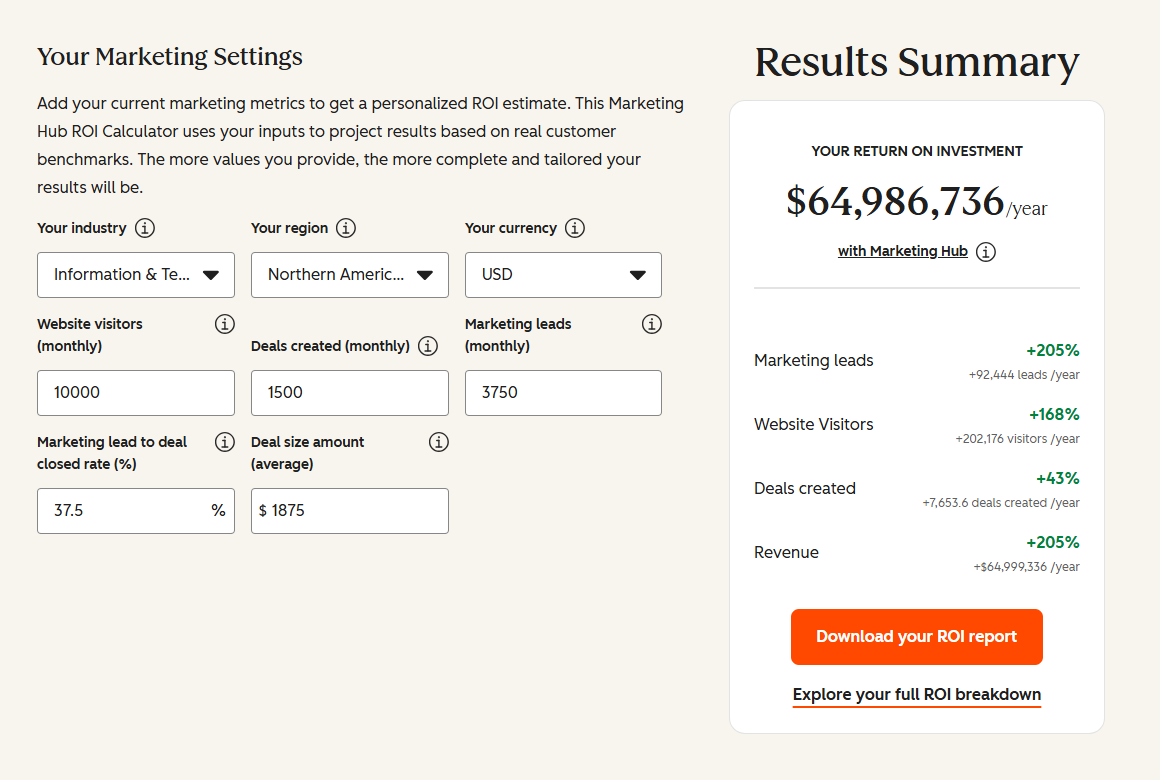
See your 12-month revenue impact with HubSpot CRM
Enter your current numbers — visitors, leads, deal size — and get a personalized projection based on real HubSpot customer benchmarks.
FAQs
Can I generate official tax invoices directly from HubSpot?
Yes, but with caution. While HubSpot can generate PDF invoices, most finance teams prefer to have HubSpot trigger the invoice creation in their ERP (like QuickBooks or NetSuite) to ensure the invoice number sequence and tax codes are perfectly compliant.
Is it safe to store credit card info in HubSpot?
No. You should never store raw credit card numbers in standard HubSpot text fields. Use integrations like Stripe or Braintree which store the sensitive data on their secure servers and only sync a “token” or reference ID to HubSpot.
How does this help with collections?
By syncing “Payment Status” (e.g., “Overdue”) from your accounting software to HubSpot, you can trigger automated emails from the account manager (e.g., “Hey, just noticed this is past due, can you check?”) which often gets a faster response than a generic finance email.
Bottom Line
Finance automation isn’t about replacing accountants with robots; it’s about freeing them from data entry so they can focus on strategy. By integrating HubSpot with your financial core whether that’s NetSuite, Stripe, or QuickBooks you create a seamless, transparent flow of data that accelerates cash flow and delights customers.
Stop treating your CRM and ERP as enemies. Connect them, and watch your efficiency soar.


Table of Contents
- Key Takeaways
- 1. NetSuite: The Enterprise Backbone
- 2. QuickBooks Online: The SMB Standard
- 3. Sage Intacct: For Growing Financial Complexity
- 4. Xero: The User-Friendly Alternative
- 5. Stripe: The Payment Powerhouse
- 6. PayPal: The Global Wallet
- 7. Braintree: For Custom Payment Flows
- 8. Square: The POS Connector
- FAQs