

Your outbound is running. Ross Bee is prospecting from a database of 700M+ contacts, firing off personalized emails, and booking meetings on autopilot. But back in HubSpot, you’re still manually logging activities, creating contact records, and moving deals through pipeline stages. That gap isn’t a minor annoyance it’s a data accuracy problem, and it compounds fast.
The 1bee AI HubSpot integration closes that gap. When it’s built properly, every email Ross Bee sends, every reply it handles, and every meeting it books flows straight into HubSpot as contacts, deal records, activities, and lifecycle stage updates all without a human touching a keyboard.
At Integrate IQ, we’re a HubSpot Diamond Solutions Partner with custom integration accreditation. We’ve processed 20 billion+ records across 300+ platform integrations and sync 7 million fields daily. We know exactly where the 1bee.ai native HubSpot connector handles the job, and where it doesn’t.
Free estimator
Know what your HubSpot project costs before the first call.
Select your services and get a transparent price range in minutes. No sales call needed to get a number.
Firm quote after a free discovery call. Build estimate
What Does the 1bee AI HubSpot Integration Actually Do?
The 1bee AI HubSpot integration connects 1bee.ai’s outbound sales automation platform to HubSpot’s CRM, so that prospect data, outreach activity, and meeting outcomes flow directly into your HubSpot records in real time. Ross Bee, 1bee.ai’s AI SDR, handles the outbound work prospecting, emailing, replying, booking and the integration ensures every action it takes becomes a clean, structured record in HubSpot.
Think about what that means in practice. A prospect pulled from 1bee’s database becomes a Contact in HubSpot, enriched with their professional data. When Ross Bee sends an email, that activity logs on the Contact record automatically. When it books a meeting, a Deal gets created, and the Contact’s Lifecycle Stage advances to SQL. No manual entry. No stale pipeline. No guessing what the AI actually did.
That’s the integration working correctly. Whether the native 1bee.ai connector delivers all of that depends heavily on how complex your HubSpot setup is but more on that in a moment.
HubSpot Data Objects That Sync with 1bee AI
A properly built 1bee AI HubSpot integration touches four core data objects. Here’s what each one does and why it matters:
Contacts and Lead Records
When Ross Bee identifies a new prospect, the integration creates or updates a Contact in HubSpot, pulling in name, email, company, job title, and enrichment data sourced from 1bee’s 700M+ contact database. For teams already running HubSpot, deduplication logic checks against existing records first updating rather than duplicating which is a common failure point in shallow connector setups.
Activity and Email Writeback
Every email Ross Bee sends, every reply it handles, and every follow-up it sequences gets written back to HubSpot as an Activity on the relevant Contact record. Sales managers see a complete outreach history without chasing reps for updates. RevOps gets accurate engagement data without relying on manual logging.
Deal Creation and Stage Updates
When Ross Bee books a meeting, the integration automatically creates a Deal in HubSpot, associates it to the correct Contact and Company, and places it in the right pipeline stage. As the meeting progresses through your sales process, deal stage updates can fire automatically based on 1bee.ai engagement signals no rep intervention needed.
Lifecycle Stage Automation
One of the most underused aspects of this integration is lifecycle stage automation. When a prospect responds positively to Ross Bee’s outreach, that engagement signal triggers a Lifecycle Stage update in HubSpot from MQL to SQL, or from Lead to Marketing Qualified Lead. Your HubSpot Sales Hub workflows pick up from there, enrolling the prospect in sequences or alerting the right rep at exactly the right moment.
Turn HubSpot Into A Real-Time SMS Engine with Message IQ
 Two-Way Conversations
 Shared Team Inbox
 Automation Triggers
 Advanced Reporting
 Compliance Tools
- 98% SMS read within 3 min
- 78% Buy from first responder
- 21× More likely to qualify

*MessageIQ is an IntegrateIQ product – built natively for HubSpot by the same team.
When 1bee AI’s Native HubSpot Connector Isn’t Enough
1bee.ai offers a native connector to HubSpot. For small teams doing basic outbound to a clean prospect list, it works fine. But mid-market and enterprise teams running complex HubSpot pipelines hit its ceilings fast.
The core problem: native connectors map to standard HubSpot properties and basic data flows. They don’t know your custom deal stages, your multi-pipeline setup, your custom objects, or your nuanced deduplication rules. They also tend to fail silently meaning a sync conflict or a missed field mapping just doesn’t happen, with no alert and no retry.
Here’s how the native connector compares to a custom-built integration:
| Dimension | 1bee AI Native Connector | Integrate IQ Custom Integration |
| Data objects synced | Contacts, basic activity | Contacts, Deals, Activities, Lifecycle Stage, Custom Objects |
| Deal creation trigger | Manual or limited | Auto-created when Ross Bee books a meeting |
| Lifecycle Stage updates | Not supported | Automatic MQL to SQL on engagement signal |
| Custom field mapping | Pre-built only | Fully configurable per HubSpot property schema |
| Deduplication logic | Basic email match | Multi-field matching with merge rules |
| Error handling | Silent failures | Logging, alerts, and retry logic built in |
| HubSpot Workflow triggers | Limited | Full any 1bee event can fire a workflow |
| Implementation time | Hours (self-serve) | ~8 weeks from kickoff to go-live |
| Post-go-live support | Self-service docs | Included dedicated support from IntegrateIQ team |
The choice between native and custom isn’t about budget it’s about data integrity at scale. If Ross Bee is prospecting thousands of contacts per month and booking dozens of meetings per week, the native connector’s deduplication and deal creation gaps translate directly into pipeline inaccuracy and reporting noise. A custom integration built through Integrate IQ solves all of that upfront, with error handling and sync conflict logic built into the architecture.
How Different Teams Use the 1bee AI HubSpot Integration
SDR Teams Running High-Volume Outbound
An SDR team using Ross Bee to run 5,000 outbound touches per month can’t manually log that activity in HubSpot it just doesn’t happen. With proper activity writeback, every email and every reply flows into HubSpot automatically. Reps show up to calls with full context already in the record. They stop data entry work and focus on the conversations that actually close deals.
RevOps Teams Maintaining CRM Data Integrity
For RevOps, the 1bee AI HubSpot integration is primarily a data quality problem. Without it, two things break: deduplication (Ross Bee prospects someone who’s already in HubSpot as a different lifecycle stage) and field consistency (outbound engagement data never makes it into the properties that drive your HubSpot dashboards). Custom field mapping solves both. Every 1bee.ai data point maps to a specific HubSpot property, and merge rules prevent duplicate records from polluting the database.
Staffing Agencies and Professional Services Teams
Take a staffing agency running Ross Bee for candidate and placement partner outreach. They need contacts created with custom properties (skill tags, placement history, engagement score), deals tied to specific pipelines for client vs. candidate tracks, and lifecycle stages that reflect where each relationship stands. None of that works out of the box. A custom integration maps 1bee.ai’s outbound data directly to that schema turning Ross Bee from an outbound tool into a fully integrated part of the agency’s HubSpot-driven operations.
This is exactly the kind of problem our HubSpot integration services are designed to solve.
See your 12-month revenue impact with HubSpot CRM
Enter your current numbers — visitors, leads, deal size — and get a personalized projection based on real HubSpot customer benchmarks.
Calculate My ROI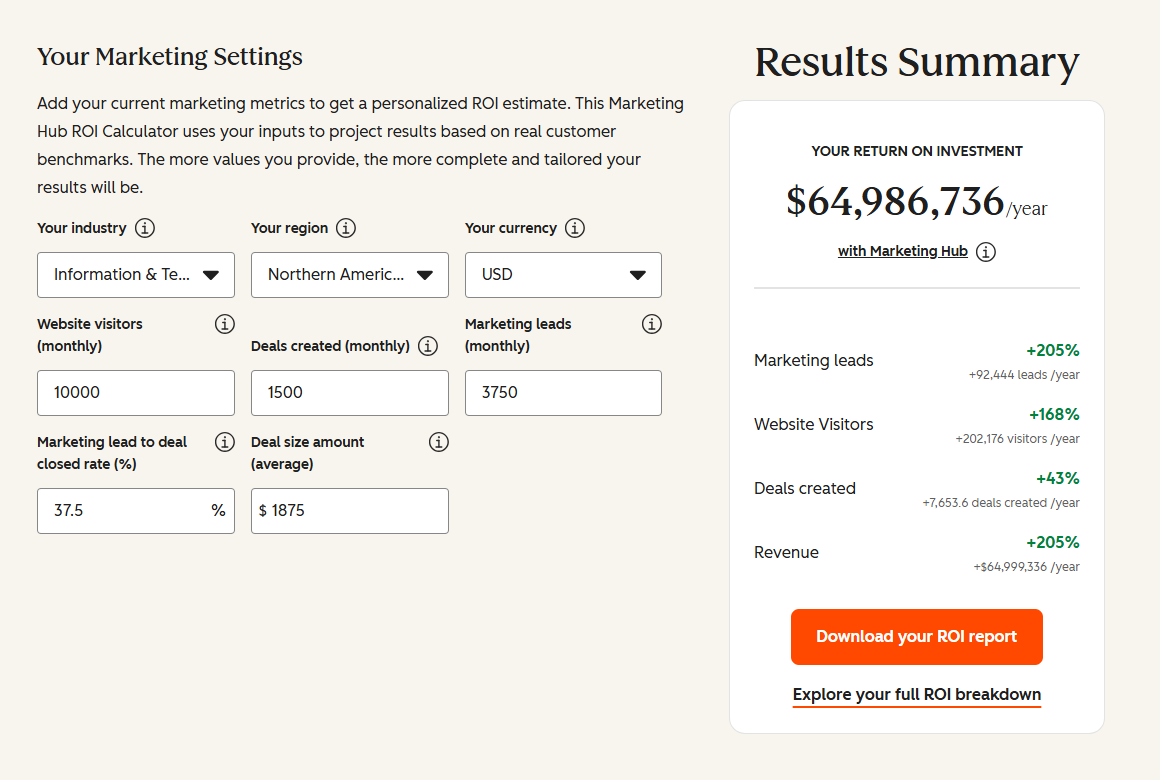
How Integrate IQ Builds Your 1bee AI HubSpot Integration
We don’t start building until we understand exactly how your HubSpot instance is set up and exactly what 1bee.ai needs to write back. That scoping work is what separates an integration that holds up at scale from one that breaks the moment prospect volume spikes.
Here’s what the process looks like:
- Scoping call We map your HubSpot pipeline structure, contact properties, deal stages, and lifecycle stage rules against 1bee.ai’s data output. We define the sync direction, field mapping spec, and deduplication logic before a single line of code gets written.
- Field mapping spec Every 1bee.ai data point gets a defined destination in HubSpot. Custom fields, standard properties, and activity types all get documented explicitly.
- Our engineers build the integration against HubSpot’s API and 1bee.ai’s data model, with error handling, retry logic, and conflict resolution built in from the start.
- Sandbox testing We test in your HubSpot sandbox environment before touching production data. This is where sync conflict scenarios, dedup edge cases, and workflow triggers get validated.
- Go-live and hypercare We push to production with monitoring active. For the first two weeks, our team stays on the integration to catch any edge cases that only surface under real-world load.
- Post-go-live support Ongoing support is included. We don’t hand you documentation and disappear.
Typical delivery runs approximately 8 weeks from kickoff to go-live for a full custom integration. That timeline reflects real work scoping, build, testing, and hypercare not a sales promise. Teams who’ve tried to rush this with a native connector and paid for data cleanup later know exactly what we mean.
Our integration process page walks through what each phase looks like in detail. And if you’re weighing the ROI, our ROI calculator gives you a concrete framework.
Teams running 1bee.ai alongside other sales engagement tools like Outreach or Salesloft often find that a unified integration approach rather than independent connectors keeps HubSpot data consistent across every touchpoint. Our field mapping blog post covers the practical side of that in detail.