













HubSpot FieldAware Integration: Connecting Your CRM to Field Operations
Field service companies running FieldAware for job management and HubSpot for sales and marketing hit the same wall: sales closes a deal in HubSpot, and operations manually re-creates the customer and work order in FieldAware.
When a job completes, the service record stays inside FieldAware invisible to the account manager planning a renewal campaign or tracking asset history in the CRM.
There’s no native connector between HubSpot and FieldAware in HubSpot’s App Marketplace. FieldAware’s existing integrations focus on ERP systems like NetSuite and accounting tools like QuickBooks.
The CRM-to-FSM connection is the gap and it’s a solvable one. FieldAware is built on an open REST API with JSON payloads, the same architecture it uses for all its back-office integrations. That API is the foundation for a custom HubSpot connection.
We’re Integrate IQ, a HubSpot Diamond Solutions Partner with custom integration accreditation. We’ve built custom CRM-to-field-service-management connections for companies running 50 to 500+ technicians, including HubSpot ServiceTitan integration and HubSpot BrioStack integration for similar field service stacks. Here’s how the HubSpot FieldAware build works.
Why HubSpot and FieldAware Belong Together
| Platform | What It Handles | What It Misses |
| HubSpot | Lead capture, deal pipeline, contact management, marketing automation, email campaigns, reporting | Work order creation, job scheduling, technician dispatch, field mobile access, asset tracking, service compliance |
| FieldAware | Job scheduling, technician dispatch, work orders, mobile offline access, asset management, invoicing, service history | Inbound marketing, CRM pipeline, lead nurturing, contact segmentation, marketing attribution |
When both platforms are running but aren’t connected, you get double data entry, delayed work order creation, and account managers who can’t see service history when they’re trying to renew a contract. The two data flows that fix this:
- HubSpot to FieldAware: Deal/contact data from HubSpot creates FieldAware customers and work orders automatically when deals close or reach a specific pipeline stage.
- FieldAware to HubSpot: Job completion events, service records, asset updates, and invoice status from FieldAware push back to HubSpot contact and company records for CRM visibility and marketing automation triggers.
Does a Native HubSpot FieldAware Integration Exist?
No. FieldAware doesn’t appear in HubSpot’s App Marketplace, and there’s no pre-built connector in Zapier or Make with meaningful field service data depth between the two platforms.
What does exist is FieldAware’s open API architecture. The platform is built on RESTful APIs with JSON payloads, explicitly designed for integration with ERP, CRM, and financial systems.
FieldAware’s own documentation describes the API as supporting connections to ‘most ERP, CRM and financial solutions’. The API exposes the data objects you need: customers, jobs, work orders, scheduling, assets, and invoices. Authentication uses standard API key or OAuth patterns. You can review FieldAware’s integration architecture at fieldaware.com/tour/extensions/integrations.
A custom integration built on FieldAware’s API and HubSpot’s API gives you complete control: trigger events, field mapping, sync frequency, error handling, and bidirectional data flow none of which a pre-built connector could deliver for the specifics of your field service operation.

Turn HubSpot Into A Real-Time SMS Engine with Message IQ
 Two-Way Conversations
 Shared Team Inbox
 Automation Triggers
 Advanced Reporting
 Compliance Tools
- 98% SMS read within 3 min
- 78% Buy from first responder
- 21× More likely to qualify

*MessageIQ is an IntegrateIQ product – built natively for HubSpot by the same team.
What a Custom HubSpot FieldAware Integration Connects
Direction 1: HubSpot to FieldAware
| HubSpot Trigger | FieldAware Action |
| Deal moves to ‘Closed Won’ | FieldAware customer record created from HubSpot contact/company data |
| Deal moves to ‘Closed Won’ or specific pipeline stage | FieldAware work order created with service type, address, and priority from deal properties |
| HubSpot contact address or phone updated | FieldAware customer record updated in real time |
| HubSpot quote accepted | FieldAware job draft created with scope from quote line items |
Direction 2: FieldAware to HubSpot
| FieldAware Event | HubSpot Action |
| Job completed / work order closed | HubSpot contact property updated with last service date, job type, technician name |
| Asset installed or serviced | HubSpot company record updated with asset details and service history |
| Invoice generated / paid | HubSpot deal or contact timeline updated with billing status |
| Service contract renewal due | HubSpot workflow triggers renewal outreach sequence |
| Service contract lapsed | HubSpot contact enrolled in win-back campaign |
Use Cases for Field Service Companies
Lead-to-Work-Order Without the Manual Handoff
A telecom field service company generates commercial leads through HubSpot’s marketing automation. When the sales team closes the deal, the integration creates a FieldAware customer record and a work order automatically populated with the contact address, service type from the deal properties, and priority level.
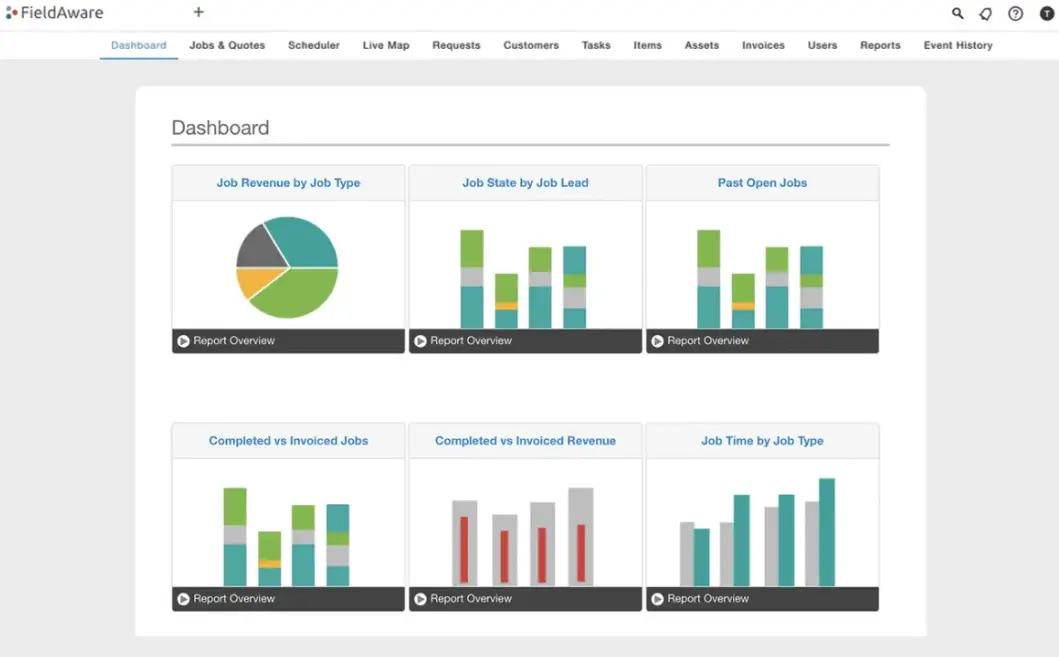
The dispatch team sees it in FieldAware’s scheduling dashboard within minutes of the deal close. No email thread. No spreadsheet. No missed installs.
Asset Tracking Visible in HubSpot
HVAC companies servicing commercial buildings manage equipment records unit models, installation dates, warranty status, last service date inside FieldAware. The integration pushes asset updates to the HubSpot company record after each service visit.
Account managers handling contract renewals can see the full equipment history without logging into FieldAware, and can trigger targeted renewal campaigns based on equipment age or warranty expiry date stored as HubSpot contact properties.
Service Contract Renewal Triggered by Real Job Data
When FieldAware marks a service contract as due for renewal, the integration fires a HubSpot workflow. The contact gets enrolled in a timed renewal outreach sequence structured around the actual service history and remaining contract value that FieldAware holds.
For companies managing hundreds of annual service agreements, this replaces the manual renewal tracking that otherwise lives in spreadsheets. See more on building renewal campaigns in our HubSpot integrations for field service overview.
Multi-Branch Job Routing
Field service companies with multiple service regions or branches use HubSpot to capture leads across all territories. The custom integration reads the lead’s service address, matches it to the correct FieldAware branch or service zone, and creates the work order under the right operational unit. No central dispatcher re-routing. No misassigned jobs across regions.
Custom API vs. Zapier: Which Integration Path Is Right?
| Factor | Zapier / Make | Custom API Integration |
| Setup time | Hours to days | 6-8 weeks |
| Best for | Simple one-directional triggers (deal close creates FieldAware job) | Bidirectional sync, complex field mapping, high volume, error handling |
| Field flexibility | Limited to pre-exposed fields in Zapier connectors (FieldAware coverage is thin) | Any field in FieldAware’s API and HubSpot’s API |
| Error handling | Basic Zap failure alerts; no retry logic | Custom retry logic, alerting, and conflict resolution |
| Volume | Rate-limited on lower plans | Scales to enterprise volume |
| Asset / inventory data | Not supported in standard Zapier FieldAware connector | Fully supported via FieldAware API |
If your only requirement is creating a FieldAware job when a HubSpot deal closes, Zapier can work for that. Once you need bidirectional sync, asset data, service history back to HubSpot, or any conditional logic based on deal properties Zapier hits its ceiling fast and a custom build is the cleaner path.
See your 12-month revenue impact with HubSpot CRM
Enter your current numbers — visitors, leads, deal size — and get a personalized projection based on real HubSpot customer benchmarks.
Calculate My ROI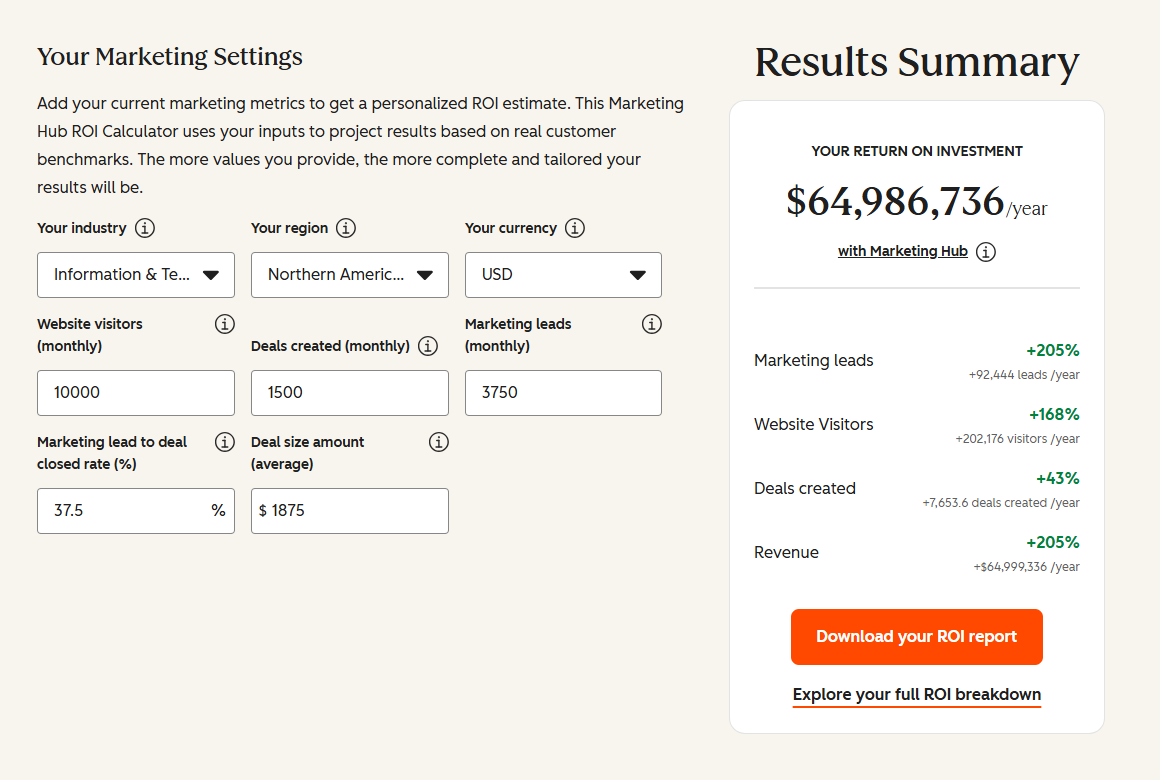
What to Expect from the IntegrateIQ Build
FieldAware’s open API architecture and HubSpot’s well-documented API make the technical scope predictable. Here’s how the typical build runs:
- Weeks 1-2: Discovery and Field Mapping. Map every FieldAware data object that needs to move to HubSpot and vice versa. Define trigger events, field mapping logic (FieldAware job fields vs. HubSpot deal/contact properties), and error handling approach. Confirm FieldAware API access.
- Weeks 3-4: Build and Sandbox Testing. Build against both APIs in a sandboxed environment. Test every trigger-action pair with real data shapes. Validate field mapping for asset records, work order fields, and job status values.
- Weeks 5-6: UAT. Your operations team validates that work orders are creating correctly in FieldAware. Your sales and marketing teams validate that service events are appearing on HubSpot records and triggering the right workflows.
- Weeks 7-8: Go-Live and Monitoring. Production deployment with active monitoring. Error logging and retry logic are part of the build. The first two weeks post-launch include proactive monitoring to catch edge cases before they become operational issues.
We’ve processed over 20 billion records annually across 300+ platform integrations, including field service management builds for companies operating at similar scale. See how our integration process works.
For teams also evaluating HubSpot NetSuite integration to complete the CRM-ERP-FSM stack, we scope those alongside the FieldAware build when both are in scope.