










































What is a HubSpot FieldServio integration?
A HubSpot FieldServio integration connects your CRM to your field service management platform, syncing jobs, equipment, materials, and billing data so sales and service teams share one accurate view of every customer engagement from quote to invoice.
How does the HubSpot FieldServio integration work?
The integration maps HubSpot deals, line items, and contacts to FieldServio jobs, materials and labor codes, and customer accounts. A Closed-Won deal can automatically create a job in FieldServio with the scope of work and site details already filled in, while job status and final invoice amounts sync back to HubSpot.

Turn HubSpot Into A Real-Time SMS Engine with Message IQ
 Two-Way Conversations
 Shared Team Inbox
 Automation Triggers
 Advanced Reporting
 Compliance Tools
- 98% SMS read within 3 min
- 78% Buy from first responder
- 21× More likely to qualify

*MessageIQ is an IntegrateIQ product – built natively for HubSpot by the same team.
Does FieldServio have a native HubSpot integration?
There’s no confirmed native HubSpot integration listed for FieldServio in either marketplace, and unlike many platforms, there’s essentially no third-party market discussion of this integration at all. Businesses connecting the two today build a custom integration against FieldServio’s API.
How long does a HubSpot FieldServio integration take to build?
A custom HubSpot FieldServio integration typically takes 8 weeks: 2 weeks of discovery and job-costing field mapping, 3 weeks of build and staging, and the remaining weeks for testing and go-live support.
Can HubSpot and FieldServio sync bi-directionally?
Yes. A custom integration can sync new jobs, equipment data, and invoice amounts from FieldServio into HubSpot, and push closed deals, scope of work, and updated contact information from HubSpot back into FieldServio. Direction and timing are configurable per object.
Can the integration handle change orders that increase a job’s value after the deal has closed?
Yes, when built for it. We flag jobs where the final FieldServio value exceeds the original HubSpot deal amount due to a change order, so the deal record reflects the true final contract value instead of the original quote, keeping revenue reporting accurate.
Three Ways to Connect FieldServio and HubSpot
Not every team needs custom, but FieldServio doesn’t offer the packaged options most other platforms do. Here is the honest comparison, currently absent from the page.
| Factor | No Packaged Connector | Generic iPaaS | Custom Integration (Integrate IQ) |
|---|---|---|---|
| Best for | Manual exports for a small book of business | Simple one-way trigger automation | Field service contractors needing job-costing accuracy and change-order tracking |
| Job-costing accuracy | Manual, error-prone | Not designed for materials/labor code nuance | Line items mapped to your actual materials and labor codes, preserving estimated margins |
| Sync direction | None, manual | One-way per trigger | True bi-directional, configurable per object |
| Custom objects/fields | None | Limited, mapped per trigger | Full mapping of equipment/assets, job types, and custom fields |
| Business logic | None | Basic conditional logic | Custom rules, e.g. change-order value reconciliation, warranty claim routing |
| Volume handling | Manual, doesn’t scale | Struggles at seasonal peak volume | Built for peak seasonal service load without timeouts |
| Maintenance | None needed, but no value either | You manage it | Monitored, maintained, and supported |
If you’re doing occasional manual exports for a small book of business, that may hold for now. Once job-costing accuracy, change orders, or equipment history matter to how you run the business, a custom integration is what keeps that complexity from becoming a liability.
Additional Service Workflows You Can Automate Once FieldServio Data Lives in HubSpot
This page already covers seamless deal-to-job handoffs, inventory awareness, real-time status tracking, proactive renewals, revenue attribution, and service-based segmentation. The five below are deliberately new.
- Change Order Value Reconciliation. When a job’s scope expands mid-project and the FieldServio job value increases beyond the original HubSpot deal amount, the integration flags the discrepancy so the deal record reflects the true final contract value, not just what was originally quoted.
- Technician Callback Rate by Original Estimator. By tracking which technician completed a job against which sales rep originally estimated and closed the deal, HubSpot can surface callback and rework rates tied back to specific estimators, revealing whether certain reps consistently under-scope jobs.
- Warranty Claim Routing to Original Deal. When a warranty service call comes in for previously installed equipment, HubSpot links that warranty job back to the original sales deal and rep, giving account history context instead of treating the warranty call as a brand-new, disconnected record.
- Multi-Site Customer Rollup for National Accounts. For customers with multiple service locations tracked separately in FieldServio, HubSpot rolls up total spend and service history at the parent company level, so account managers see the full national relationship instead of fragmented, per-site views.
- Preventive Maintenance Contract Upsell Timing. Using equipment age and service frequency data from FieldServio, HubSpot can time preventive maintenance contract upsell outreach to align with when equipment is statistically most likely to need it, rather than a generic post-install follow-up.
What Breaks in a FieldServio HubSpot Sync, and How We Prevent It
This section is currently absent from the page entirely.
- Duplicate records and identity resolution. A customer with multiple service locations or historical accounts under slightly different names in FieldServio can create duplicate HubSpot companies. We match on a stable account identifier, not name or address string matching alone.
- System-of-record conflicts. Dispatch may update a job’s scope or materials directly in FieldServio while the original HubSpot deal still reflects the initial quote. We define FieldServio as the source of truth for job execution and billing fields once work begins, HubSpot for the sales relationship, with locked writes.
- Field mapping and job-costing drift. FieldServio’s materials and labor codes are configured per company and don’t map to a generic HubSpot line-item structure by default. We build the mapping deliberately against your actual chart of codes, preserving estimated margins rather than assuming a standard cost structure.
- No packaged connector or third-party market discussion exists. FieldServio is specialized enough that there’s no confirmed native HubSpot marketplace app and, unlike many platforms, essentially no third-party guides or competitor content addressing this integration at all. Businesses connecting the two today are doing so through custom API work exclusively, with no existing playbook to fall back on.
- API rate limits at seasonal service volume. HVAC and mechanical service contractors see seasonal spikes, summer AC failures, winter heating emergencies, that can multiply job volume overnight. Across 300+ platform integrations moving 20 billion plus fields annually, we build for peak seasonal load, not average daily volume.
See your 12-month revenue impact with HubSpot CRM
Enter your current numbers — visitors, leads, deal size — and get a personalized projection based on real HubSpot customer benchmarks.
Calculate My ROI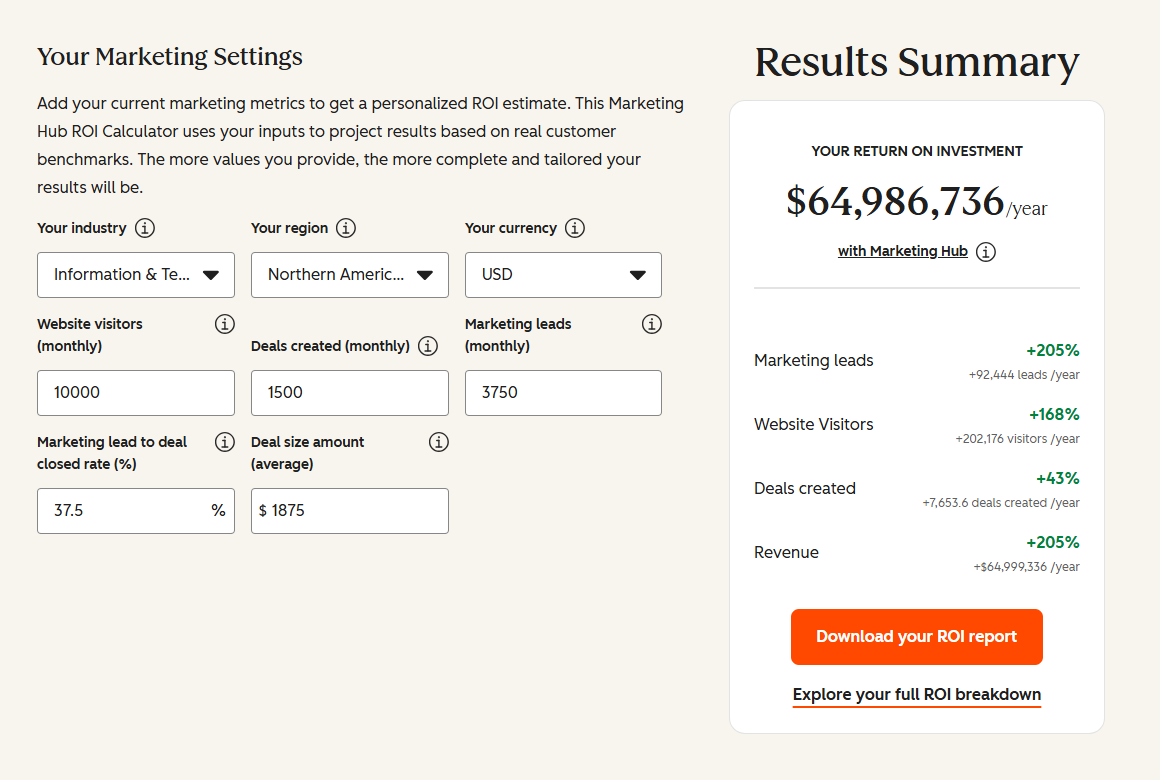
Connect the Rest of Your Service Stack
See our dedicated manufacturing industry work for the broader industrial and mechanical services picture. Custom job-costing logic or change-order reconciliation beyond the standard build often needs full-stack development support. Getting sales and dispatch teams onto the new workflow goes faster with HubSpot training. Migrating off a legacy CRM at the same time? Our CRM migration services cover that too. Not sure what any of this is worth to your team? Run the numbers on our Integration ROI Calculator.


Table of Contents
- What is a HubSpot FieldServio integration?
- How does the HubSpot FieldServio integration work?
- Does FieldServio have a native HubSpot integration?
- How long does a HubSpot FieldServio integration take to build?
- Can HubSpot and FieldServio sync bi-directionally?
- Can the integration handle change orders that increase a job’s value after the deal has closed?
- Three Ways to Connect FieldServio and HubSpot
- Additional Service Workflows You Can Automate Once FieldServio Data Lives in HubSpot
- What Breaks in a FieldServio HubSpot Sync, and How We Prevent It
- Connect the Rest of Your Service Stack