

Explore this article with AI:

Teams that automate HubSpot workflows well typically save 5-20 hours per person per week. A 10-person revenue team automating lead routing, follow-ups, and data entry together usually reclaims 480-960 hours a month. The exact number depends on your fully loaded hourly rate and whether the workflows are still working properly six months in.
Key takeaways
- Most teams save 5-20 hours per person per week; the top end comes from combining lead routing, follow-ups, and data entry automation, not any single workflow.
- First-year ROI on workflow automation typically runs 200-400%, with breakeven in 2-4 months.
- Workflows decay without a quarterly review, and savings can quietly drop by half within six months.
- Time saved inside HubSpot can leak back out at the integration layer if data doesn’t sync cleanly to other systems.
Most teams that automate HubSpot workflows well reclaim somewhere between 5 and 20 hours per person, per week, depending on team size and how many manual handoffs the automation actually removes. That’s a wide range on purpose. The number depends less on which workflows you build and more on whether they keep working six months later.
Calculate your team’s hours saved
Enter your team size and loaded rate — get your number in under 2 minutes.
What is HubSpot workflow automation? It’s the use of HubSpot’s workflow tool to trigger actions (assigning owners, sending emails, updating properties, creating tasks) automatically based on contact, deal, or ticket behavior, instead of a person doing each step by hand.
We’ve built HubSpot automations for 300+ platform combinations at IntegrateIQ, and the pattern holds across industries: the teams that get the full 20 hours are the ones who treat automation as an operating system, not a one-time project.
Free estimator
Know what your HubSpot project costs before the first call.
Select your services and get a transparent price range in minutes. No sales call needed to get a number.
Connect HubSpot to your ERP, billing platform, or database field mapping, custom logic, and support included.
Pipelines, workflows, email templates, and reporting configured for how your team actually works.
Live, role-based sessions with recordings and written guides built around a custom plan for your team.
HubSpot Partner
Client retention
Platforms integrated
What actually gets automated and how much time each piece saves

The time savings aren’t evenly spread. A handful of workflows account for most of the hours reclaimed. Here’s how the manual version compares to the automated one for the tasks that show up most often.
| Task | Manual time | Automated time |
|---|---|---|
| Lead routing to the right owner | 5-10 minutes per lead | Instant, 0 minutes |
| Follow-up email sequences (per rep) | 2-3 hours/week | 15 minutes to set up once |
| CRM data entry after calls or meetings | 1.5-2 hours/day | Near-zero with call logging + property updates |
| Deal stage and lifecycle updates | 30-60 minutes/day | Automatic on trigger |
| Internal notifications (deal stalled, ticket unassigned) | Ad hoc, often missed | Instant |
A 10-person revenue team automating these five workflows well typically reclaims 12-24 hours per person per week, which adds up to 480-960 hours a month across the team. That range comes directly from documented B2B automation case studies, and it lines up with what we see in client engagements.
The enrollment trigger and unenrollment criteria matter more than people expect here. A workflow with a sloppy trigger enrolls the wrong contacts, and someone ends up manually cleaning up the mess it created. That’s automation debt, and it eats into the hours you thought you’d saved.
The ROI math: how to calculate your own number

Skip the vague “workflows save time” claims and run the actual formula:
Monthly Labor Savings = (Hours saved per month) × (Fully loaded hourly rate)
Your fully loaded hourly rate isn’t your team’s salary divided by hours worked. It includes benefits, taxes, and overhead, typically 1.3x to 1.5x the base rate. A $70,000/year employee with a $33.65/hour base rate actually costs $44-50/hour once you load it in.
Run the math on a mid-size team:
- 5 reps, each saving 10 hours/week on manual follow-up and data entry
- 50 hours/week total, roughly 217 hours/month
- At a $45/hour loaded rate: $9,765/month in reclaimed labor cost
Documented first-year ROI for workflow automation lands between 200% and 400%, with breakeven typically hitting 2-4 months after deployment. Labor savings drive most of that (60-80% of total benefit), and error reduction accounts for another 15-25%.
That second number matters as much as the first. A workflow that saves time but introduces bad data creates a different kind of cost, one that shows up later as a rep chasing down a lead that got routed to the wrong owner or a deal stage that never updated.

Turn HubSpot Into A Real-Time SMS Engine with
Message IQ

Two-Way Conversations

Shared Team Inbox

Automation Triggers

Advanced Reporting

Compliance Tools
-
98%
SMS read within 3 min -
78%
Buy from first responder -
21×
More likely to qualify
3–5 min avg response
$45–$50 ROI / $1

*MessageIQ is an IntegrateIQ product – built natively for HubSpot by the same team.
Why most teams don’t hit these numbers
Here’s what the ROI calculators don’t tell you: workflows decay. A setup that saved 15 hours a week in month one often saves half that by month six, and nobody notices because nobody’s watching.
Three failure patterns show up constantly:
Workflows automate whole processes instead of transitions. Trying to automate an entire sales process end to end is fragile. The workflow breaks the moment one step changes, and now someone’s debugging automation instead of doing the job it was supposed to replace. The workflows that hold up automate the handoff points where work usually stalls, not everything in between.
Nobody owns quarterly review. Workflows aren’t a set-it-and-forget-it purchase. Teams that skip a quarterly check (are workflows still firing correctly, are alerts still useful, are there dead steps left over from an old process) watch their time savings erode without ever measuring the drop.
The automation stops at HubSpot’s edge. This is the gap almost nobody talks about. A workflow can fire perfectly inside HubSpot and still leave someone reconciling data by hand the moment it needs to reach a second system, whether that’s an ERP, a billing platform, or a support tool. The hours saved on the HubSpot side get spent again on the sync side.
Native connector vs. custom integration: where automated time leaks back out
This is where a lot of “automated” workflows quietly stop being automated. A native connector or off-the-shelf integration handles the common fields fine, but the moment your data model has a custom object, a non-standard field mapping, or a bidirectional sync requirement, someone starts checking the two systems by hand to make sure they agree.
We build bi-directional, real-time field mapping with error handling built in specifically because this is where time savings get lost. A workflow that updates a deal stage in HubSpot but silently fails to push that update to the platform your finance team uses isn’t saving anyone time. It’s just moving the manual work downstream and making it harder to spot.
A quick way to tell which situation you’re in:
| Signal | Native connector is fine | Custom integration is worth it |
|---|---|---|
| Data objects involved | Standard (contacts, deals, tickets) | Custom objects, non-standard field mapping |
| Sync direction | One-way | Bi-directional, real-time |
| Error handling needs | Minimal, low volume | High volume, needs retry/error logic |
| Team already reconciling data manually | No | Yes, regularly |
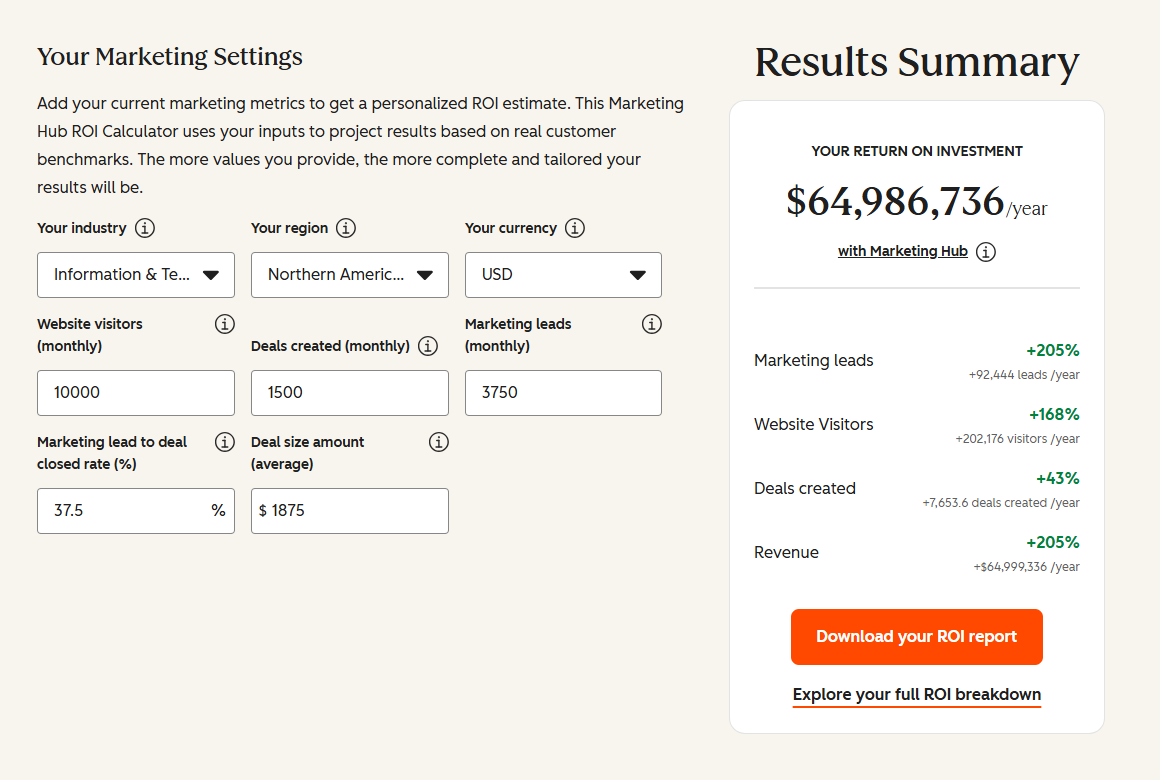
See your 12-month revenue impact with HubSpot CRM
Enter your current numbers — visitors, leads, deal size — and get a personalized projection based on real HubSpot customer benchmarks.
A simple audit to size your own time savings
Before building anything, spend an hour running this:
- List every manual task tied to a HubSpot record. Lead routing, follow-up emails, data entry after calls, deal stage updates. Be specific about who does each one.
- Time-track for one week. Have each person log actual minutes spent on these tasks, not estimates. Estimates run low almost every time.
- Multiply by your fully loaded hourly rate. This gives you the real dollar cost of the manual version before you automate anything.
- Rank tasks by frequency, not complexity. The highest-frequency, lowest-complexity tasks (lead routing, simple follow-ups) usually deliver the fastest payback.
- Set a quarterly review date now, before you build anything. Put it on the calendar. This is the step almost everyone skips, and it’s the one that determines whether your hours saved in month one still exist in month six.
FAQ
How many hours does HubSpot automation typically save per week?
Most teams that automate well save 5-20 hours per person per week, with the top end reserved for teams automating lead routing, follow-up sequences, and data entry together rather than one at a time.
What’s a realistic payback period for HubSpot workflow automation?
Documented benchmarks put breakeven at 2-4 months for most automation investments, driven mainly by direct labor savings rather than error reduction alone.
Do I need HubSpot Operations Hub to get these time savings?
No. Workflow automation is available on HubSpot Professional and Enterprise plans without Operations Hub, though Operations Hub adds data quality automation that helps the savings hold up over time.
How often should HubSpot workflows be audited?
Quarterly, at minimum. Workflows built for a process that has since changed keep running anyway, quietly wasting the enrollment slots and alert volume they were given, until someone checks.
Does automation reduce errors as much as it saves time?
Error reduction typically accounts for 15-25% of total ROI, smaller than labor savings but still meaningful, especially for data entry tasks where a manual mistake (wrong deal amount, missed field) creates rework later.
Why do automated workflows sometimes create more manual work, not less?
This happens when a workflow updates HubSpot correctly but doesn’t sync that change to a second system reliably. Someone ends up manually checking both systems to catch what the automation missed, which cancels out much of the time saved.
How many workflows can I run on HubSpot before hitting a limit?
HubSpot Professional caps out at 300 active workflows and Enterprise at 1,000. Most teams hit their real time-saving ceiling long before that limit, since a handful of well-built workflows account for most of the hours reclaimed.
Does Operations Hub increase the time HubSpot workflows save?
It can. Operations Hub Professional (around $800/month) adds custom-coded actions and data quality automation, which matters once native workflow actions aren’t enough to keep data clean as volume scales. For most teams starting out, standard workflow automation on Professional or Enterprise delivers the bulk of the time savings first.
What’s the difference between contact-based and deal-based workflows for time savings?
Contact-based workflows save the most time on marketing tasks like lead routing and follow-up sequences. Deal-based workflows save the most time on sales tasks like stage updates and stalled-deal alerts. Most of the hours in the ranges above come from running both together, not either alone.
What are the best HubSpot workflow examples for saving time?
The highest-impact examples are lead routing on record creation, automated follow-up sequences after a meeting or form fill, deal stage updates tied to CRM triggers, and internal alerts for stalled deals or unassigned tickets. These five account for most of the hours reclaimed in typical case data.
Is HubSpot workflow automation free?
No. Workflow automation requires HubSpot Marketing, Sales, Service, or Operations Hub Professional or Enterprise. The Free and Starter tiers don’t include the workflow builder, so the time savings discussed here apply once a team is on a paid tier.
How does HubSpot workflow automation compare to Zapier for time savings?
HubSpot workflows save the most time on native CRM tasks like lead routing and lifecycle updates, since they run inside the same data model with no sync delay. Zapier adds time savings when a process needs to reach one of the 7,000+ apps HubSpot doesn’t natively support. Most teams use both rather than choosing one over the other.
What triggers a HubSpot workflow?
Common enrollment triggers include a property value changing (like lifecycle stage), a form submission, a deal stage change, a specific date, or a combination of these with AND/OR logic. Getting the trigger right is what determines whether a workflow saves time or creates cleanup work.
How do I measure the actual ROI of a HubSpot workflow after building it?
Track enrollment volume, completed actions, and time saved per record type for a full quarter, then multiply the hours saved by your fully loaded hourly rate using the formula above. Comparing that number against your setup and maintenance time gives you the real payback period, not an estimate.
Sources and methodology
Hours-saved and ROI figures in this article are drawn from published B2B workflow automation case studies and workflow ROI benchmark research, rounded for practical use. Your actual numbers will depend on team size, current process quality, and how disciplined your team is about the quarterly review step above.
What to do with this
The math on hours saved is straightforward once you run it against your own team’s data instead of an industry average. The harder part is making sure the savings survive past the first quarter, and that usually comes down to whether your workflows are built on solid, bi-directional field mapping and data transformation rather than a connector that quietly falls out of sync.
If you’re seeing workflows that fail silently or noticing your team is still reconciling data by hand after “automating” a process, that’s usually a sign the integration underneath the workflow needs attention, not the workflow itself.
As a HubSpot Diamond Solutions Partner, we’ve processed this exact problem across 20 billion+ records a year for clients who needed their automation to actually hold up past month one. Our HubSpot integration work is built around 8-week delivery timelines with a 98.5% client retention rate, because a workflow that breaks in month four isn’t the win anyone was promised.
Run the audit above first. If it turns up gaps that a native connector can’t close, see our integration process or use our ROI calculator to size the number for your own team before you commit budget.