










Explore this article with AI:
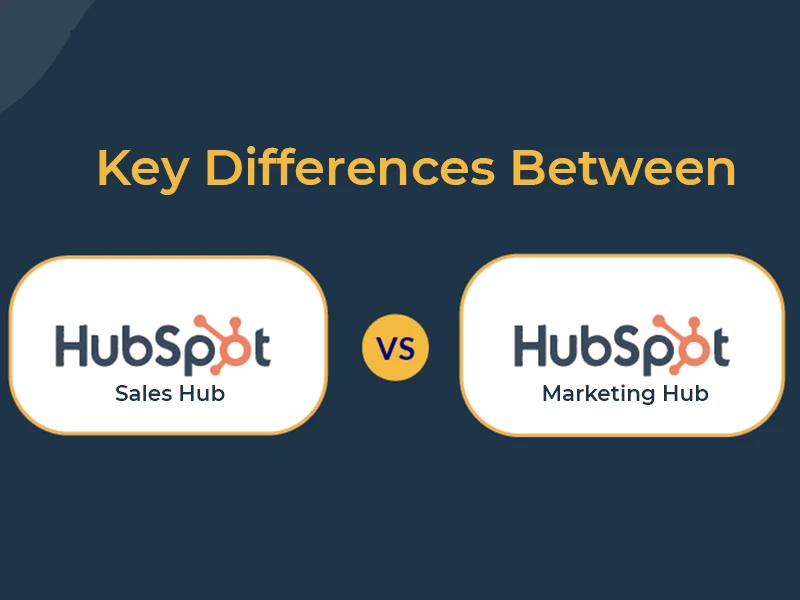
If you’re trying to figure out which HubSpot hub to buy, you’ve probably already read five articles that say something like ‘Marketing Hub is for marketers and Sales Hub is for sales reps.’ True. Not helpful. The real questions are: what specific features live in each hub, how does pricing actually work, and what do you lose if you only buy one? This is the hubspot hub comparison those other five articles skip.
We’ve helped 300+ companies configure and integrate HubSpot across their full RevOps stack. Here’s what nobody tells you about the difference between these two hubs.
Free estimator
Know what your HubSpot project costs before the first call.
Select your services and get a transparent price range in minutes. No sales call needed to get a number.
Fixed, Outcome-Based quote after a free discovery call. Build estimate
What is HubSpot Marketing Hub?
Marketing Hub is HubSpot’s inbound marketing platform. What is HubSpot Marketing Hub used for? It gives marketing teams the tools to run campaigns, automate lead nurturing, publish content, manage social media, and measure campaign ROI. It sits on top of HubSpot’s shared CRM and feeds qualified contacts to the sales team.
What is HubSpot Sales Hub?
Sales Hub is HubSpot’s sales engagement and pipeline management platform. It gives sales reps the tools to manage deals, run personalized outreach, track communications, forecast revenue, and close business faster with AI-driven insights.
Both hubs run on HubSpot’s shared CRM. Both have automation. Both do email. But that’s where the similarities stop. The key differences between HubSpot Sales Hub and HubSpot Marketing Hub come down to who each hub is built for, how the automation actually works, how pricing scales, and what breaks when you run them in isolation.

Turn HubSpot Into A Real-Time SMS Engine with Message IQ
 Two-Way Conversations
 Shared Team Inbox
 Automation Triggers
 Advanced Reporting
 Compliance Tools
- 98% SMS read within 3 min
- 78% Buy from first responder
- 21× More likely to qualify

*MessageIQ is an IntegrateIQ product – built natively for HubSpot by the same team.
What HubSpot Marketing Hub Actually Does
Marketing Hub gives marketing teams everything they need to generate and nurture leads before a sales rep ever picks up the phone. These are the core HubSpot Marketing Hub features, grouped by what they’re actually for:
- Campaign email (Workflows): Send automated emails to large contact lists from your company domain. Trigger them on contact properties, form submissions, page views, or list membership.
- Content and landing pages: Build blogs, landing pages, and CTAs natively inside HubSpot without a separate CMS.
- Social media management: Schedule, publish, and monitor social posts across LinkedIn, Facebook, Instagram, and X from a single dashboard.
- Ads management: Connect Google Ads, Facebook Ads, and LinkedIn Ads, then attribute revenue back to specific campaigns.
- Lead scoring: Score contacts based on behavioral and demographic data. Automatically push contacts to a sales rep when they hit a threshold.
- Revenue attribution (Enterprise): Multi-touch attribution across all marketing channels. Understand which campaigns and touchpoints actually drove pipeline.
- Breeze AI for marketing: Includes content AI for generating copy, SEO recommendations, social media caption suggestions, and campaign performance intelligence.
HubSpot data shows that companies using Marketing Hub alone see a 51% increase in deals closed over 12 months. That number jumps to 144% when both Marketing Hub and Sales Hub are active. The hub doesn’t close deals on its own. Its job is making sure the right leads reach sales with enough context to convert.

What HubSpot Sales Hub Actually Does
Sales Hub handles everything from the moment a lead hits a rep’s queue to the moment a deal is marked closed-won. It’s built for the people working the pipeline, not the team filling it.
- Pipeline management: Build and manage multi-stage deal pipelines. Assign tasks, move deals, track deal age, and get alerts when deals go stale.
- Sequences: Send automated, personalized outreach from a rep’s personal email inbox (Gmail or Outlook). The sequence pauses automatically when a contact replies or books a meeting.
- Meeting scheduling: Share a booking link so prospects can schedule directly into a rep’s calendar with no back-and-forth.
- Call recording and coaching (Pro+): Record calls, transcribe them, and surface coaching moments for sales managers reviewing rep performance.
- Forecasting (Pro+): Predict close revenue by rep, team, or pipeline. Sales managers get a rolling view of what’s expected to close and what’s stalled.
- Playbooks (Pro+): Interactive call scripts and reference guides that reps can pull up live during a call. Keeps messaging consistent across a team.
- Breeze AI for sales: Includes a prospecting agent that surfaces high-fit leads, deal intelligence that flags at-risk opportunities, and call summarization that logs key takeaways automatically after every meeting.
We process over 20 billion records annually across 300+ platform integrations. Sales Hub’s data fidelity issues typically show up when a deal object needs to sync with an external system, like pushing closed-won deals to a finance tool or syncing pipeline data to a BI dashboard. That’s where native integrations often fall short and a custom-built connector becomes the right call.
Key Differences Between HubSpot Sales Hub and Marketing Hub
Here’s the comparison most articles skim over. These are the functional differences that actually affect buying decisions:
|
Dimension |
Marketing Hub |
Sales Hub |
|
Primary User |
Marketing teams, demand gen, content teams |
Sales reps, AEs, RevOps leaders |
|
Core Job |
Attract, capture, and nurture leads |
Manage pipeline and close deals |
|
Email Tool |
Workflows (sends from domain email) |
Sequences (sends from rep’s personal inbox) |
|
Automation Scope |
Campaign-wide, contact-property triggers |
Personal outreach cadences, task queues |
|
Pricing Model |
Marketing contacts (tiered by volume) |
Per paid seat (per rep) |
|
Landing Pages / Blogs |
Yes, native builder included |
No |
|
Pipeline Management |
No |
Yes, multi-pipeline with deal stages |
|
Sales Forecasting |
No |
Yes (Pro and Enterprise only) |
|
Playbooks |
No |
Yes (Pro and Enterprise only) |
|
Social Media Tools |
Yes |
No |
|
AI Features (Breeze) |
Content AI, SEO suggestions, campaign intelligence |
Prospecting agent, deal intelligence, call summarization |
|
Call Recording |
No |
Yes (Pro and Enterprise) |
|
Revenue Attribution |
Yes, multi-touch attribution (Enterprise) |
No |
Workflows vs Sequences: The Email Tool That Confuses Everyone
Both hubs send email. They just don’t do it the same way, and mixing them up is one of the most common HubSpot configuration mistakes we see.
Workflows (Marketing Hub) send email from a domain-connected address, typically something like hello@yourcompany.com or noreply@yourcompany.com. They trigger based on contact properties, form submissions, list membership, or behavioral events. Unenrollment happens when a contact meets a specified criteria, say, their lifecycle stage changes to Customer, or they complete a goal action like booking a demo. Workflows are built for volume. You’d use them to nurture 10,000 contacts through a three-email onboarding series.
Sequences (Sales Hub) send from a rep’s personally connected inbox. When rep@yourcompany.com sends through Sequences, it looks like the rep typed and sent it. Unenrollment is automatic when a contact replies to any email in the sequence or books a meeting through a HubSpot scheduling link. Sequences are built for direct, one-to-one sales outreach. You’d use them to follow up with 50 high-fit prospects from a recent event.
The practical rule: if your marketing team is sending it, it’s a Workflow. If your sales rep is sending it, it’s a Sequence.
The Pricing Model Difference Most Buyers Miss
This is the section missing from every HubSpot pricing comparison article on the internet, and it’s the one that causes the most budget surprises.
Marketing Hub prices by marketing contacts. A marketing contact is any contact you actively market to, meaning contacts you send emails to or include in ad audiences. Starter includes 1,000 marketing contacts. Professional includes 2,000. Enterprise requires a custom quote. You can add more contacts in increments. Non-marketing contacts (everyone else in your CRM) don’t count toward the limit.
Sales Hub prices per paid seat. Each rep who needs access to Sequences, Forecasting, Playbooks, or call recording needs a paid seat. Starter seats cost around $20/month. Professional seats run about $100/month. Enterprise seats are approximately $150/month.
Not every seat is priced the same way, and this is where most budgets go wrong. HubSpot splits access into three seat types across both hubs: Core Seats (roughly $45–$50/month) give edit access to shared CRM records and basic tools but not Sequences, Forecasting, or Playbooks; Sales Seats or Marketing Seats (the $20/$100/$150 figures above) unlock the hub-specific features; and View-Only Seats are free and unlimited for people who just need to see reports and records, not edit them. A common budgeting mistake is putting every rep on a full paid seat when half the team, support staff checking on a deal, a manager glancing at a dashboard, only ever needs a Core Seat or a View-Only Seat. Map each person’s actual job to the cheapest seat type that covers it before you price out a rollout.
Here’s what that looks like in practice:
|
Tier |
Marketing Hub |
Sales Hub |
Customer Platform Bundle |
|
Free |
Basic tools, 2,000 emails/mo |
Basic pipeline, email tracking |
Available (limited) |
|
Starter |
~$20/mo, 1,000 marketing contacts |
~$20/seat/mo |
~$15/user/mo (bundle) |
|
Professional |
~$800/mo, 2,000 marketing contacts + $3,000 onboarding |
~$100/seat/mo + $1,500 onboarding |
~$890/mo (bundle) |
|
Enterprise |
~$3,600/mo + $7,000 onboarding |
~$150/seat/mo + $3,500 onboarding |
Custom quote |
A team with 5 reps and 8,000 marketing contacts would pay roughly $800/month for Marketing Hub Professional plus $500/month for 5 Sales Hub Professional seats, totaling $1,300/month before onboarding fees. Buying both as the Professional Customer Platform bundle often drops that figure meaningfully. If you’re evaluating standalone vs bundle, the bundle math almost always wins at Professional tier.
Marketing Hub Professional also carries a one-time $3,000 onboarding fee. Sales Hub Professional adds $1,500. Budget for those upfront if you’re starting fresh.
What You Lose Running Only One Hub
Most articles tell you ‘use both.’ Almost none of them explain what actually breaks when you don’t.
Running Only Marketing Hub
Your marketing team can generate and nurture leads. But when a contact becomes sales-qualified, the handoff falls apart. There’s no native pipeline for reps to manage deals inside HubSpot. No Sequences, so reps either send manual emails or use a separate outreach tool. No call recording, no forecasting, no sales playbooks. Reps can see contact activity from marketing campaigns in the CRM, but they can’t work deals efficiently without the sales-specific tooling.
The workaround most teams use: a separate CRM or sales tool alongside HubSpot Marketing Hub. That creates a data synchronization problem. Field mapping, contact deduplication, and contact timeline continuity all become integration challenges you have to solve manually or through a custom connector.
Running Only Sales Hub
Sales reps can work their pipeline, send sequences, and close deals. But marketing has nothing to work with inside HubSpot. No blog, no landing page builder, no social scheduling, no campaign-level email workflows, no multi-touch revenue attribution. The marketing team runs campaigns in a separate platform, leads come in through a form integration, and the contact data arriving in HubSpot often lacks the behavioral context that came from the marketing tool it originated in.
We sync 7 million fields daily across integrations at Integrate IQ. The messiest data problems consistently come from teams that ran one hub for a long time, patched another tool alongside it, and then tried to bring everything into a unified HubSpot setup later. Starting with both hubs from day one avoids the data archaeology.
How Leads Actually Move Between the Two Hubs
When both hubs are active and configured correctly, here’s what a clean MQL-to-SQL handoff looks like:
- Contact enters Marketing Hub: A contact fills out a form on a landing page. They get enrolled in a nurture Workflow and start receiving educational emails.
- Lead scoring triggers: As the contact opens emails, revisits product pages, and downloads a case study, their lead score increases automatically based on Marketing Hub’s scoring rules.
- Lifecycle stage updates: When the score hits your SQL threshold, a Workflow automatically updates the contact’s lifecycle stage to Sales Qualified Lead and triggers an internal notification to the assigned rep.
- Rep picks up in Sales Hub: The rep sees the contact in their queue with the full activity timeline from Marketing Hub visible on the contact record. Every email open, page view, and form submission is logged.
- Sequence enrollment: The rep enrolls the contact in a Sales Hub Sequence. The first email sends from the rep’s personal inbox. The contact unsubscribes from Marketing Hub Workflows automatically to avoid overlap.
- Deal created: The rep converts the contact to a deal. Pipeline stages, tasks, and forecasting all activate within Sales Hub.
That flow only works cleanly when both hubs share the same CRM data model. When a third-party system is involved, like a CPQ tool, an ERP, or a data warehouse, the contact and deal data need to sync bi-directionally across that boundary. That’s where custom API integration work becomes necessary. We typically deliver those custom connectors within 8 weeks of project kickoff.
Which HubSpot Hub Do You Actually Need
Use this table to cut through the noise:
|
Your Situation |
What You Need |
Why |
|
Run campaigns, manage content, generate leads |
Marketing Hub |
Workflow automation, landing pages, attribution |
|
Manage a sales pipeline, reps doing direct outreach |
Sales Hub |
Sequences, deal forecasting, call coaching |
|
Both teams use HubSpot as their system of record |
Both hubs (or bundle) |
144% more deals closed; unified contact timeline |
|
Small team, tight budget, testing HubSpot |
Starter Customer Platform |
Access to both hubs at ~$15/user/mo |
|
Connect HubSpot to non-native tools (Salesforce, NetSuite, data warehouse) |
Both hubs + custom integration |
Native integrations often lack field-level control; custom API work fills the gap |
The tiebreaker question: where does your biggest revenue problem live right now? If pipeline is full but marketing can’t generate enough quality leads, start with Marketing Hub. If leads exist but reps can’t manage or close them efficiently, start with Sales Hub. If both are problems and your team uses HubSpot as the central system of record, buy both or go straight to the bundle.
Frequently Asked Questions
Which is better: HubSpot Marketing Hub or Demandbase One?
They’re not really competing for the same buyer, which makes “better” the wrong question. Demandbase One is a dedicated enterprise ABM platform: account identification, intent data, programmatic advertising to named accounts, and sales orchestration, typically priced from the high five figures into six figures a year, and built for large B2B orgs running coordinated account-based programs with dedicated marketing ops staff to run it. Marketing Hub is a broader inbound marketing platform, campaigns, content, email, lead scoring, ads attribution, priced from free up to a few thousand dollars a month, and built to cover a marketing team’s full workflow, not just a target-account motion. If your marketing strategy is built entirely around a short list of named target accounts and a real ABM budget, Demandbase is the more specialized tool. If you need a marketing platform that also runs your CRM, content, and lead nurture in one place, and ABM is one motion among several, Marketing Hub (Enterprise tier has some account-based tooling) is the more practical fit. Some enterprise teams run both, Marketing Hub as the system of record and Demandbase layered on top for the ABM-specific motion, though that adds real integration work to keep account and intent data in sync between the two.
Can I use HubSpot without buying Marketing Hub or Sales Hub?
Yes. HubSpot’s free tools include basic CRM, 2,000 emails per month, forms, a live chat widget, and a simple deal pipeline. The free tier works for teams just getting started. You’ll hit the ceiling when you need automation depth, reporting beyond surface-level metrics, or sales tooling like Sequences and Forecasting.
What’s the actual difference between Workflows and Sequences?
Workflows send from a company domain email and trigger automatically based on contact behavior or properties. Sequences send from a rep’s personal connected inbox and pause automatically when a contact replies or books a meeting. Workflows are for marketing campaigns at scale. Sequences are for direct sales outreach to a named list of prospects. Running both for the same contact simultaneously causes email overlap, so HubSpot has native logic to manage enrollment priority.
Does Marketing Hub include the HubSpot CRM?
Marketing Hub runs on top of HubSpot’s shared CRM. You get contact management, basic deal visibility, and full contact timeline access. But CRM features specific to deal management, including multi-pipeline, deal forecasting, playbooks, and call recording, live inside Sales Hub and require a paid Sales Hub tier.
Which hub makes more sense for a B2B company?
Most B2B companies need both eventually. The sequencing depends on your current bottleneck. If marketing can’t generate enough quality pipeline, Marketing Hub comes first. If reps are overwhelmed with manual follow-ups and poor pipeline visibility, Sales Hub is the immediate fix. Companies that have aligned marketing and sales teams on HubSpot typically see faster deal velocity because the contact context stays intact through every stage of the buyer journey.
How does pricing work if I want both hubs?
HubSpot offers Customer Platform bundles that include both Marketing and Sales Hub plus other hubs at a discounted rate. The Professional Customer Platform starts around $890/month and includes both Marketing Hub Professional and Sales Hub Professional. This is almost always cheaper than buying each hub standalone. Note that both Professional hubs require a one-time onboarding fee on top of the subscription cost.
Can I integrate HubSpot Marketing Hub or Sales Hub with tools outside HubSpot’s marketplace?
Both hubs expose the HubSpot API, which gives you access to contacts, deals, companies, and activity data. HubSpot’s native app marketplace covers common tools like Salesforce, Slack, and Google Workspace. For non-native integrations with bi-directional sync requirements, custom field mapping, or real-time data pipelines to a data warehouse or ERP, a custom API integration is typically required. We’ve built 300+ of these custom connectors for mid-market and enterprise companies, and we deliver them within 8 weeks of project kickoff.
Does Sales Hub or Marketing Hub include quoting or CPQ?
No. Quoting, CPQ, contracts, and billing now live in a separate product called Revenue Hub, which HubSpot renamed from Commerce Hub on June 16, 2026 and expanded into a full quote-to-cash system. Neither Sales Hub nor Marketing Hub includes CPQ at any tier, including Enterprise. If your reps need to build and send quotes from inside HubSpot, budget for Revenue Hub as a separate line item, priced per seat in roughly the same range as Sales Hub, on top of whichever combination of Sales Hub and Marketing Hub you land on.
See your 12-month revenue impact with HubSpot CRM
Enter your current numbers — visitors, leads, deal size — and get a personalized projection based on real HubSpot customer benchmarks.
Calculate My ROI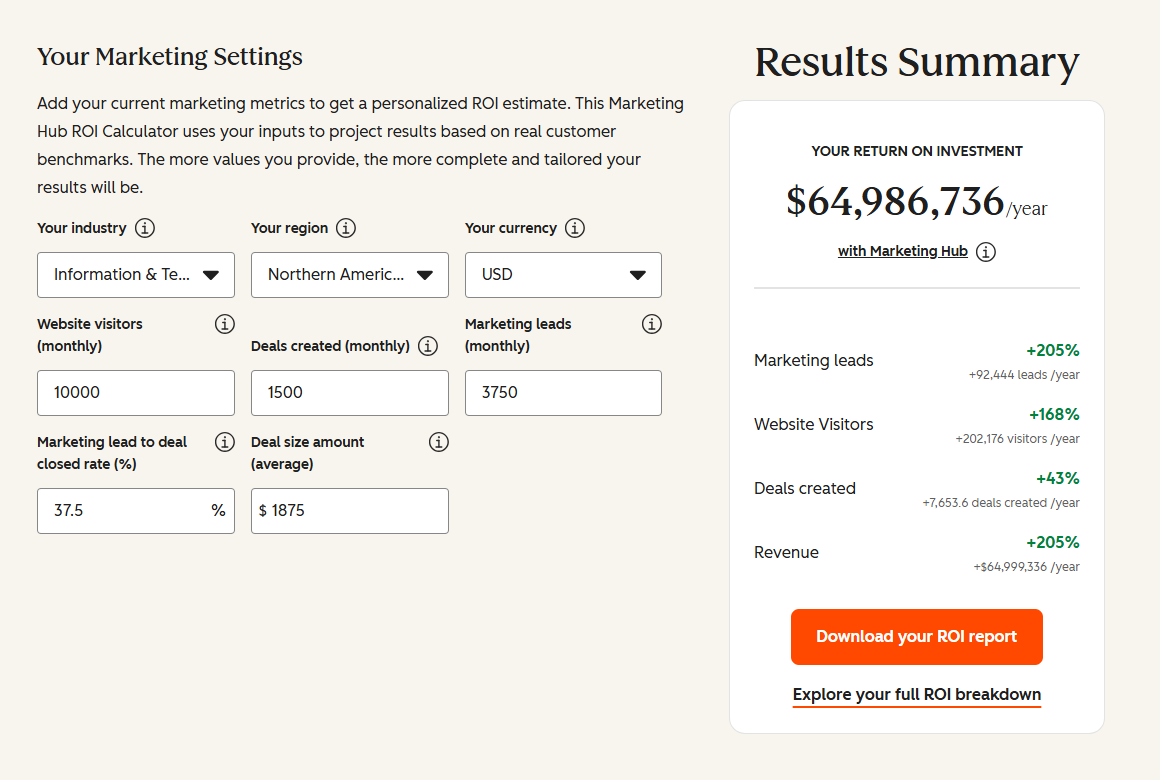
Your HubSpot Stack Doesn’t Stop at the Hub Boundary
Once you’ve settled on which hub or combination of hubs fits your team, the next question is whether HubSpot talks to the rest of your tech stack cleanly. Most RevOps teams have a mix of tools: a data warehouse pulling from HubSpot for BI reporting, a finance system that needs deal data, a customer success platform that needs contact history, or a custom internal tool that needs to push data back into HubSpot.
Native integrations handle the easy cases. The edge cases field-level mapping, bi-directional sync, real-time pipelines, custom object management need a different approach.
As a HubSpot Diamond Solutions Partner with HubSpot custom integration accreditation and 20 billion records processed annually, we build the connectors that make HubSpot the true system of record across your full stack. We scope, build, and deliver custom integrations in 8 weeks from kickoff.
If you’re ready to make your HubSpot investment work harder, start with our integration process

Table of Contents
- What is HubSpot Marketing Hub?
- What is HubSpot Sales Hub?
- What HubSpot Marketing Hub Actually Does
- What HubSpot Sales Hub Actually Does
- Key Differences Between HubSpot Sales Hub and Marketing Hub
- The Pricing Model Difference Most Buyers Miss
- What You Lose Running Only One Hub
- How Leads Actually Move Between the Two Hubs
- Which HubSpot Hub Do You Actually Need
- Frequently Asked Questions
- Your HubSpot Stack Doesn't Stop at the Hub Boundary