





























What is a HubSpot Less Annoying CRM migration?
A HubSpot Less Annoying CRM migration moves your contacts, companies, pipelines, notes, and custom fields out of LACRM and into HubSpot using the LACRM API, rebuilding the relationships between records instead of dumping a flat file. It’s a one-time move, not an ongoing sync between two live systems.
How does a HubSpot Less Annoying CRM migration work?
The migration extracts contacts, companies, pipelines, notes, emails, and custom fields directly from the LACRM API, maps each LACRM object to its HubSpot equivalent (Pipelines become Deals, Groups become Active Lists), rebuilds the relationships between records, then validates and de-duplicates before handoff.

Turn HubSpot Into A Real-Time SMS Engine with Message IQ
 Two-Way Conversations
 Shared Team Inbox
 Automation Triggers
 Advanced Reporting
 Compliance Tools
- 98% SMS read within 3 min
- 78% Buy from first responder
- 21× More likely to qualify

*MessageIQ is an IntegrateIQ product – built natively for HubSpot by the same team.
Can I just use HubSpot’s CSV importer to migrate from Less Annoying CRM?
HubSpot’s CSV importer can move basic contact fields but cannot carry over notes, email history, file attachments, or the relationships between contacts, companies and deals. A CSV import typically leaves you with a flat contact list and orphaned activity data instead of a working CRM history.
How long does a Less Annoying CRM to HubSpot migration take?
Timeline depends on data volume and complexity. Simple contacts-only migrations can finish in days; a full LACRM migration with notes, pipelines, custom fields and validation for a mid-sized business typically takes 2 to 4 weeks, most of it spent on field mapping and data cleanup rather than the transfer itself.
Does a Less Annoying CRM migration preserve notes, emails, and pipeline history?
Yes, when the migration is built on the LACRM API rather than a CSV export. Notes, emails, and files attach to the correct contact, company or deal record, and pipeline stages, including historical won and lost deals, get rebuilt in HubSpot rather than flattened into a single list.
What Less Annoying CRM data can migrate into HubSpot?
Contacts, companies, pipelines and leads, notes and emails, Groups, and custom fields can all migrate from LACRM into HubSpot, landing as contacts, companies, deals, activities, active lists, and custom properties respectively. Which fields carry over, and how they’re mapped, depends on how your LACRM account is structured.
How a HubSpot Less Annoying CRM Migration Actually Works
A HubSpot Less Annoying CRM migration works by treating LACRM as the source of truth one last time: everything gets extracted through the API, mapped to HubSpot’s data model, and validated before your team ever logs into the new system.
The extraction pulls contacts, companies, pipelines, notes, emails, files, and custom fields directly from LACRM, preserving which notes belong to which contact and which deals belong to which pipeline instead of flattening everything into a single export.
Mapping and validation come next: LACRM Pipelines become HubSpot Deals with matching stages, Groups become Active Lists, and custom fields land in new HubSpot properties. A deduplication pass runs before go-live so you’re not just moving old duplicates into a new system.
Three Ways to Migrate from Less Annoying CRM to HubSpot
Not every team needs custom. Here is the honest comparison.
| Factor | CSV Export / Import | DIY API Export | Custom Migration (Integrate IQ) |
|---|---|---|---|
| Best for | Tiny contact lists with no history worth keeping | Technical teams comfortable scripting against the LACRM API | Businesses with real pipeline, note, and relationship history to preserve |
| Relationship data | Flattened, contact-to-company links lost | Possible but must be coded manually | Fully rebuilt, contacts stay linked to companies and deals |
| Notes / emails / files | Not supported | Possible with significant scripting effort | Migrated and attached to the correct record automatically |
| Custom fields | Manual remapping after import, error-prone | Must be scripted field by field | Mapped to new HubSpot properties as part of the build |
| Pipeline and deal stages | Lost, deals import as flat records | Possible with custom scripting | Rebuilt with matching stages, including historical won/lost deals |
| Historical data | Often skipped or partial | Depends on script scope | Full historical load, not just active records |
| Deduplication | None, duplicates import as-is | Must be built | Validation and dedup pass before go-live |
| Post-migration support | None | You own any bugs | Monitored cutover with support after go-live |
If you’re a two-person team with a short contact list and no deal history worth keeping, HubSpot’s CSV importer will get you moving in an afternoon. Once notes, pipelines, and relationships actually matter to how your team sells, a custom migration is what gets you a working CRM on day one instead of a cleanup project.
What You Unlock in HubSpot Once Your Less Annoying CRM Data Is Fully Migrated
- Deal-Stage Automation Your Old Pipeline Never Had. HubSpot workflows can auto-assign tasks, send internal notifications, or update deal properties the moment a migrated deal changes stage, something LACRM’s pipeline never triggered on its own.
- Contact Scoring on Day One. Because historical deal outcomes migrate with the contact, HubSpot can score new leads against what actually closed in your LACRM history instead of starting lead scoring from zero.
- Team Permissions and Territory Rules. HubSpot’s role and permission structure lets you restrict which reps see which migrated accounts, a level of access control LACRM’s flatter user model doesn’t offer.
- Native Email and Calendar Sync. Once contacts are in HubSpot, two-way email and calendar sync connects to each rep’s inbox directly, logging activity automatically instead of the manual logging LACRM relied on.
- AI-Assisted Data Hygiene Going Forward. HubSpot’s built-in deduplication and data quality tools keep the newly migrated database clean, so the mess that justified this migration doesn’t quietly rebuild itself.
What Breaks in a Less Annoying CRM Migration, and How We Prevent It
- Orphaned notes and activities. A straight export can dump notes and emails into a flat file disconnected from the contact they belong to. We attach every note, email, and file to its correct HubSpot record during extraction, not after.
- Broken pipeline-to-deal mapping. LACRM’s Pipelines and stages don’t map one-to-one onto HubSpot’s Deal pipelines by default. We rebuild your exact stages before a single deal migrates, so won and lost history lands where it belongs.
- Custom field type mismatches. A LACRM free-text field can’t drop cleanly into a HubSpot dropdown property. We map field types deliberately instead of letting an importer guess, so data doesn’t get silently truncated or dropped.
- Groups-to-Lists misalignment. LACRM Groups and HubSpot Active Lists don’t behave the same way, static membership versus dynamic membership, so a naive migration can leave segmentation broken on day one. We rebuild list logic to match how your team actually uses Groups today.
- Duplicate records at load. Merging years of LACRM contact history without deduplication multiplies your data problem instead of solving it. Across 300+ platform migrations and integrations, we validate and de-duplicate before go-live, not after.
Implementation Timeline: What to Expect
A Less Annoying CRM migration timeline depends on how much history you’re keeping, not just how many records you have. A contacts-only migration can finish in days. A full migration with notes, pipelines, custom fields, and a validation pass typically takes 2 to 4 weeks: the first week covers discovery and field mapping, the middle stretch runs extraction and relational rebuild in a staging environment, and the final days cover deduplication, validation, and go-live support. Tools that promise a same-day migration are usually moving a flat contact list, not your full relationship history. Our HubSpot integration process is the same repeatable framework behind our 98.5% client retention rate.
See your 12-month revenue impact with HubSpot CRM
Enter your current numbers — visitors, leads, deal size — and get a personalized projection based on real HubSpot customer benchmarks.
Calculate My ROI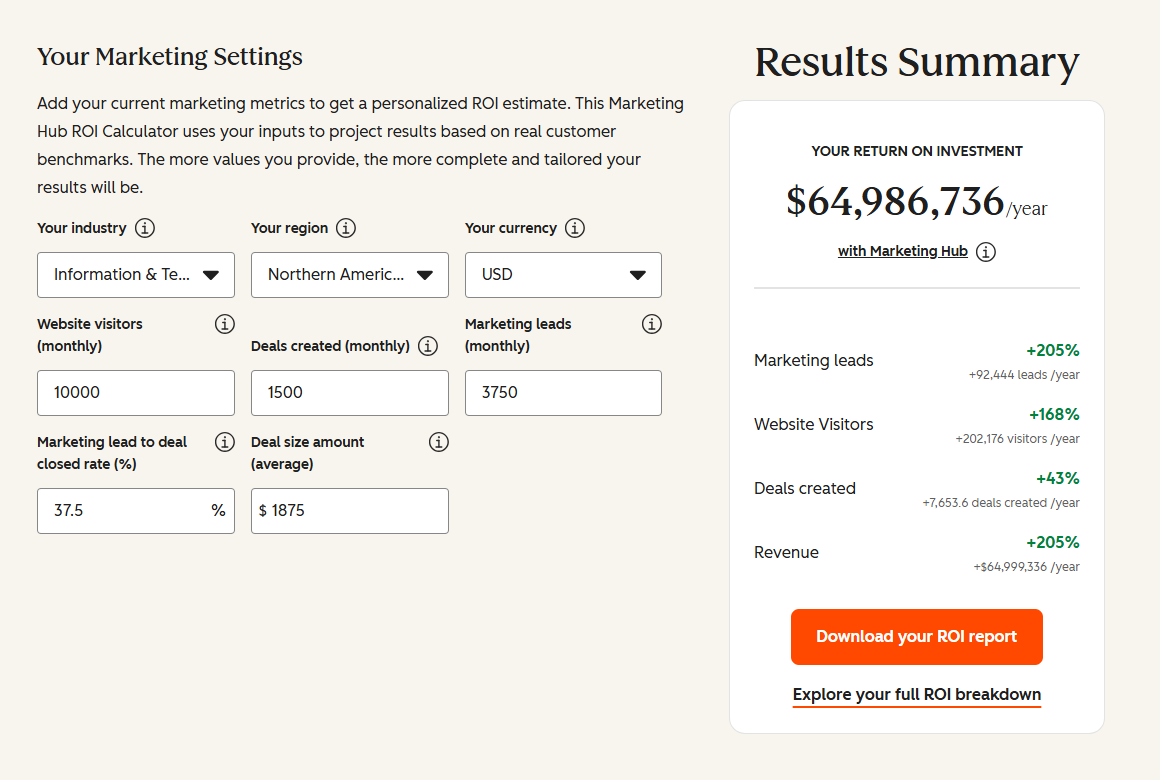
Connect the Rest of Your Revenue Stack
A clean migration is the starting point, not the finish line. Most teams pair this with HubSpot onboarding so reps aren’t just moved to a new system, they know how to use it, and HubSpot training to get the whole team fluent in the new pipeline. If your LACRM setup relied on custom fields or workflows that need a HubSpot equivalent built from scratch, our full-stack development team can build it. And if this migration is one of several system moves happening at once, see our broader CRM migration services. Not sure what any of this is worth to your team? Run the numbers on our Integration ROI Calculator.



Table of Contents
- What is a HubSpot Less Annoying CRM migration?
- How does a HubSpot Less Annoying CRM migration work?
- Can I just use HubSpot’s CSV importer to migrate from Less Annoying CRM?
- How long does a Less Annoying CRM to HubSpot migration take?
- Does a Less Annoying CRM migration preserve notes, emails, and pipeline history?
- What Less Annoying CRM data can migrate into HubSpot?
- How a HubSpot Less Annoying CRM Migration Actually Works
- Three Ways to Migrate from Less Annoying CRM to HubSpot
- What You Unlock in HubSpot Once Your Less Annoying CRM Data Is Fully Migrated
- What Breaks in a Less Annoying CRM Migration, and How We Prevent It
- Implementation Timeline: What to Expect
- Connect the Rest of Your Revenue Stack