

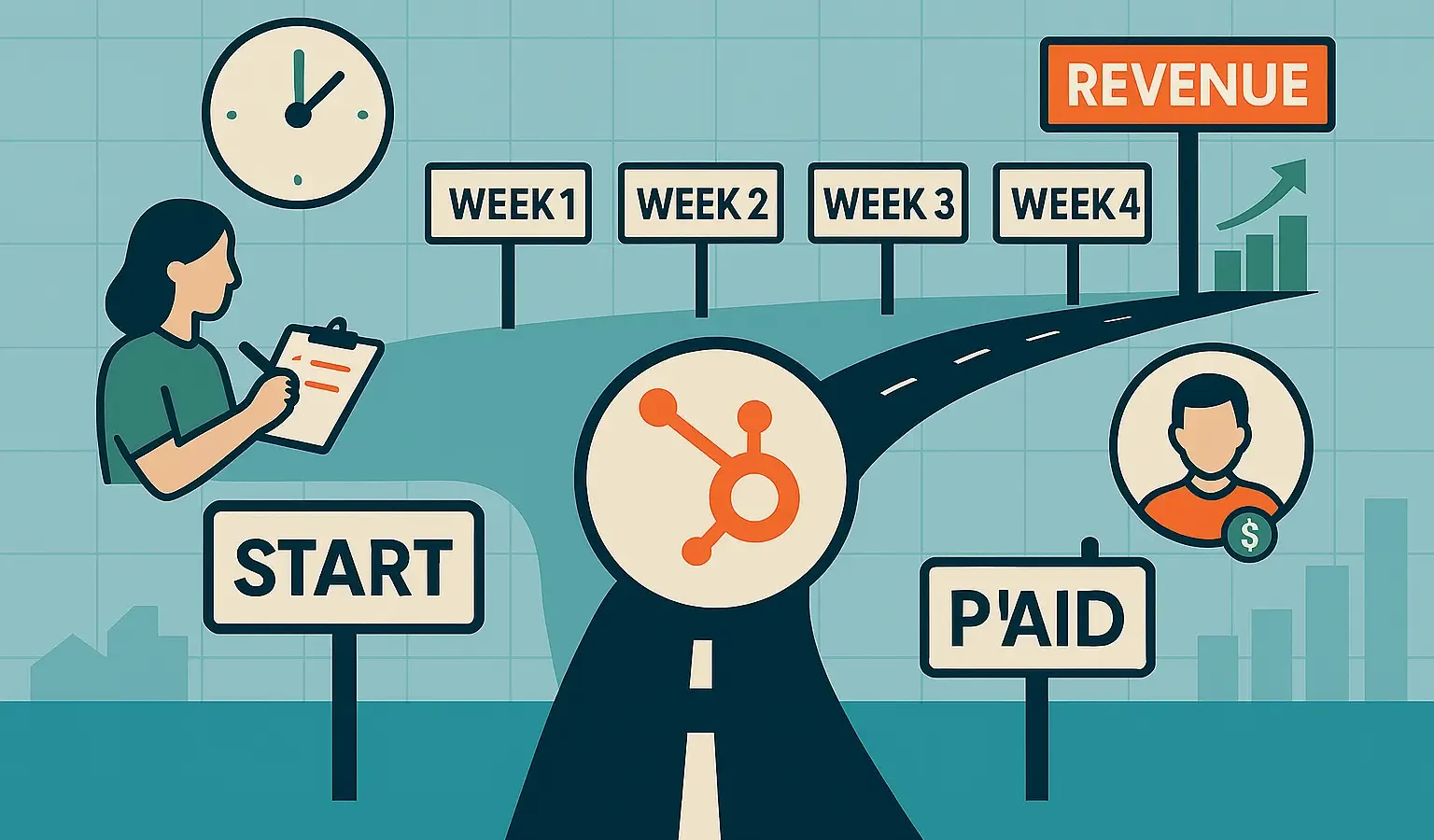
Investing in HubSpot is a massive step toward scaling your operations, but the platform’s potential is only realized through execution. Without a structured HubSpot onboarding timeline, many mid-market firms find themselves six months deep into a subscription with nothing to show but a glorified spreadsheet.
In 2026, “onboarding” is no longer just about importing contacts. It is about architecting a system where Breeze AI agents, automated sales playbooks, and clean data streams converge. At Integrate IQ, we specialize in moving companies from the “purchase” phase to the “profit” phase in a tight, 42-day sprint.
Key Takeaways
- The 6-Week Standard: A professional HubSpot onboarding timeline typically spans 42 days to ensure both technical accuracy and team adoption.
- Data Integrity: Cleaning your CRM data before migration is the single most important factor for AI readiness.
- Phased Rollouts: Success requires a “crawl, walk, run” approach starting with technical infrastructure before moving to advanced automation.
- ROI Acceleration: Partner-led implementations reach full operational capacity 50% faster than self-guided attempts.
Why a Structured HubSpot Onboarding Timeline Is Critical for ROI
The transition to a new CRM is often met with internal friction. Without a clear HubSpot onboarding timeline, momentum stalls, and the “old way of doing things” begins to creep back in. In the current market, your competitors aren’t just using HubSpot; they are using it to automate their entire lead-to-cash lifecycle.
A documented timeline serves as your North Star. It sets expectations for stakeholders, holds teams accountable for data cleanup, and ensures that the technical “plumbing” is sound before you start sending thousands of marketing emails.
Week 1–2: Technical Architecture and Core Strategy
The first 14 days of your HubSpot onboarding timeline are dedicated to the “Foundational Four”: Tracking, Domains, Users, and Strategy.
Establishing the Technical Root
Before we look at a single lead, we ensure your environment is healthy. This includes:
- Domain Authentication: Setting up DKIM and SPF records so your emails bypass the spam folder.
- Advanced Tracking: Installing the HubSpot pixel and configuring “Custom Behavioral Events” to track high-intent actions on your site.
- Property Mapping: Defining the custom fields that matter to your business, not just the default “Industry” or “City.”
Defining the 2026 Buyer Journey
We don’t just use standard lifecycle stages. We build a model that reflects modern buying habits. We define exactly when a lead transitions from “Awareness” to “Opportunity,” ensuring your sales team only spends time on prospects with genuine intent signals.
Week 3–4: Data Migration and CRM Logic Integration
The middle of the HubSpot onboarding timeline is where the heavy lifting occurs. This is the “make or break” period for your CRM’s long-term health.
The “Clean-First” Migration Strategy
Migrating “dirty” data into HubSpot is the fastest way to break your automation. We focus on:
- Deduplication: Removing the noise from your legacy system.
- Data Standardization: Ensuring phone numbers, states, and job titles follow a consistent format for better segmentation.
- Historical Mapping: Bringing over your notes, deals, and communication history so your reps don’t lose context on Day 1.
Connecting the Tech Stack
A CRM shouldn’t be an island. During this phase, we connect your essential tools, ERP systems, proprietary databases, or specialized HubSpot integrations to ensure a unified view of the customer.
Week 5: Advanced Automation and AI Agent Deployment
Once the data is clean, the HubSpot onboarding timeline shifts toward efficiency. This is where we replace manual tasks with intelligent workflows.
Building the “Loop” Playbook
We configure the automations that keep your revenue engine spinning:
- Lead Distribution: Automatic, weighted rotation to your top-performing reps.
- Breeze AI Configuration: Training AI agents to handle meeting scheduling and initial lead qualification.
- Nurture Sequences: Personalized 1:1 outreach that triggers based on specific website interactions.
Week 6: Team Enablement and Operational Launch
The final week of the HubSpot onboarding timeline focuses on the human element. If your team doesn’t use the tool, the previous five weeks were for nothing.
Role-Specific Training
We don’t do “one-size-fits-all” training. We host sessions tailored to:
- Marketing Leaders: Focused on attribution reporting and campaign ROI.
- Sales Reps: Focused on deal management, the mobile app, and email sequences.
- Operations: Focused on data health and automation maintenance.
Check out our HubSpot Onboarding Checklist
Critical Pitfalls to Avoid During Implementation
- The “Everything Everywhere” Trap: Trying to launch Marketing, Sales and Service Hubs all on the same Monday.
- Neglecting the Sandbox: Making major structural changes in a live environment instead of testing in a HubSpot Sandbox first.
- Poor Naming Conventions: If your workflows aren’t named clearly, your portal will become unmanageable within three months.
- Ignoring Feedback Loops: Not asking the sales team what they actually need from the CRM before building it.
Strategic Action Steps for Marketing Leaders
- Inventory Your Assets: List every form, landing page, and automated email that needs to be moved to avoid “broken link” syndrome.
- Verify Your Data Quality: Run a data audit on your current CRM to identify how much “trash” needs to be purged.
- Appoint a HubSpot Champion: Designate one person who has the authority to make decisions on process and naming conventions.
- Set “Phase 1” Goals: Identify three specific workflows that will save your team the most time immediately after launch.
The Bottom Line on Successful Implementation
A successful HubSpot onboarding timeline is the difference between a tool that “works” and a tool that “grows your business.” By following a 6-week phased approach, you ensure your data is clean, your team is trained, and your AI is actually intelligent. Don’t just turn on the lights—build a system that illuminates your path to revenue.
Need a partner to lead the way? Book a conversation with Integrate IQ today to see how we can customize this timeline for your specific tech stack.
Frequently Asked Questions
What is the average HubSpot onboarding timeline for a Diamond Partner?
While a self-setup can drag on for months, a professional HubSpot onboarding timeline is typically optimized into a 6 to 10-week window. This timeframe ensures all technical integrations are stress-tested before the full team begins daily operations.
How does the HubSpot onboarding timeline change for multi-hub implementations?
If you are implementing Marketing, Sales, and Service Hubs simultaneously, the HubSpot onboarding timeline may extend to 12 weeks. We recommend a staggered approach—launching the CRM and Sales Hub first to establish the data foundation before layering on complex Marketing automation.
Can we shorten the HubSpot onboarding timeline?
Yes, the HubSpot onboarding timeline can be accelerated to 4 weeks if the company has a dedicated internal team and pre-cleaned data. However, rushing the strategy phase often leads to technical debt that must be fixed later at a higher cost.
