









Explore this article with AI:
If you’re running a roofing business on spreadsheets, sticky notes, and group texts, you already know the problem. Leads slip through the cracks. Follow-ups don’t happen. Estimates sit in email drafts until the homeowner picks someone else. The best CRM for roofing companies fixes all of that but choosing the wrong one can make things worse, not better.
After integrating 300+ platforms and working with contractors across residential, commercial, and restoration roofing, we’ve seen what actually works. Some companies need a roofing-specific tool with production management built in. Others need a full-stack CRM with marketing automation and the integrations to connect it to their measurement and accounting software. The 9 options on this list cover both categories. We’ll tell you exactly who each one is right for.
Research shows that CRM adoption can improve job efficiency for roofing contractors by as much as 35%, and that 55% of CRM implementations fail usually because companies picked a tool that didn’t fit their actual workflow or had no support getting it set up. That’s the context behind this list. We’re ranking these nine options not by which product has the best demo, but by which ones we’ve seen hold up in real roofing operations. Our top pick is HubSpot, and we’ll explain why. But read through the full list before you decide the right answer depends on where your business is today and where you want it to go.
Free estimator
Know what your HubSpot project costs before the first call.
Select your services and get a transparent price range in minutes. No sales call needed to get a number.
Connect HubSpot to your ERP, billing platform, or database field mapping, custom logic, and support included.
Pipelines, workflows, email templates, and reporting configured for how your team actually works.
Live, role-based sessions with recordings and written guides built around a custom plan for your team.
HubSpot Partner
Client retention
Platforms integrated
What to Look for in a CRM for Roofing Companies
Don’t evaluate roofing CRMs the same way you’d evaluate a generic business CRM. The features that matter in roofing are specific to how jobs actually move from a knocked door or a storm lead to a signed contract, a crew on the roof, and a paid invoice. Here are the six criteria that actually separate a useful roofing CRM from one that collects dust.
Lead-to-Estimate Pipeline Speed
In roofing, the first contractor with a proposal in front of the homeowner tends to win the job. A CRM that can’t accelerate the path from captured lead to delivered estimate costs you deals before you even know you lost them. Look for tools that either include built-in estimation features or integrate cleanly with your measurement software so proposals go out fast.
Insurance Claim Workflow Support
Storm restoration and insurance work are a major revenue stream for most residential roofers. A CRM built for this needs deal stages that reflect how insurance jobs actually move: adjuster appointment, claim approval, supplement requests, material release, install, and final payment. Generic CRMs don’t have this structure by default. Roofing-specific tools do but they vary widely in how well they handle it.
Field-to-Office Sync
Your crew is on a roof in a different neighborhood every day. The office needs real-time job status, updated photos, material changes, and customer notes without calling the crew every two hours. A mobile app that syncs field activity back to the CRM in real time isn’t optional; it’s the difference between an organized operation and a chaotic one.
Integration with Measurement and Estimation Tools
EagleView, HOVER, Xactimate, RoofSnap most roofing companies already use at least one of these. A CRM that forces manual re-entry of measurement data into an estimate, and then into an invoice, is building waste into your process. Check which integrations are native versus which ones require a middleware connector or custom build.
Proposal and E-Signature Capability
Printing a proposal, asking the homeowner to sign, scanning it back, and emailing it as a PDF loses deals. A CRM that delivers digital proposals with built-in e-signature tools closes jobs on the doorstep or in the initial follow-up before the homeowner talks to your competitor.
Scalability Beyond Job Management
Most roofing-specific CRMs are strong at managing jobs. They’re weak at building a business. Marketing campaigns, customer lifetime value tracking, referral pipelines, automated re-engagement for past customers before storm season these are growth levers that roofing-specific tools typically don’t offer. If your goal is growing beyond your current revenue level, look for a CRM that scales with your business model, not just your job count.
1. HubSpot — Best CRM for Roofing Companies That Want to Grow
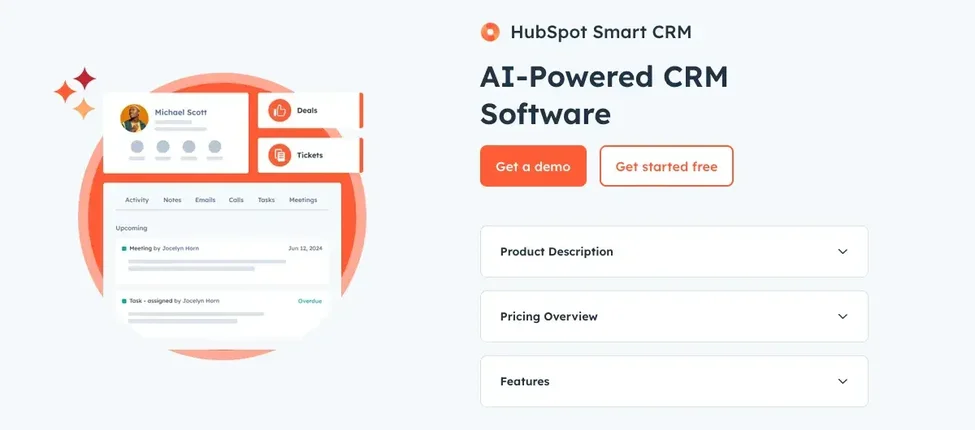
Most roofing CRMs track jobs. HubSpot tracks the entire customer relationship and that’s a meaningful difference for any company trying to build repeat business, generate referrals, and run marketing campaigns alongside their operations. We rank HubSpot first not because it’s a roofing-specific tool, but because it’s the only platform on this list that handles both pipeline management and the full marketing and customer lifecycle layer that drives long-term growth in the roofing industry.
We’ve worked with roofing businesses that migrated from JobNimbus and AccuLynx to HubSpot specifically because they outgrew job-tracking software. They needed lead attribution, automated follow-up sequences, and the ability to run email campaigns to past customers before storm season. HubSpot when integrated with the right roofing tools via our HubSpot integration services gives you all of that without forcing you to abandon the measurement and production tools you already rely on.
Vertical-specific strengths for roofing companies:
- Deal pipeline customizable to roofing stages: lead, site survey, estimate sent, insurance approval, materials ordered, install scheduled, final invoice, closed
- Automated follow-up sequences that trigger after estimate delivery the majority of roofing deals close on the second or third follow-up, not the first
- Full marketing automation for seasonal campaigns, storm alerts to past customers, and referral programs features no roofing-specific CRM offers at this level
- Native integrations with QuickBooks, DocuSign, PandaDoc, and Stripe plus custom builds connecting to EagleView, CompanyCam, and Xactimate via Integrate IQ
- Customer lifetime value tracking across every job, referral, and touchpoint so you know which customers generate the most downstream revenue
Honest limitation: HubSpot doesn’t come with roofing workflows built in. There’s no native aerial measurement tool, no material ordering, and no production management. Roofing companies that want HubSpot to replace their entire operations stack will be disappointed it’s a CRM and marketing platform, not a job management system. The right setup pairs HubSpot with your existing measurement and production tools via a custom integration.
Pricing: Free CRM with core contact and deal management. Sales Hub starts at $15 per seat per month. Sales Hub Professional the tier most growing roofing businesses need starts at $100 per seat per month.
Integrate IQ note: As a HubSpot Diamond Solutions Partner with custom integration accreditation, we’ve migrated roofing businesses from JobNimbus, AccuLynx, and spreadsheets into HubSpot. The process typically runs 8 weeks from kickoff, covering contact and deal history migration, integration builds for your measurement and accounting tools, and team onboarding. You can see how we approach this at our CRM migration services page.

Turn HubSpot Into A Real-Time SMS Engine with
Message IQ

Two-Way Conversations

Shared Team Inbox

Automation Triggers

Advanced Reporting

Compliance Tools
-
98%
SMS read within 3 min -
78%
Buy from first responder -
21×
More likely to qualify
3–5 min avg response
$45–$50 ROI / $1

*MessageIQ is an IntegrateIQ product – built natively for HubSpot by the same team.
2. JobNimbus — Best Roofing-Specific CRM for Mid-Size Contractors
JobNimbus sits at the top of the roofing-specific CRM category for good reason. It handles the full job lifecycle from lead capture to final invoice without requiring significant setup or customization. If you want a CRM that understands roofing workflows out of the box and doesn’t need an IT team to configure it, JobNimbus gets there faster than any general-purpose platform.
Vertical-specific strengths:
- Pre-built roofing workflow stages covering the full sales and production cycle no custom configuration needed to get started
- SumoQuote integration (acquired 2024) for professional proposal and quoting workflows speeds up estimate delivery significantly
- Strong mobile app for field teams photos, status updates, and notes sync back to the office without manual handoffs
- Job costing and production tracking built in useful for crews managing multiple active projects simultaneously
- Scheduling board and crew management tools that connect field activity to the central job record
Honest limitation: JobNimbus’s automations and third-party integrations are a recurring complaint in user reviews. The integrations can be finicky, and the platform has a steeper learning curve than its marketing suggests. It also lacks the marketing automation and customer lifecycle tools that growing companies eventually need which is why many mid-size roofing companies outgrow it and migrate.
Pricing: Custom pricing; must request a demo. No public pricing page.
3. AccuLynx — Best for Operations-Heavy Roofing Companies with Supplier Relationships
AccuLynx is the oldest player in the roofing CRM space and has the deepest integrations with roofing industry suppliers and production tools. If you’re running a company where material ordering, supplier relationships, and production management are as important as the sales pipeline, AccuLynx covers that ground better than any other option on this list.
Vertical-specific strengths:
- Direct ordering integrations with ABC Supply, QXO, and SRS pull live pricing and place material orders without leaving the platform
- Native HOVER and EagleView integration aerial measurements flow directly into estimates without manual re-entry
- AI-powered lead intelligence for scoring and prioritizing inbound leads based on conversion probability
- Production management tracking across multiple active job sites crew scheduling, material procurement, and job sequencing in one view
- Xactimate integration for insurance restoration work a critical feature for companies doing significant storm or hail damage volume
Honest limitation: AccuLynx is expensive and the pricing model adds up fast with features and users. The mobile app draws consistent criticism from users, and the platform has limited third-party integration options outside its own ecosystem. If you want to connect AccuLynx to tools outside its approved integration list, you’ll hit walls.
Pricing: Essential plan from $250 per month. Full-featured pricing is custom and scales significantly with user count and add-ons.
4. ServiceTitan — Best for Large, Multi-Trade Roofing Operations
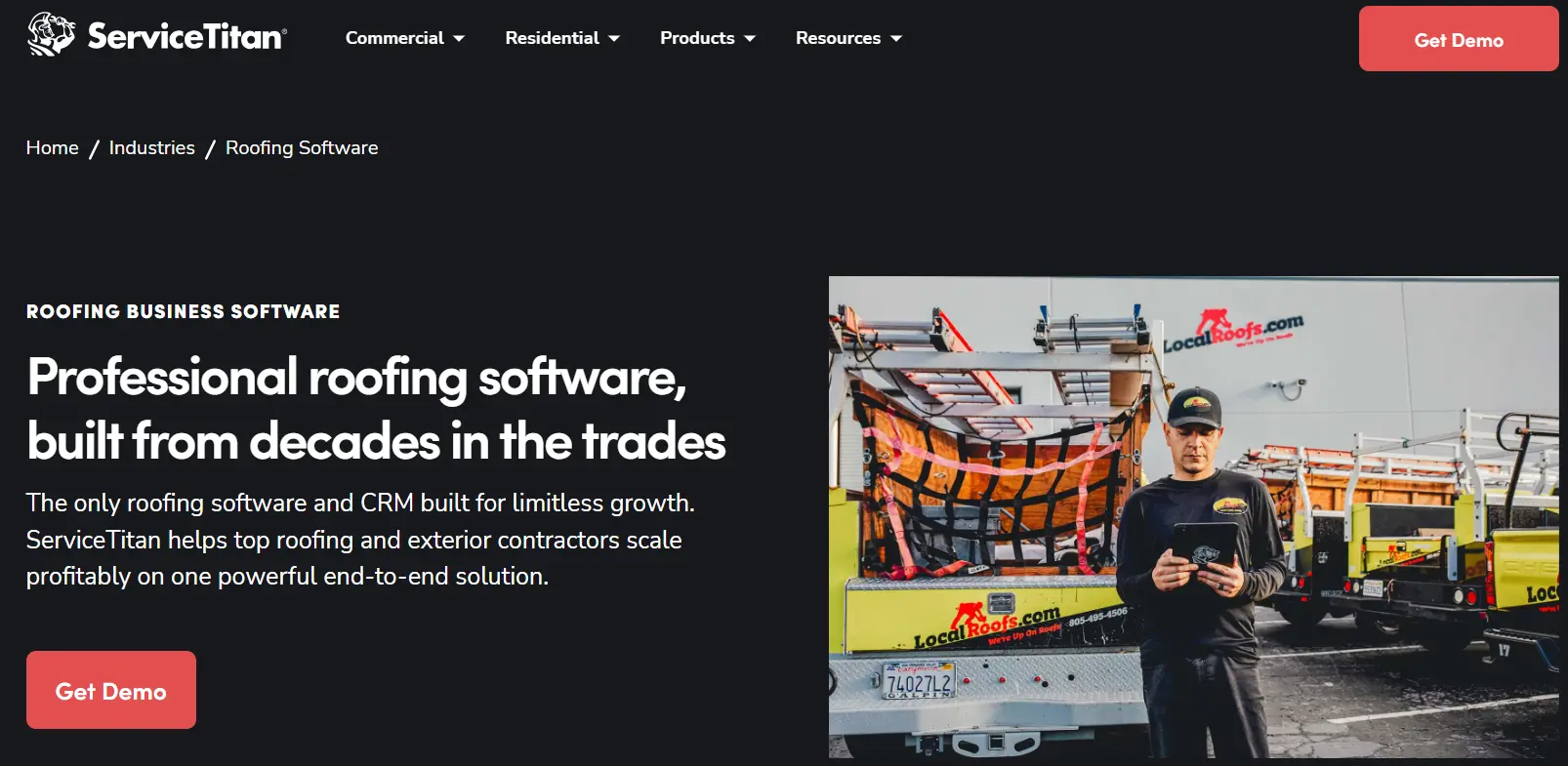
ServiceTitan isn’t really a roofing CRM. It’s a full-stack field service management platform built for large home service companies that happen to include roofing as one of their service lines. If you’re running a $5M+ operation, managing multiple crews across multiple trades, or building a private equity-backed home services company, ServiceTitan has the depth to match.
Vertical-specific strengths:
- Unifies CRM, scheduling, dispatch, invoicing, payroll, and accounting in a single system eliminates the need for multiple disconnected tools in large operations
- Advanced analytics dashboards covering revenue per job, technician performance, pipeline health, and marketing attribution across channels
- Marketing attribution tools that track which campaigns, channels, and lead sources drive closed revenue valuable for companies spending significantly on ads
- Multi-location support with centralized reporting built for companies managing crews across several markets simultaneously
Honest limitation: ServiceTitan is, by multiple user accounts, ‘unbelievably expensive.’ The implementation is complex and time-consuming, and companies under $3M in revenue will likely pay for capabilities they can’t fully use. The platform is also not roofing-specific it serves HVAC, plumbing, electrical, and other trades so some roofing workflows require customization.
Pricing: Custom pricing. Expect a premium investment.
5. Jobber — Best for Smaller Roofing Teams That Want a Professional Client Experience
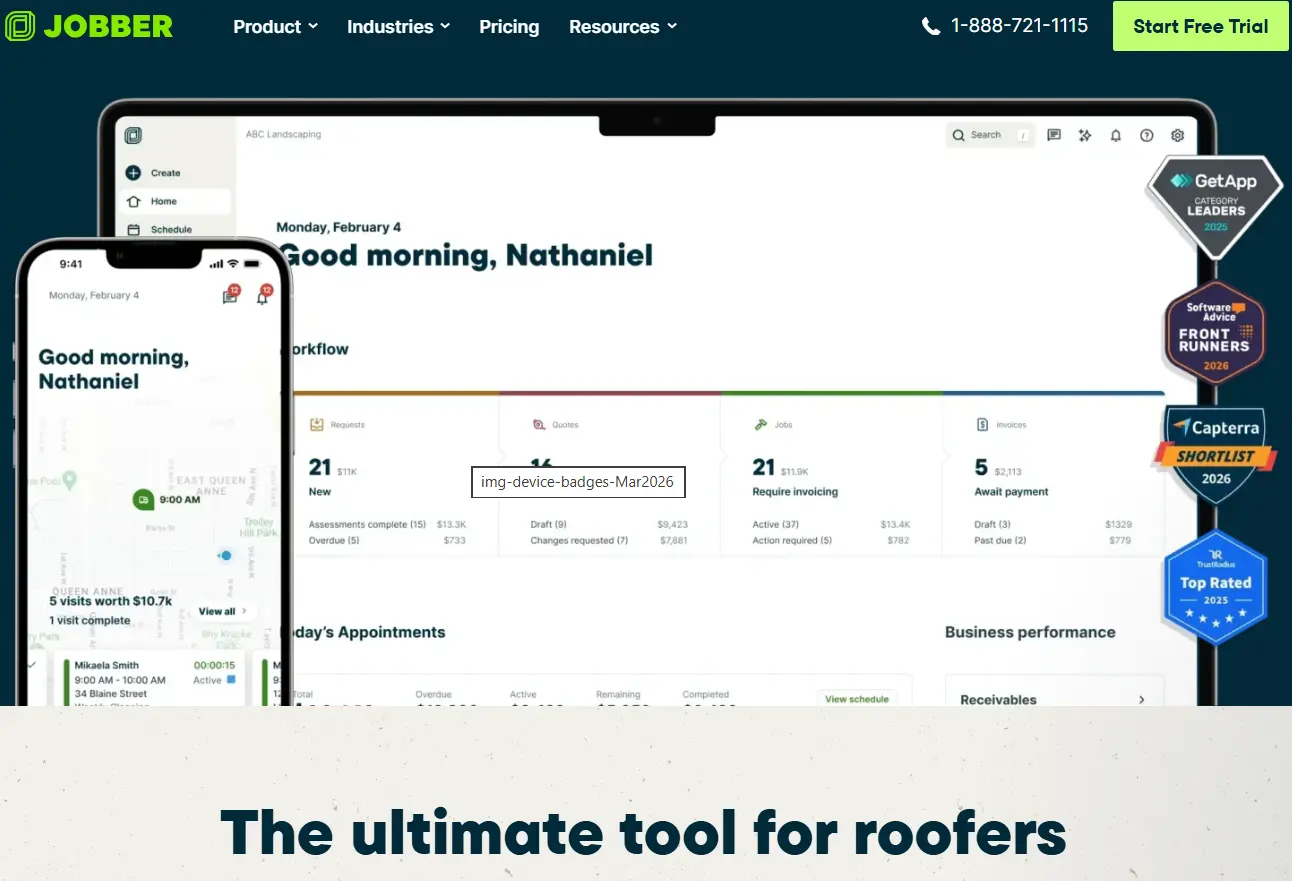
Jobber doesn’t try to be a roofing-specific tool and doesn’t pretend otherwise. It’s a field service management platform with a strong CRM layer, clean client-facing features, and solid quoting and invoicing. For a roofing company with a small team that wants to look professional and stay organized without a complex setup, Jobber delivers a lot for its price.
Vertical-specific strengths:
- Client portal lets homeowners approve quotes, track job progress, and pay invoices online reduces back-and-forth and speeds up payment
- Clean quoting workflow that lets reps generate and send proposals from the mobile app while still on-site
- Scheduling and crew management with a drag-and-drop calendar that keeps the office and field teams aligned
- Automated client reminders and follow-ups reduce no-shows and keep jobs moving without manual tracking
Honest limitation: Jobber isn’t built for roofing specifically. There’s no aerial measurement integration, no insurance claim workflow, and the sales pipeline tools are lighter than roofing-specific alternatives. It’s a strong operations tool for smaller companies but won’t serve companies that need deep roofing-native features.
Pricing: Core plan from $49 per month. Connect from $149 per month. Grow plan from $249 per month.
6. Roofr — Best for Sales-Driven Roofers Who Lead with Estimates
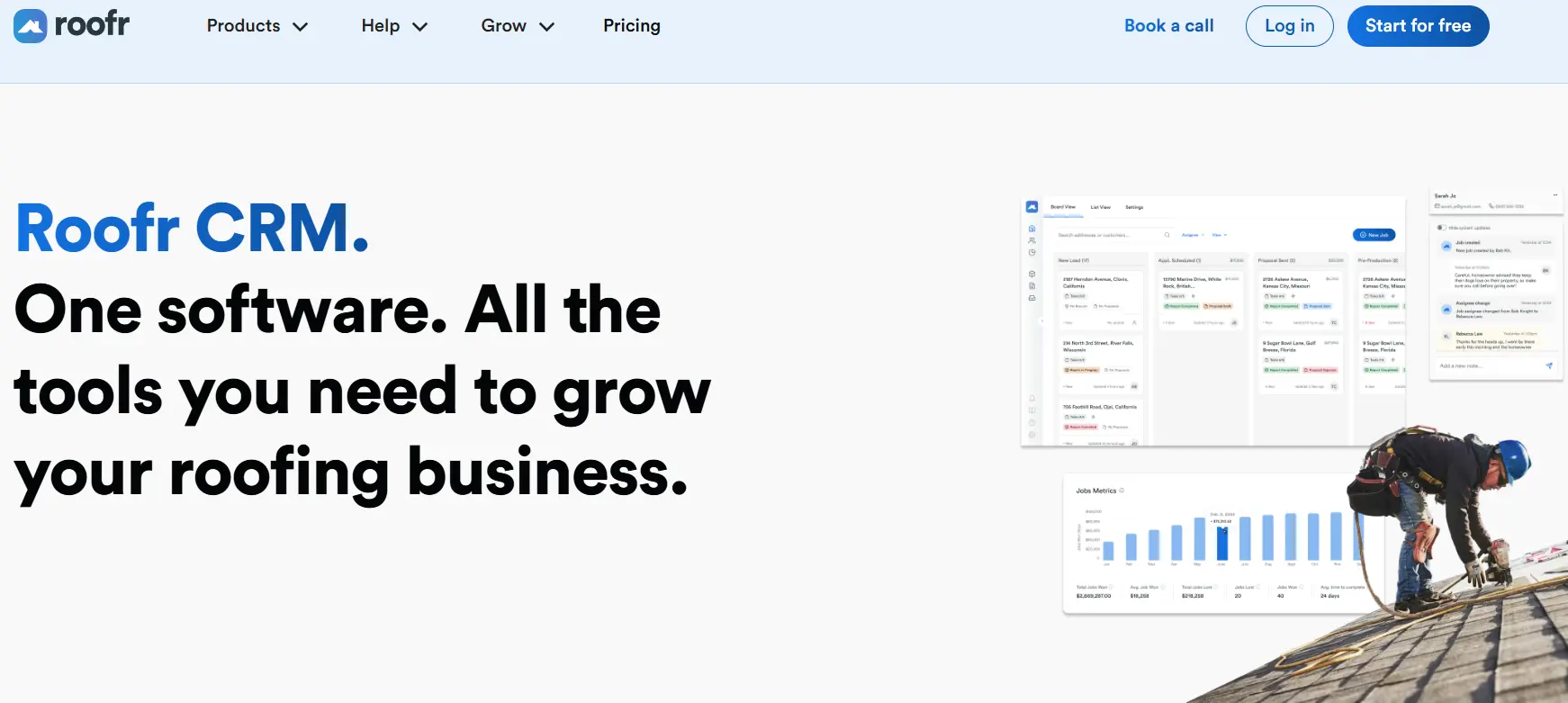
Roofr started as a measurement and proposal tool and built a CRM around it. That origin shows in a good way. If your sales process leads with fast, accurate estimates and digital proposals, and you want the entire measurement-to-signed-contract workflow in one place, Roofr is built for exactly that.
Vertical-specific strengths:
- Aerial roof measurement integrated directly with the CRM order a report by address and it flows into your proposal workflow automatically
- Instant estimator lets homeowners get roof quotes from your website a legitimate lead capture tool that roofing-specific CRMs rarely offer
- Material ordering built into the signed proposal workflow pull quantities from the measurement report and place orders without re-entering data
- Pipeline management with drag-and-drop job cards simple, visual, and fast for teams focused on moving estimates to closed jobs
Honest limitation: Roofr’s CRM features are still maturing. User reviews note that certain capabilities are works in progress, and the platform lacks the marketing automation, reporting depth, and integration ecosystem of more established CRMs. It works well as a sales and estimation tool but won’t replace a full business CRM for growing companies.
Pricing: Free plan available. Paid plans must be requested.
7. Pipedrive — Best for Sales-Focused Roofing Companies That Want Pipeline Clarity
Pipedrive is a sales CRM, not a roofing tool but for contractors whose core bottleneck is sales pipeline visibility rather than job management, it’s a credible option at a competitive price. It’s visual, fast to set up, and works well for smaller operations with a dedicated sales team. If you’re already using a separate job management tool and just need a cleaner sales pipeline, Pipedrive fills that gap. If you eventually want to consolidate onto HubSpot, we build that HubSpot Pipedrive integration as well.
Vertical-specific strengths:
- Visual pipeline board with drag-and-drop deal management fast to customize for roofing stages without extensive configuration
- Strong activity tracking and automated follow-up reminders reduces the ‘forgot to follow up’ deal loss that costs roofing companies revenue
- Affordable entry point for smaller teams that don’t need the full HubSpot feature set yet
Honest limitation: Pipedrive has no roofing-specific features, no field service functionality, and limited reporting depth compared to HubSpot or ServiceTitan. It works as a pure sales CRM but needs to be paired with a job management tool to cover the full roofing workflow.
Pricing: Essential plan from $14 per seat per month. Advanced from $34 per seat per month.
8. Salesforce Best for Enterprise Roofing Companies With IT Resources
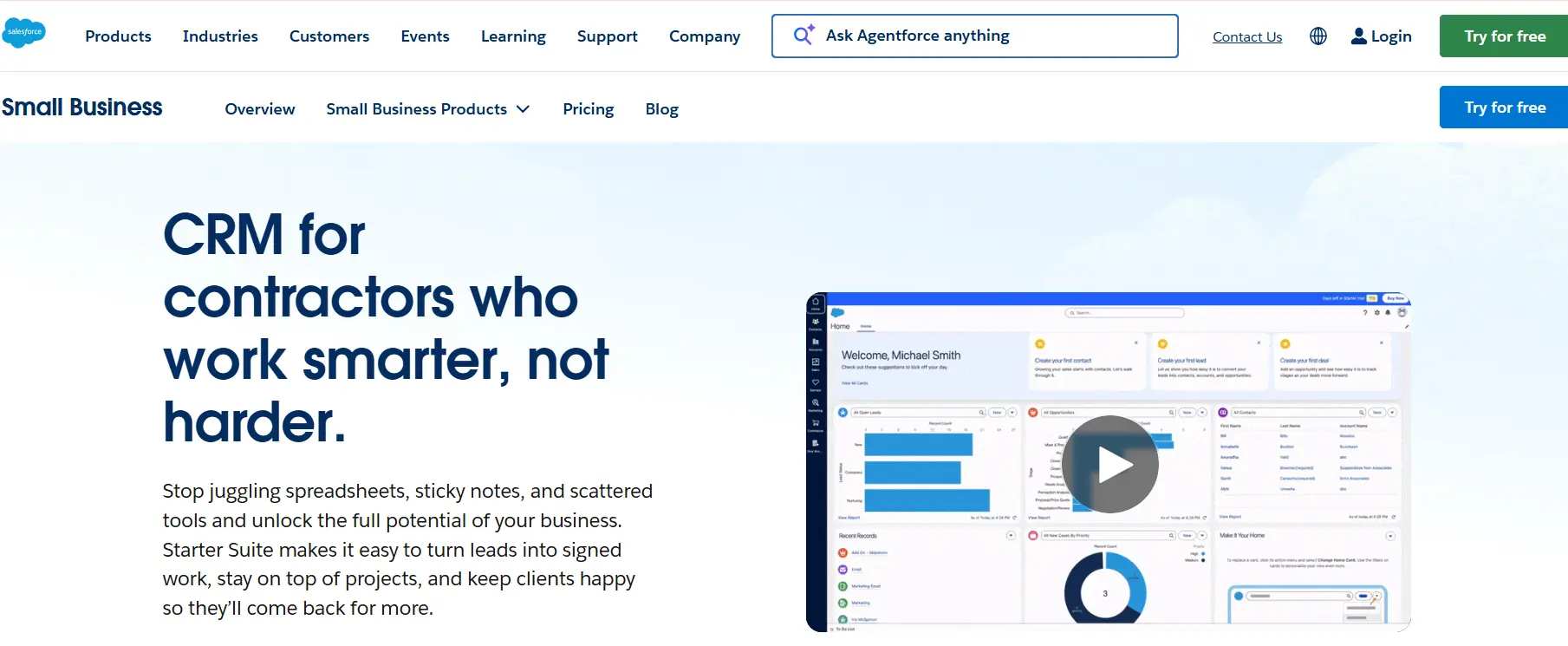
Salesforce earns a place on this list for one category of roofing company: large, multi-location operations with IT staff and the budget and timeline to build a custom CRM environment. For everyone else, it’s overkill. If you’re a roofing company that’s been acquired by a private equity firm with existing Salesforce infrastructure, or if you’re managing 20+ crews across multiple states, Salesforce gives you the customization depth to build exactly the system your operation needs. We build the HubSpot Salesforce integration for companies running both platforms or migrating between them.
Vertical-specific strengths:
- Highly configurable custom objects, fields, and workflows can model any roofing process with enough development investment
- Connects to nearly every enterprise tool via AppExchange if your roofing operation uses enterprise accounting, ERP, or analytics tools, Salesforce integrates with them
- Strong reporting and analytics at scale built to give executives visibility across hundreds of active jobs, multiple service lines, and large sales teams
Honest limitation: Salesforce requires real implementation investment a dedicated admin, ongoing development, and a meaningful budget. The ‘starts at $25 per seat’ pricing grows fast once you add the features a real roofing operation needs. For companies under $10M in revenue, the cost-to-value ratio rarely makes sense.
Pricing: Starter Suite from $25 per seat per month. Enterprise pricing scales significantly from there.
9. ProLine — Best for Residential Roofers Running Door-to-Door Sales Teams
ProLine is a narrowly focused CRM built specifically for residential roofing contractors who lead with canvassing and door-to-door sales. If your revenue model depends on rep-driven prospecting in storm-affected neighborhoods, ProLine’s workflows are built around that process in a way that no general-purpose CRM matches.
Vertical-specific strengths:
- Door-to-door canvassing workflows designed to track rep activity by neighborhood, giving management visibility into prospecting volume and conversion
- Commission tracking tied to gross profit reps see their earnings tied to job margin, which focuses attention on profitable deals, not just deal count
- Fast onboarding new reps can get productive in the system quickly, which matters for companies with high sales rep turnover
- Built for residential roofers the assumptions in the platform match the workflow of a rep-driven, insurance-heavy roofing business
Honest limitation: ProLine’s narrow focus is also its ceiling. It’s built for canvassing-led residential sales and doesn’t serve commercial roofing, large multi-location operations, or companies that need marketing automation and full customer lifecycle management. If your business grows beyond the residential canvassing model, you’ll outgrow it.
Pricing: Solo accounts from $79 per month. Team accounts from $249 per month.
How These 9 CRMs Compare for Roofing Businesses
| CRM | Best For | Key Roofing Feature | Integrates with HubSpot? | Starting Price | IQ Integration Available |
|---|---|---|---|---|---|
| HubSpot | Growing companies needing marketing + pipeline | Full automation, lifecycle tracking, custom deal stages | N/A (it’s HubSpot) | Free; Sales Hub from $15/seat/mo | Yes, full custom builds |
| JobNimbus | Mid-size roofing-specific ops | Built-in roofing workflow stages + SumoQuote | Limited | Must request demo | No native IQ page |
| AccuLynx | Operations-heavy with supplier needs | Direct ABC Supply/SRS ordering + EagleView | Limited | From $250/mo | No native IQ page |
| ServiceTitan | Large multi-trade enterprises | Full field service management | Limited | Custom (premium) | No native IQ page |
| Jobber | Small teams, strong client experience | Client portal, on-site quoting | Yes via Zapier | From $49/mo | No native IQ page |
| Roofr | Sales-first, estimate-led teams | Aerial measurement + instant estimator | Limited | Free plan available | No native IQ page |
| Pipedrive | Sales pipeline-focused teams | Visual deal board, activity tracking | Yes, IQ builds it | From $14/seat/mo | Yes,hubspot-pipedrive |
| Salesforce | Enterprise, multi-location operations | Fully customizable enterprise CRM | Yes,IQ builds it | From $25/seat/mo | Yes, hubspot-salesforce |
| ProLine | Residential canvassing-led roofers | Door-to-door workflows, commission tracking | No | From $79/mo | No native IQ page |
How to Choose the Right CRM for Your Roofing Business
The roofing CRM market splits into two fundamentally different categories: tools built for roofing job management, and tools built for customer relationship management and marketing. Most companies need both but which one to prioritize depends on where your biggest bottleneck is today. Use this framework to make the call.
Solo contractor or sub-$500K revenue
Start with Roofr for estimation and proposals. Layer HubSpot’s free CRM on top for lead capture and follow-up automation. You don’t need an expensive platform at this stage you need something that stops leads from slipping through the cracks and gets estimates out fast.
2-10 person crew, $500K-$2M revenue
JobNimbus or Jobber for daily operations. If you’re running insurance work with heavy production management needs, AccuLynx is worth the cost. Consider HubSpot for the marketing layer even at this stage, automated follow-up sequences and referral tracking can meaningfully increase closed jobs without adding headcount.
$2M-$10M, actively growing
This is the range where roofing-specific tools start showing their ceilings and a general CRM with solid integrations becomes the smarter long-term play. HubSpot with Integrate IQ handling the integration to your measurement, production, and accounting tools gives you a single source of truth without giving up the roofing-native workflows you depend on. Our typical delivery from kickoff to go-live is 8 weeks.
$10M+ or multi-location
HubSpot or ServiceTitan, depending on whether your priority is marketing and customer lifecycle management (HubSpot) or unified field service operations (ServiceTitan). Salesforce makes sense here if you already have IT infrastructure and the implementation budget to customize it for roofing workflows.
Heavy insurance and storm restoration work
Confirm Xactimate integration before committing to any CRM. AccuLynx handles this natively. HubSpot handles it via a custom integration build. This matters more than most other feature comparisons if insurance claims represent more than 40% of your revenue.
Building recurring revenue through maintenance contracts
HubSpot’s subscription management, lifecycle stages, and renewal automation tools are purpose-built for this. No roofing-specific CRM comes close for companies trying to build a recurring revenue layer on top of project-based work.
What Switching to HubSpot Looks Like for Roofing Companies
Switching CRMs is real work, and we won’t pretend otherwise. We’ve managed CRM migrations for contractors moving from JobNimbus, AccuLynx, spreadsheets, and in some cases, nothing at all. Here’s what the process actually looks like so you can plan accurately.
Step 1: Audit your current data
Before moving anything, identify what data you actually have and what format it’s in. Contacts, deal history, active pipeline, email logs, proposal records, notes each of these needs a destination field in HubSpot. Data that doesn’t get mapped correctly either disappears or ends up duplicated. This is where most DIY migrations break down.
Step 2: Map your roofing workflow to HubSpot deal stages
A roofing pipeline has different stages than a SaaS sales pipeline. Site survey, estimate sent, insurance approval, materials released, install scheduled, final invoice these stages need to be configured in HubSpot before data moves in, or you’re importing history into a pipeline that doesn’t reflect your actual process.
Step 3: Build integrations with your roofing tools
This is the step that separates a successful HubSpot implementation from a frustrating one. We sync HubSpot with QuickBooks for invoicing, CompanyCam for job photos, and EagleView or HOVER for measurement data. We process over 20 billion records annually and sync 7 million fields daily across our client integrations the field mapping and data transformation work is the core of what we do.
Step 4: Migrate and validate
Move contacts, companies, and deal history in batches. Validate that relationships between records are intact a contact tied to the wrong company or a deal missing its history is worse than no data. We run validation checks at each stage before moving to the next.
Step 5: Team onboarding and go-live
The CRM only works if your team uses it. We run onboarding sessions covering your specific workflow stages, the automations we’ve set up, and how to use the tools your team will interact with daily. Most roofing clients are live in 8 weeks from kickoff. Our 98.5% client retention rate reflects how that process lands.
Common tools we migrate roofing companies FROM: JobNimbus, AccuLynx, Zoho, spreadsheets, and occasionally older platforms like Infusionsoft or legacy construction management software. If you’re not sure whether your current setup is migratable, reach out we’ve handled it before.
Frequently Asked Questions
Is HubSpot good for roofing companies?
Yes, but with the right setup. HubSpot’s strength in roofing is its marketing automation, customizable pipeline stages, and ability to integrate with the roofing-specific tools your team already uses. It doesn’t have native aerial measurement or production management, so roofing companies that want HubSpot to cover their full workflow need an integration partner to connect those tools. When that’s done right, HubSpot handles both the sales pipeline and the customer lifecycle in a way no roofing-specific CRM can match.
What’s the best free CRM for roofing contractors?
HubSpot’s free tier is the strongest free option available. You get contact management, a visual deal pipeline, email tracking, and basic follow-up automation without paying anything. The free plan has limits you can’t do advanced automation or multi-touch marketing sequences without upgrading but for a small crew just getting off spreadsheets, it’s a legitimate starting point. Roofr also offers a free plan with basic CRM and measurement features.
Can I keep using AccuLynx or JobNimbus alongside HubSpot?
Yes. Running HubSpot for marketing, lead management, and customer lifecycle while keeping your roofing-specific tool for production management and job tracking is a legitimate setup. We build that integration regularly. Contact records, deal stages, and job data sync between the two platforms so your sales team works in HubSpot and your production team stays in the tool they know. You can see how we approach these builds at our HubSpot integration process page.
How much does a CRM cost for a roofing business?
It ranges from free to over $500 per month depending on team size and features. HubSpot’s free CRM handles the basics at no cost. JobNimbus and AccuLynx require demos for pricing, but roofing companies typically report costs of $200-$600 per month at mid-size scale. ServiceTitan sits at a premium tier reserved for larger operations. The more important cost question is implementation a CRM you buy and don’t configure properly is a waste of money regardless of the license fee.
What’s the difference between a roofing-specific CRM and a general CRM for roofing?
Roofing-specific CRMs (AccuLynx, JobNimbus, Roofr) have production management, supplier ordering, and roofing workflow stages built in no configuration needed. General CRMs (HubSpot, Salesforce, Pipedrive) are stronger on marketing automation, customer lifecycle management, reporting, and integration flexibility, but they need to be set up for roofing workflows. The right choice depends on whether your biggest bottleneck is operations management or customer and pipeline management. Companies that need both typically run HubSpot for the CRM and marketing layer, connected to a roofing-specific production tool via integration.
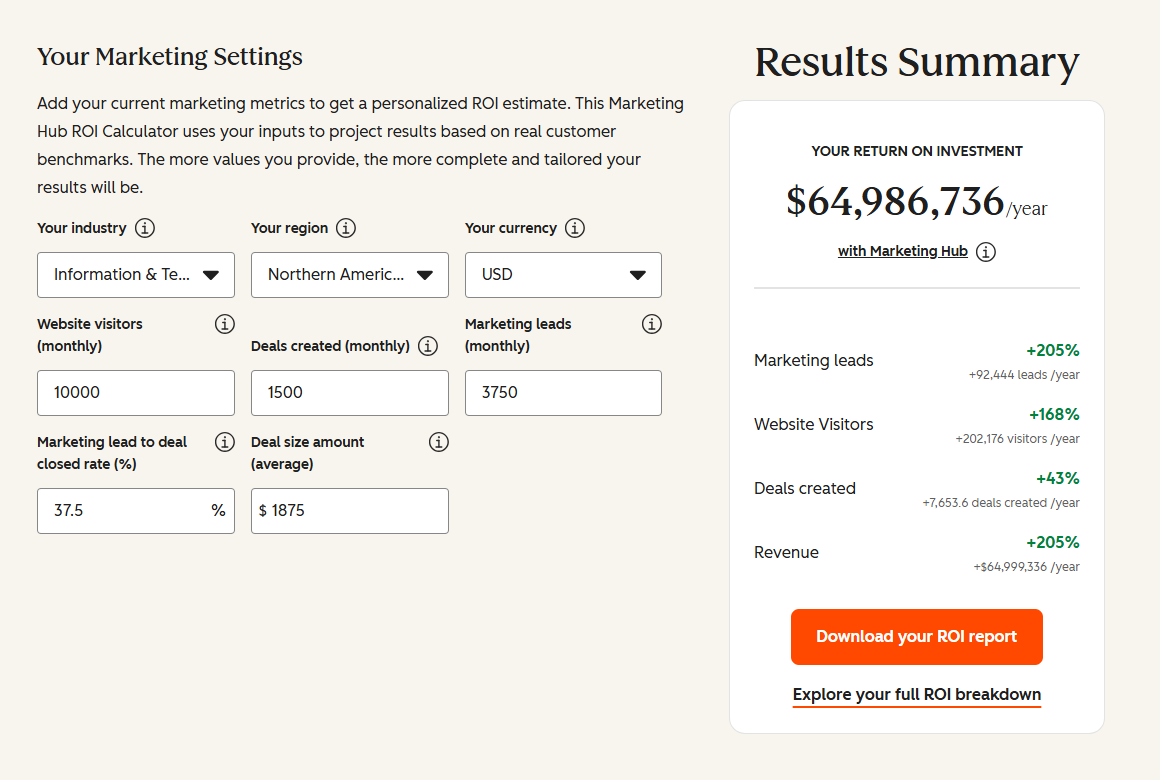
See your 12-month revenue impact with HubSpot CRM
Enter your current numbers — visitors, leads, deal size — and get a personalized projection based on real HubSpot customer benchmarks.
Ready to Move Your Roofing Business to HubSpot?
Most roofing companies don’t lose revenue because their work is bad. They lose it because their follow-up is inconsistent, their marketing relies entirely on word of mouth, and their CRM data lives in three different tools that don’t talk to each other. HubSpot solves all three but only if it’s set up right and connected to the roofing tools your team actually uses.
We’re a HubSpot Diamond Solutions Partner with custom integration accreditation. We’ve processed over 20 billion records annually and built integrations connecting HubSpot to the measurement tools, production software, and accounting platforms that roofing operations run on. Our typical project runs 8 weeks from kickoff to a live, integrated CRM that your team is actually using. You can learn about our approach at the IntegrateIQ integration process page, or go straight to our CRM migration services page if you’re ready to start planning the move.
Switching CRMs is real work. The businesses we work with do it once, do it right, and don’t do it again. That’s the goal.


Table of Contents
- What to Look for in a CRM for Roofing Companies
- 1. HubSpot -- Best CRM for Roofing Companies That Want to Grow
- 2. JobNimbus -- Best Roofing-Specific CRM for Mid-Size Contractors
- 3. AccuLynx -- Best for Operations-Heavy Roofing Companies with Supplier Relationships
- 4. ServiceTitan -- Best for Large, Multi-Trade Roofing Operations
- 5. Jobber -- Best for Smaller Roofing Teams That Want a Professional Client Experience
- 6. Roofr -- Best for Sales-Driven Roofers Who Lead with Estimates
- 7. Pipedrive -- Best for Sales-Focused Roofing Companies That Want Pipeline Clarity
- 8. Salesforce Best for Enterprise Roofing Companies With IT Resources
- 9. ProLine -- Best for Residential Roofers Running Door-to-Door Sales Teams
- How These 9 CRMs Compare for Roofing Businesses
- How to Choose the Right CRM for Your Roofing Business
- What Switching to HubSpot Looks Like for Roofing Companies
- Frequently Asked Questions
- Ready to Move Your Roofing Business to HubSpot?