












Explore this article with AI:

If your business needs to track something that does not fit cleanly into contacts, companies, deals, or tickets, HubSpot custom objects can turn the CRM from a standard record system into a model that reflects how the business actually runs. Teams often discover this only after trying to force a more complex process into standard objects and extra properties. At first, that seems manageable. Then the record layout becomes awkward, reporting gets harder to trust, workflows become more brittle, and teams start compensating with manual work.
HubSpot custom objects solve a different problem than ordinary field expansion. They let you define a new object with its own schema, properties, and associations . That makes them valuable when the business entity you need to track has its own identity, its own lifecycle, and its own relationship to the rest of the CRM.
This guide explains when custom objects are warranted, how they differ from custom properties, how to design them responsibly, and how to avoid building a complicated model that becomes harder to maintain than the problem you were trying to solve.
Answer-ready summary: Use HubSpot custom objects when you need to track a business entity with its own records, properties, and relationships, such as subscriptions, locations, projects, contracts, or assets. Use custom properties when you only need more fields on an existing standard object.
Free estimator
Know what your HubSpot project costs before the first call.
Select your services and get a transparent price range in minutes. No sales call needed to get a number.
Connect HubSpot to your ERP, billing platform, or database field mapping, custom logic, and support included.
Pipelines, workflows, email templates, and reporting configured for how your team actually works.
Live, role-based sessions with recordings and written guides built around a custom plan for your team.
HubSpot Partner
Client retention
Platforms integrated
What a custom object actually is in HubSpot
HubSpot custom objects let you define a new CRM object type with its own schema, properties, required fields, display logic, and associations to other objects . In practical terms, that means you can create a first-class business entity inside HubSpot instead of trying to stretch an existing standard object beyond what it was designed to do.
A custom object can have:
- Its own record type
- Its own properties
- Its own unique identifier
- Associations to contacts, companies, deals, tickets, or other custom objects
- Searchability and display rules defined at the schema level
HubSpot’s documentation also notes that custom objects are account-specific and subject to subscription-related limits . That matters because custom objects are a strategic CRM design choice, not a casual field-level convenience.
Why teams reach for custom objects in the first place
The trigger is usually process complexity.
Examples:
- A company needs to track subscriptions separately from deals
- A customer success team needs implementation projects with their own milestones
- A support or service team needs asset-level visibility
- A multi-location business needs branch-level records linked to one parent company
- A revops team needs a structured way to track contracts, service plans, or partner entities
The common thread is that the business needs to track something that behaves like its own record, not just like an extra detail on another record.

Turn HubSpot Into A Real-Time SMS Engine with
Message IQ

Two-Way Conversations

Shared Team Inbox

Automation Triggers

Advanced Reporting

Compliance Tools
-
98%
SMS read within 3 min -
78%
Buy from first responder -
21×
More likely to qualify
3–5 min avg response
$45–$50 ROI / $1

*MessageIQ is an IntegrateIQ product – built natively for HubSpot by the same team.
When a custom property is enough
Custom properties are still the right answer for many needs
Use a custom property when:
- The information belongs directly on an existing object
- The value does not need its own lifecycle
- The value does not need its own associations
- The field is useful as context, not as a standalone record
Examples:
- A qualification field on a contact
- A billing status on a company
- A technical readiness value on a deal
- A product-interest field on a lead
The best question here is simple: does the team need a new field, or does the business actually need a new record type?
When a custom object becomes the better answer
A custom object becomes the better answer when the thing you need to track behaves like its own entity.
A strong custom-object use case usually has at least three traits:
- The record has its own lifecycle or status progression
- The record needs more than a handful of fields
- The record needs meaningful relationships to other records
That is why examples like subscriptions, contracts, projects, locations, installations, assets, or service plans are strong fits. They are not just descriptive details. They shape how the business operates.
A practical decision framework
Use this framework before creating anything:
| Question | If yes | If no |
|---|---|---|
| Does this entity need its own record list? | consider custom object | consider property |
| Does it have its own lifecycle? | custom object is likely justified | property may be enough |
| Does it relate to several other records? | custom object becomes more useful | property may be simpler |
| Will it need reporting or workflow logic of its own? | custom object is often the better fit | property is often enough |
| Will external systems reference it? | custom object plus unique ID may be needed | property may remain simpler |
The goal is not to maximize object count. The goal is to model the business clearly enough that records, reports, and workflows stay usable.
What good custom object use cases look like
Here are some high-value examples:
| Use case | Why a custom object makes sense |
|---|---|
| Subscription or contract | has dates, term, renewal status, and account relationships |
| Customer project | has ownership, milestones, deadlines, and associated companies or contacts |
| Physical asset or installation | has serial or asset identifiers and service history |
| Franchise or location | has branch-level detail and needs relationship to parent account and local contacts |
| Implementation record | has its own delivery lifecycle and customer handoff implications |
| Service plan | has entitlement, status, and support context |
Each of these examples supports stronger automation and clearer reporting because the CRM model mirrors the actual operating structure.
How custom objects work structurally
At the schema level, HubSpot custom objects require decisions around:
- Object label and internal name
- Properties and required properties
- Searchable fields
- Display properties
- Associations
HubSpot also supports unique value properties on custom objects . That is a major design benefit when the object will need to sync with another system or behave like a stable business record over time.
Some decisions are harder to change later. HubSpot notes that object names and labels cannot be changed after creation . That alone should push teams to do more upfront design work than they might do for an ordinary field.
How to design a custom object before you build it
Most custom-object problems come from building too quickly. Good design starts with five questions.
1. What business entity are we modeling?
Be explicit. “Implementation project” is clear. “Extra delivery data” is not. The object should represent something a business user can understand as a real thing.
2. What is the stable identifier?
If the object needs to integrate with another system, you need a field that stays stable across systems. HubSpot supports unique value properties for this reason
3. What records should this object relate to?
Associations shape whether the object becomes operationally useful. Ask:
- Should it relate to contacts
- Should it relate to companies
- Should it relate to deals
- Should it relate to tickets
- Should it relate to another custom object
Poor association planning creates weak workflows and awkward reporting later.
4. Which properties belong here and which belong elsewhere?
Do not overload a custom object with fields that really belong on an associated company, contact, or deal. The object should carry the fields that define its own state and role.
5. Does the object need a pipeline or status structure?
HubSpot supports object pipelines and pipeline rules in supported scenarios . That makes custom objects significantly more powerful when the entity has a clear process model, such as implementation stages, service states, or project progression.
What mistakes make custom objects hard to live with
Several mistakes show up repeatedly.
Creating a custom object when a property would work
This adds complexity without improving clarity. More records are not automatically better records.
Refusing to create a custom object when the model clearly needs one
This creates bloated contact, company, or deal records filled with fields that do not really belong there. Reporting and usability both get worse.
Building the object before defining associations
Associations are not a technical afterthought. They shape automation, visibility, and reporting.
Ignoring the unique identifier
If the object will ever be referenced outside HubSpot, identifier discipline should exist from the start.
Treating custom objects as a developer-only feature
Custom objects work best when revops, system design, reporting, and business process owners are involved. The CRM model has to support the people using it, not just the API.
How custom objects affect workflows, reporting, and integrations
Custom objects are useful because they influence more than storage.
Once the model is set up, they can support:
- Record views and filtering
- Object-specific properties and governance
- API-based create, read, update, and batch operations
- Associations to standard CRM records
- Workflow logic that depends on the object’s own fields and relationships
- Pipeline behavior in supported use cases
- Customer success workspace configuration in supported enterprise scenarios
This is where custom objects become strategic. The CRM starts reflecting the real structure of the business instead of forcing the business to flatten itself into contact, company, and deal records alone.
Who should use custom objects?
Custom objects are best for:
- Enterprise HubSpot teams
- Revops leaders with complex handoff models
- Companies with subscriptions, projects, assets, or multi-entity customer relationships
- Teams integrating HubSpot with ERP, finance, product, or service systems
They are less useful when:
- The portal is simple
- Only a handful of extra fields are needed
- No one owns CRM governance
- The team does not yet have clear process structure
Complexity should be earned. When the operating model justifies it, custom objects create clarity. When the model is still vague, they can lock confusion into the CRM at a deeper level.
How to know your design is working
A good custom-object design usually leads to:
- Cleaner standard object records
- Easier workflow logic
- Better business-specific reporting
- Clearer object ownership
- More stable integrations
If the custom object makes the CRM easier to understand for the teams who use it, the design is probably moving in the right direction.
A deeper design checklist before you create a custom object
Many teams know they “need” a custom object but still create one too quickly. A stronger checklist prevents expensive cleanup later.
Ask these questions before build:
Does the entity have a natural owner?
If no team owns the object operationally, the record type can become another neglected layer in the portal.
Does the entity need to appear in reports?
If the answer is yes, define the reporting outcomes early. That changes how you choose properties, associations, and pipelines.
Will users search for it directly?
If yes, searchable properties and display properties matter more .
Will external systems reference it?
If yes, stable identifiers and schema discipline become much more important .
Does the object affect handoffs?
If yes, the workflow logic and associated record design should be mapped before creation.
This checklist prevents the custom object from becoming a purely technical build with unclear business value.
How custom objects change workflow design
Custom objects become especially valuable when they simplify workflow logic.
Examples:
- Onboarding workflows can act on implementation records instead of overloading deals
- Customer success workflows can operate on service plans or project records
- Renewal or expansion workflows can use subscription-like entities rather than trying to infer status from several unrelated fields
Without the right object model, workflows often compensate by using:
- Overloaded deal stages
- Too many conditional branches
- Repeated property copying between unrelated records
- Awkward workarounds that users stop trusting
A stronger custom object can reduce that complexity because the workflow is acting on the right entity from the beginning.
What to avoid after the custom object goes live
- The launch is not the end of the work.
- After the object exists, avoid:
letting teams create uncontrolled new properties on the object
This recreates the same sprawl problem that often existed on standard objects.
Adding associations casually
Associations should exist because they support process, reporting, or context. More links are not automatically better.
Building workflows before users understand the record
If the team does not understand the object, automation on top of it becomes harder to diagnose.
Ignoring display and usability choices
A correct object model still needs to be usable inside the portal.
Frequently asked questions
What is the difference between a HubSpot custom object and a custom property?
A custom property adds a field to an existing object. A custom object creates a new record type with its own schema and associations .
Can custom objects be associated with standard HubSpot records?
Yes. HubSpot supports associations between custom objects and standard objects like contacts, companies, deals, and tickets .
Can custom objects have unique identifiers?
Yes. HubSpot supports unique value properties for custom objects, which is useful for integrations and matching .
Should I use a custom object for subscriptions or projects?
Often yes, especially if they have their own lifecycle, ownership, and reporting needs.
Are custom objects useful for customer success workflows?
Yes. HubSpot’s customer success workspace can be configured to use custom objects for customers, projects, or revenue objects in supported accounts .
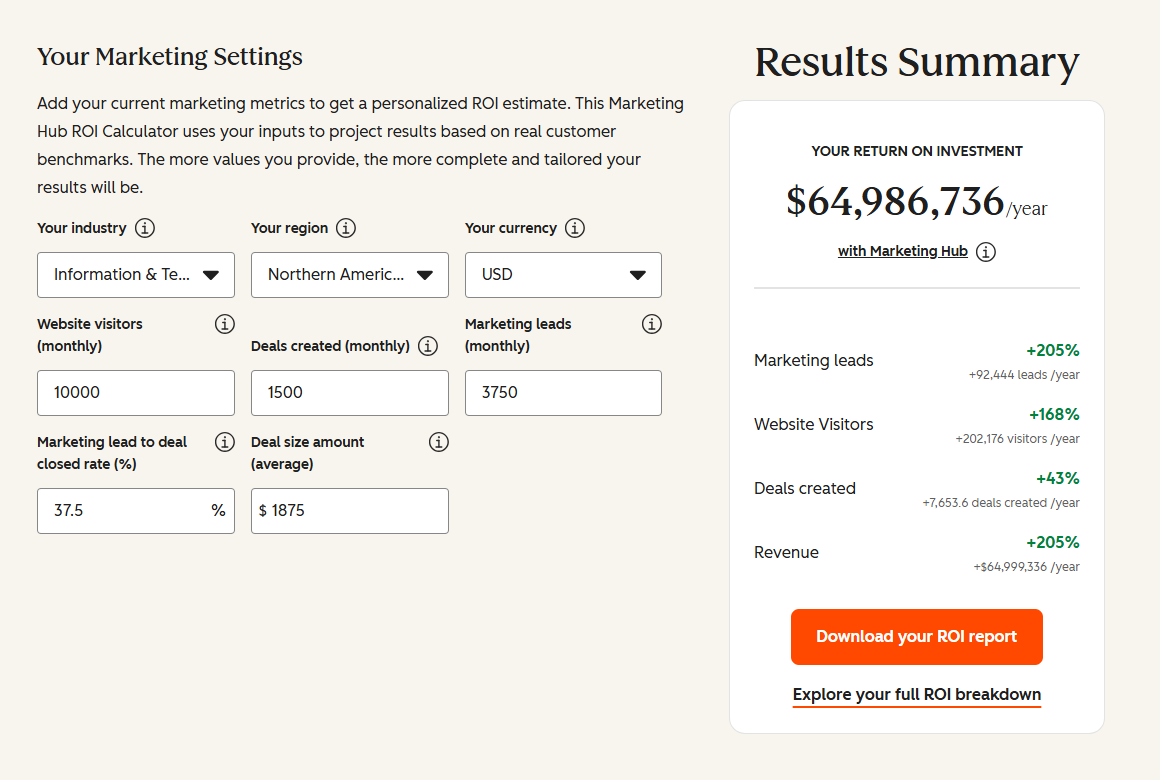
See your 12-month revenue impact with HubSpot CRM
Enter your current numbers — visitors, leads, deal size — and get a personalized projection based on real HubSpot customer benchmarks.
Final answer
HubSpot custom objects are the right move when your business needs to track a real entity, not just extra fields.
If a record has its own lifecycle, relationships, and operational importance, forcing it into contact, company, or deal properties usually creates more cleanup later. A well-designed custom object gives you cleaner reporting, better workflows, and a CRM model that reflects the business more accurately.
That is why custom objects are not just a technical feature. They are a data-architecture decision.


Table of Contents
- What a custom object actually is in HubSpot
- Why teams reach for custom objects in the first place
- When a custom property is enough
- When a custom object becomes the better answer
- A practical decision framework
- What good custom object use cases look like
- How custom objects work structurally
- How to design a custom object before you build it
- How custom objects affect workflows, reporting, and integrations
- Who should use custom objects?
- How to know your design is working
- A deeper design checklist before you create a custom object
- How custom objects change workflow design
- What to avoid after the custom object goes live
- Frequently asked questions
- Final answer