












Explore this article with AI:
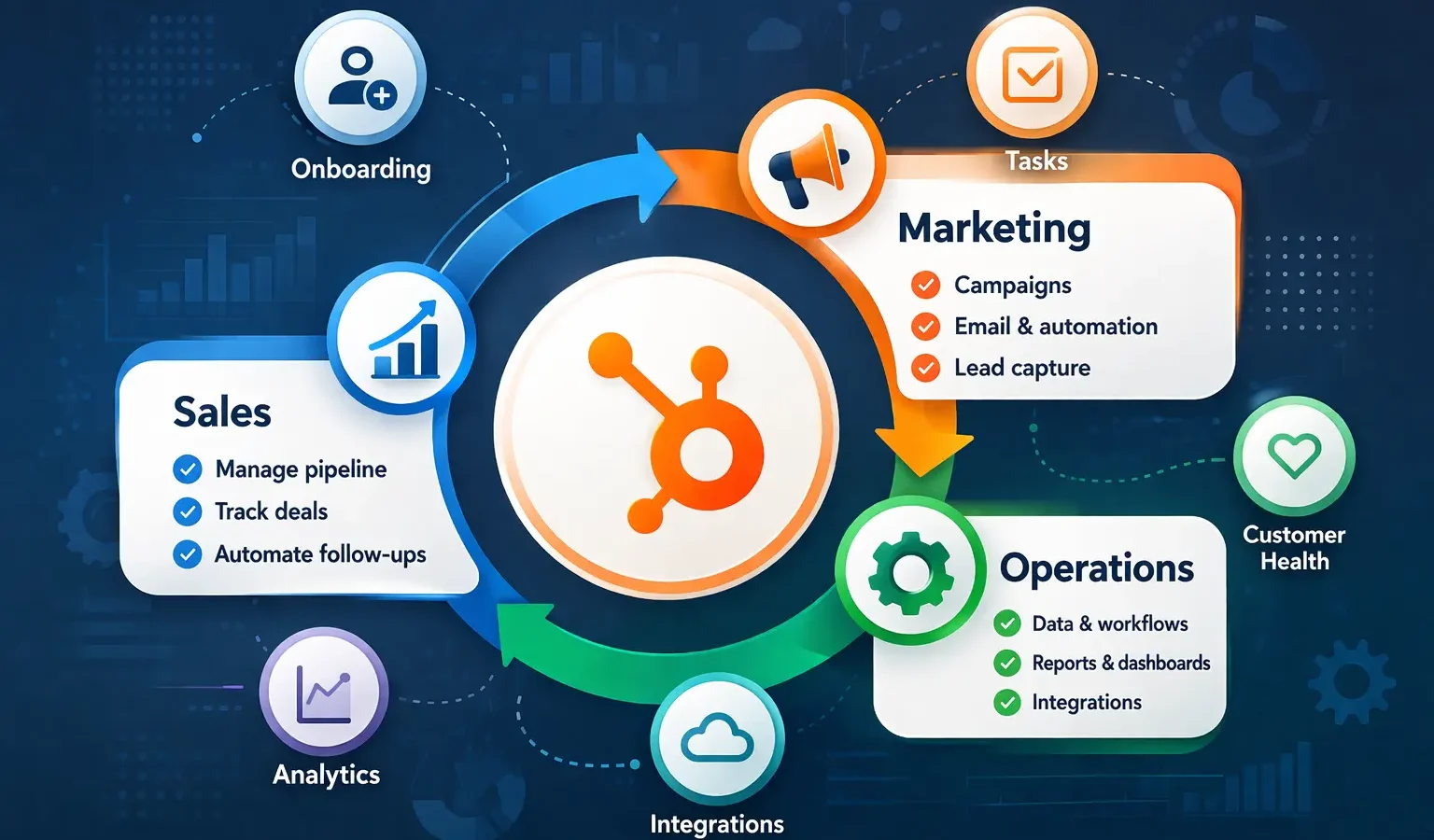
Revenue Operations (RevOps) unites your sales, marketing, and operations teams around shared metrics, data, and processes. When you build RevOps on HubSpot, you create a single source of truth that eliminates data silos, reduces friction between teams, and drives predictable revenue growth. This alignment matters: companies with strong RevOps visibility close deals 23% faster and retain customers 34% longer. HubSpot serves as the hub for this alignment because it connects customer data, pipeline visibility, and operational workflows in one platform. If your teams work in isolation today, RevOps reorganizes them around revenue outcomes instead.
Free estimator
Know what your HubSpot project costs before the first call.
Select your services and get a transparent price range in minutes. No sales call needed to get a number.
Connect HubSpot to your ERP, billing platform, or database field mapping, custom logic, and support included.
Pipelines, workflows, email templates, and reporting configured for how your team actually works.
Live, role-based sessions with recordings and written guides built around a custom plan for your team.
HubSpot Partner
Client retention
Platforms integrated
What Is RevOps and Why Does It Matter?
RevOps is the operational philosophy that treats revenue generation as a unified business function, not separate departments. Instead of sales optimizing conversion, marketing optimizing lead quality, and operations managing tools, RevOps unifies these teams under one revenue goal.
Here’s why this matters: when teams don’t share data, processes, or goals, you get friction. Sales complains that marketing sends unqualified leads. Marketing doesn’t know why deals stall in the pipeline. Operations spends time manually syncing data across disconnected tools. Each handoff introduces delay, and delay kills revenue.
RevOps fixes this. According to Forrester research, RevOps-aligned companies experience 208% faster revenue growth and 34% higher customer retention. That’s not because RevOps is magic. It’s because alignment removes waste.
How HubSpot Powers RevOps Alignment?
HubSpot exists to solve RevOps problems. The platform gives your entire team visibility into the complete customer journey, from first touch to renewal. Here’s how HubSpot enables RevOps alignment:
Single Source of Truth: HubSpot stores all customer data in one system. Sales, marketing, and operations access the same contact records, deal stages, and interaction history. No more contradictory spreadsheets or fragmented databases.
- Pipeline Transparency: Everyone sees the same deal pipeline. Marketing understands which leads convert. Sales understands which marketing sources drive quality opportunities. Operations can forecast cash flow with confidence.
- Automated Workflows: HubSpot automates handoffs between teams. When marketing qualifies a lead, HubSpot routes it to the right sales rep. When a deal closes, HubSpot triggers fulfillment workflows. No more manual work. No more delays.
- Unified Reporting: One dashboard shows revenue metrics that matter to everyone. Sales sees deal velocity. Marketing sees pipeline influence. Operations sees cost per acquired customer. Shared metrics drive shared accountability.

Turn HubSpot Into A Real-Time SMS Engine with
Message IQ

Two-Way Conversations

Shared Team Inbox

Automation Triggers

Advanced Reporting

Compliance Tools
-
98%
SMS read within 3 min -
78%
Buy from first responder -
21×
More likely to qualify
3–5 min avg response
$45–$50 ROI / $1

*MessageIQ is an IntegrateIQ product – built natively for HubSpot by the same team.
What Are the Four Pillars of RevOps on HubSpot?
Building RevOps requires four foundational pillars. Each one depends on HubSpot, and each one breaks down if you skip it.
- People and Accountability: RevOps starts with assigning clear roles and ownership. You need a RevOps leader who sits above the sales, marketing, and operations teams and holds them accountable to shared metrics. This leader typically reports to the Chief Revenue Officer (CRO) or CEO. Without this accountability structure, teams revert to optimizing for their own KPIs instead of collective revenue.
- Processes and Workflows: RevOps teams document how leads flow from marketing to sales, how opportunities progress through sales stages, and how customers transition to success. HubSpot automates these workflows. When marketing passes a lead to sales, HubSpot notifies the right rep, logs the handoff, and tracks responsiveness. These workflows remove bottlenecks.
- Technology and Integration: RevOps requires a clean, integrated tech stack. HubSpot acts as the central hub, but it needs to connect with your ERP, data warehouse, customer success platform, and forecasting tools. Integrate IQ specializes in building these integrations. When your tools talk to each other, your teams get the data they need without manual export-import cycles.
- Data Quality and Governance: Clean data is non-negotiable. If your HubSpot database contains duplicate records, missing fields, or outdated information, your reporting fails and your workflows misfire. RevOps teams implement data governance standards to ensure accuracy. This includes regular database audits, validation rules, and accountability for data entry.
How Do Sales and Marketing Align Through HubSpot?
The friction between sales and marketing stems from misalignment on lead quality. Marketing sends volume. Sales complains about quality. Neither side understands the other’s constraints.
HubSpot eliminates this friction through shared definitions and closed-loop reporting. First, the teams jointly define what a Marketing Qualified Lead (MQL) looks like. This might include: company size, industry, job title, engagement level, and fit score. HubSpot’s lead scoring engine enforces this definition automatically.
Second, HubSpot tracks which leads convert to customers. Marketing sees which campaigns generate the highest-quality leads. Sales understands which sources deliver ripe opportunities. When a deal closes, both teams celebrate the win. When a lead goes cold, they analyze why together.
Third, HubSpot automates the handoff. When a lead hits MQL status, HubSpot automatically routes it to the next available sales rep, logs the assignment, and measures sales response time. This removes the email about who gets the lead and keeps both teams focused on conversion.
How Do You Connect Operations to the Revenue Engine?
Operations teams often sit outside the revenue conversation. They manage tools, data, and process hygiene, but they don’t own revenue targets. This disconnection costs money.
RevOps redefines the operations role. Operations teams own the infrastructure that enables revenue growth. They manage HubSpot configuration, integrations, data quality, and reporting. They partner with sales and marketing to design workflows that reduce friction. They analyze bottlenecks in the customer journey and recommend process improvements.
Practically, this means operations teams should own these responsibilities: First, maintain the HubSpot database. This includes regular audits, duplicate detection, field standardization, and record validation. Second, manage integrations between HubSpot and your ERP, billing system, and data warehouse. When data flows cleanly between systems, reporting becomes reliable. Third, design and maintain workflows. When sales complains about manual work, operations streamlines the process with automation. Fourth, build dashboards that answer revenue questions. Operations creates reports that sales, marketing, and leadership use to make decisions.
Why Is Data Integration Critical for RevOps Success?
RevOps fails when teams work with incomplete or contradictory data. If your HubSpot instance doesn’t connect to your ERP, your sales team won’t see which customers have paid invoices. If HubSpot doesn’t sync with your data warehouse, your analysts can’t answer complex questions about customer lifetime value. If HubSpot doesn’t talk to your billing system, you’ll miss revenue recognition deadlines.
Data integration solves this. When HubSpot connects to your entire tech stack through APIs and webhooks, information flows in real-time. Your sales team sees updated customer payment status in HubSpot. Your operations team automatically closes invoices in the ERP when deals close in HubSpot. Your analysts build predictive models on clean, current data.
Integration isn’t one-time work. You need an integration partner who understands both HubSpot and your legacy systems. Integrate IQ, as a HubSpot Diamond Solutions Partner, has integrated more than 300+ platforms with HubSpot, processing over 20 billion records with 98.5% data accuracy. We design integrations that connect your HubSpot instance to your ERP, data warehouse, billing system, and customer success platform, ensuring your RevOps infrastructure runs smoothly.
Need help auditing your integrations or finding missing connections? Check out our guide on top HubSpot integrations for revenue growth. If you need custom integrations specific to your workflow, our team can help with that as well.
What Metrics Should RevOps Teams Track?
Metrics tie teams to outcomes. RevOps teams track metrics that matter across all three functions: sales, marketing, and operations.
- Revenue metrics measure the outcome: Monthly Recurring Revenue (MRR), Annual Recurring Revenue (ARR), win rate, average contract value (ACV), and customer acquisition cost (CAC). Every team understands that these numbers matter. Marketing owns CAC. Sales owns win rate and ACV. Operations owns data quality that enables accurate reporting.
- Velocity metrics measure how fast deals progress: lead response time, time to MQL, sales cycle length, and deal cycle time. When velocity slows, RevOps investigates why. Is a specific stage causing delays? Does a particular sales rep move deals slower than others? These metrics surface problems early.
- Quality metrics measure how qualified your pipeline is: MQL-to-SQL conversion rate, lead-to-customer conversion, and deal prediction accuracy. Strong quality metrics mean marketing sends qualified leads, sales focuses on winnable deals, and forecasts prove accurate.
HubSpot’s reporting tools let you build dashboards for each metric. Your RevOps leader reviews these dashboards weekly and takes action when trends shift. This creates accountability without micromanagement.
What Challenges Arise When Building RevOps?
RevOps sounds logical in theory. In practice, implementation faces predictable obstacles.
Resistance from teams is the biggest hurdle. Sales wants autonomy. Marketing wants to own lead generation. Operations wants to stay technical. Nobody wants a new authority figure telling them they’re doing things wrong. The solution is leadership alignment. If the CEO and CRO don’t publicly support RevOps, it dies. They need to communicate that RevOps is about enabling teams, not controlling them.
Messy data creates technical obstacles. If your HubSpot database contains duplicates, incomplete records, or inconsistent field values, you can’t build reliable workflows or reports. Clean your data before you build RevOps on top of it. This takes time but it’s non-negotiable.
Tool fragmentation prevents integration. If your sales team uses one CRM, marketing uses another tool for lead management, and operations uses a third tool for forecasting, you can’t create a unified system. Pick HubSpot as your central hub and build integrations to everything else.
Lack of executive sponsorship dooms RevOps. You need a leader with enough authority to change processes across three departments. This person needs to report directly to the CRO or CEO. Without that power, RevOps becomes a suggestion that teams ignore.
How Do You Start Building RevOps Today?
RevOps doesn’t happen overnight. Start with these steps:
- Step 1: Get executive buy-in. Present the business case to your CRO or CEO. Show them the data: RevOps-aligned companies grow 208% faster. This needs to be a top-down initiative.
- Step 2: Audit your data. Conduct a database health check on your current HubSpot instance. Count duplicates, identify missing fields, assess field standardization. This audit reveals what needs to be fixed before you build RevOps on top of it.
- Step 3: Map your processes. Document how leads move through your organization. When does marketing pass a lead to sales? What happens when a deal closes? What triggers a customer success handoff? Draw this out. This becomes your RevOps blueprint.
- Step 4: Build integrations. Connect HubSpot to your ERP, billing system, data warehouse, and customer success platform. These connections ensure that information flows without manual work.
- Step 5: Design workflows and automation. Use HubSpot’s automation tools to enforce your process. Route leads to the right sales rep. Alert managers when deals stall. Trigger fulfillment workflows when deals close. Automation removes manual work.
- Step 6: Build dashboards and reports. Create the metrics framework. Show each team what they own and how they’re performing. Use HubSpot’s reporting tools or connect to a data visualization platform.
- Step 7: Iterate and improve. RevOps is not a one-time project. Every quarter, review your metrics, identify bottlenecks, and optimize. This continuous improvement compounds over time.
Frequently Asked Questions
Do we need a dedicated RevOps person?
Yes. RevOps requires someone with organizational authority to align three departments. This person needs to report to the CRO or CEO. Smaller companies can combine RevOps with sales operations, but don’t try to bolt RevOps onto someone’s existing full-time role. It won’t get the attention it deserves.
How long does it take to implement RevOps?
Implementation typically takes 3-6 months. Data cleanup takes 4-8 weeks. Workflow design and automation takes 4-6 weeks. Integration takes 2-4 weeks depending on your tech stack. Reporting and dashboards take 2-3 weeks. Then you spend months iterating and optimizing.
How much does RevOps cost?
RevOps costs depend on your starting point. A small company with a clean HubSpot instance might spend $30,000-50,000 on implementation. A large company with messy data and multiple integrations might spend $100,000-250,000. The ROI typically appears within 12 months: faster sales cycles, higher win rates, and lower CAC add up quickly. Use Integrate IQ’s to estimate your potential return.
What happens if we don’t have clean data?
Messy data kills RevOps. You can’t build reliable workflows on bad data, and you can’t trust reports built from incomplete records. Before you implement RevOps, commit to a data cleanup project. This includes duplicate detection, field standardization, and validation rules. It’s not glamorous, but it’s essential. Learn more about
Can we build RevOps without HubSpot?
Technically yes, but HubSpot makes it much easier. You need a system that all three teams use, that automates workflows, and that provides unified reporting. HubSpot is built for this. If you’re using a different CRM, you can build RevOps, but you’ll face more friction. Consider evaluating HubSpot if RevOps is a priority.
How do we handle sales resistance to RevOps?
Sales resistance usually stems from fear that RevOps will reduce their autonomy. Combat this by showing sales teams how RevOps helps them. RevOps provides better leads, removes administrative work, and gives sales rep reps visibility into the full customer journey. Frame RevOps as a tool that helps sales win, not as a control mechanism.
Should we hire an external RevOps consultant?
It depends on your expertise. If your team has strong HubSpot knowledge and process improvement skills, you can build RevOps internally. If you’re new to HubSpot or your data is messy, hiring a consultant accelerates results. Integrate IQ has guided 300+ companies through RevOps implementations. We can advise on strategy, help with data cleanup, build integrations, and train your team.
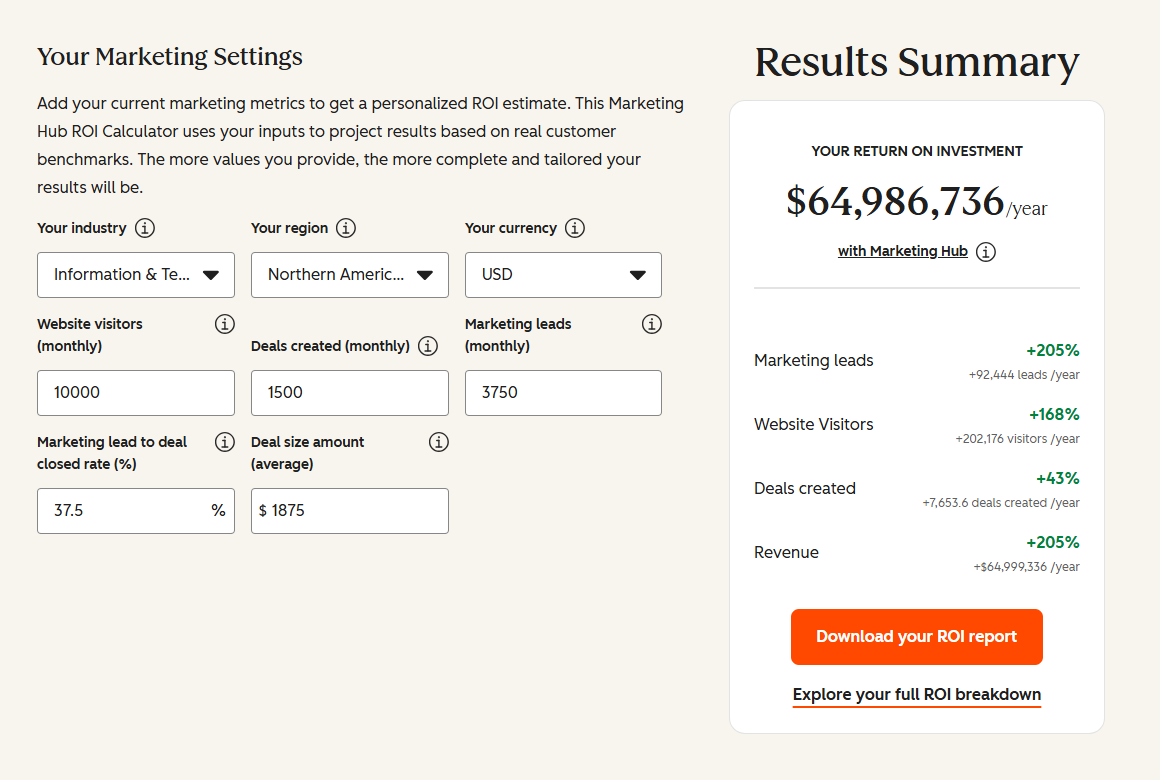
See your 12-month revenue impact with HubSpot CRM
Enter your current numbers — visitors, leads, deal size — and get a personalized projection based on real HubSpot customer benchmarks.
The Bottom Line
Revenue Operations transforms how companies grow. By aligning sales, marketing, and operations around HubSpot, you eliminate silos, reduce friction, and drive predictable revenue growth. The companies winning today don’t just have better salespeople or better marketers. They have aligned systems that enable their teams to work together.
RevOps starts with a decision: your leadership team commits to alignment, invests in data quality, and builds the infrastructure to support it. HubSpot provides the platform. Your RevOps leader owns the execution. Your teams embrace the shared accountability.
Ready to build RevOps? Start with an honest assessment of where you are today. Audit your data, map your processes, and identify the gaps. Then engage a partner who understands HubSpot deeply. Integrate IQ specializes in exactly this: we help companies build RevOps infrastructure on HubSpot, connect their entire tech stack, and train their teams to maintain it.
Want to explore how RevOps could transform your business? Get a free consultation.



Table of Contents
- What Is RevOps and Why Does It Matter?
- How HubSpot Powers RevOps Alignment?
- What Are the Four Pillars of RevOps on HubSpot?
- How Do Sales and Marketing Align Through HubSpot?
- How Do You Connect Operations to the Revenue Engine?
- Why Is Data Integration Critical for RevOps Success?
- What Metrics Should RevOps Teams Track?
- What Challenges Arise When Building RevOps?
- How Do You Start Building RevOps Today?
- Frequently Asked Questions
- The Bottom Line