
Explore this article with AI:

Fintech marketing teams want the same automation and personalization every other SaaS company gets from HubSpot. The catch is that every workflow has to survive a compliance review first, and most generic HubSpot advice doesn’t account for that. The best practices for integrating HubSpot in fintech marketing start with architecture, not automation. You build for compliance, connect the systems that actually carry client data, and only then layer on the lead scoring and personalization that make HubSpot worth using in the first place.
Free estimator
Know what your HubSpot project costs before the first call.
Select your services and get a transparent price range in minutes. No sales call needed to get a number.
Connect HubSpot to your ERP, billing platform, or database field mapping, custom logic, and support included.
Pipelines, workflows, email templates, and reporting configured for how your team actually works.
Live, role-based sessions with recordings and written guides built around a custom plan for your team.
HubSpot Partner
Client retention
Platforms integrated
What is HubSpot fintech integration?
A HubSpot fintech integration connects HubSpot’s marketing, sales and service tools to the financial systems a fintech company already runs, things like core banking platforms, loan origination software, payment processors, and compliance archiving tools. The goal is one accurate record of each client or prospect that marketing can act on without creating regulatory exposure.
We’ve built integrations across banking, lending, and financial services for years as a HubSpot Diamond Solutions Partner with custom integration accreditation. The pattern repeats itself on almost every project. Teams that get real value from HubSpot treat integration as the foundation, not an afterthought. Teams that struggle bolt it on after the workflows are already live, then spend months untangling sync conflicts nobody planned for. Here’s what the first group does differently.
Build Compliance Into the Architecture, Not as a Bolt-On
Compliance can’t be a paragraph you write after the workflows are done. It has to shape how you set up properties, permissions, and approval steps from day one.
Start with consent. Create separate subscription types for product updates, marketing communications, and compliance alerts, so a client who opts out of promotional email still receives the disclosures they’re legally entitled to. Layer role-based permissions on top of that, so only the people who should see sensitive financial data can see it inside HubSpot.
Marketing materials in financial services usually need a review step before anything goes out. Set up approval workflows that route content to your compliance team before publication, not after. This sounds like it slows you down. In practice, it’s faster than pulling a published campaign and explaining to a regulator why it went out without review.
Record-keeping matters just as much. FINRA Rule 4511 requires member firms to preserve client communications for at least six years. HubSpot’s email logging gives you a usable audit trail out of the box, but it wasn’t built specifically for WORM-compliant (write once, read many) retention. If your firm needs that level of archiving, plan for a third-party integration like Smarsh or Global Relay alongside HubSpot rather than assuming native logging covers it.

Turn HubSpot Into A Real-Time SMS Engine with
Message IQ

Two-Way Conversations

Shared Team Inbox

Automation Triggers

Advanced Reporting

Compliance Tools
-
98%
SMS read within 3 min -
78%
Buy from first responder -
21×
More likely to qualify
3–5 min avg response
$45–$50 ROI / $1

*MessageIQ is an IntegrateIQ product – built natively for HubSpot by the same team.
Decide Native Connector vs. Custom Integration Before You Scope Anything Else
This is the decision most fintech marketing teams skip, and it’s the one that determines whether your project finishes in eight weeks or drags on for six months.
HubSpot’s app marketplace handles templated connections well. Payment processors, common marketing tools, and standard SaaS products usually have a native connector that installs in an afternoon. Core banking platforms, loan origination systems (LOS), and legacy databases almost never do. Those need a custom-built bi-directional sync through HubSpot’s API, with real engineering behind field mapping, authentication, and error handling.
Use this as a quick gut check before you scope a project:
- Does the system have a documented, maintained API? If yes, a custom integration is realistic. If you’re working with a proprietary mainframe or a system your vendor barely supports, budget for discovery work before anything else.
- Does the data need to flow both ways? A one-way sync from your core system into HubSpot is simpler and cheaper than a bi-directional sync where HubSpot writes back into a system of record.
- How many objects are involved? Syncing contacts and deals is a different scope than syncing contacts, custom loan objects, transaction history, and compliance flags all at once.
- What’s the tolerance for sync delay? Real-time sync costs more to build and maintain than a scheduled batch sync running every 15 or 30 minutes, and most marketing use cases don’t actually need real-time.
| Native Connector | Custom API Integration | |
| Best for | Payment processors, standard SaaS tools, simple data needs | Core banking, LOS platforms, legacy databases |
| Setup time | Days | Weeks (typically 8 weeks from kickoff) |
| Field mapping | Limited, pre-built | Fully custom |
| Maintenance | Vendor-managed | Requires ongoing technical ownership |
| Cost | Low to none | Scoped project investment |
Skip this step and you’ll find out the hard way, usually three weeks into a project when someone discovers the core system has no public API and the “quick integration” everyone assumed was possible isn’t.
Unify Your Data Before You Automate Anything
Automation built on bad data just produces bad outcomes faster. Before you build a single workflow, get the data itself right.
Audit what you have. Pull a sample from your existing systems and check for completeness, duplicate records and inconsistent formatting across phone numbers, company names, and addresses. Deduplicate before migration, not after, because cleaning up duplicate contact records once they’re already triggering workflows in HubSpot is a much bigger job.
Map your custom fields deliberately. A loan origination system and HubSpot rarely use the same field names or data types for the same concept, so someone needs to own the mapping decisions, not leave them to default settings.
Migrate in phases. Move a small batch first, verify it landed correctly, then move the rest. We’ve seen teams try to migrate everything in one pass and spend weeks reconciling errors that a phased approach would have caught in the first batch.
This is also where data hygiene stops being a one-time project and becomes an ongoing discipline. Assign someone to own record source tracking, so you know whether a lead came from a form, an integration, or manual entry. That visibility is what makes attribution reporting trustworthy later.
Score Behavior, Not Just Demographics
Demographic fit tells you who a prospect is. Behavioral data tells you whether they’re actually close to becoming a customer, and for fintech companies running a freemium or product-led model, behavior matters more than title or company size.
Combine both. Use firmographic fields like company size, industry and role for fit, and pair them with behavioral signals like product usage events, feature activation, or API calls. A developer at a ten-person startup hitting your API a thousand times a day is a stronger signal than a VP at a large company who downloaded one whitepaper.
Build composite scoring into your lifecycle stage automation so contacts move from Subscriber to Lead to Marketing Qualified Lead to Product Qualified Lead to Sales Qualified Lead based on the combined score, not a single threshold. This is the difference between a marketing team that’s guessing at intent and one that’s actually tracking it.
Automate Client-Facing Workflows That Actually Need Automation
Not every step in a fintech client journey deserves a workflow. The ones that do tend to be repetitive, time-sensitive, and easy to get wrong by hand.
Client onboarding is the obvious starting point. Automate task assignments, document requests, and follow-up sequences so a new client doesn’t fall through the cracks between application and account setup. For lending businesses specifically, connect your loan origination system to HubSpot so document collection and application status updates trigger automatically instead of relying on someone remembering to send an email.
KYC and AML checks are another strong candidate. Manual data entry across multiple systems during onboarding is slow and prone to error, and it’s exactly the kind of repetitive task automation handles better than a person checking boxes across three different tools.
Compliance reminders deserve the same treatment. Build workflows that flag upcoming review dates, disclosure renewals, or required client communications so nothing slips because someone was busy that week.
What Breaks When You Skip the Integration Step
This is the part most fintech marketing content skips entirely, and it’s the part that actually matters once you’re past the planning stage.
Sync conflicts happen when a field gets updated in your core system and HubSpot at the same time, and there’s no clear rule for which value wins. Without a defined system of record for each field, you end up with contact records that contradict themselves depending on which system you check last.
Late or malformed data breaks lead scoring quietly. If product usage events arrive into HubSpot a day late or with missing fields, your scoring model is working off incomplete information without anyone realizing it until the numbers stop making sense.
Field mapping failures between a core banking system and HubSpot properties are common when the mapping was set up once and never revisited. Account types, product names, or status codes that change on the banking side don’t automatically update on the HubSpot side, and the mismatch usually surfaces in a report someone’s trying to present to leadership.
“We’ll connect it properly later” is the sentence that costs the most. A workaround built to hit a launch date almost always becomes the permanent solution, and untangling it after a year of accumulated workflows is a far bigger project than building it right the first time would have been.
Align Sales and Marketing With Shared SLAs
Misalignment between sales and marketing is one of the most common sources of lost revenue in financial services, and it’s almost always a data problem before it’s a communication problem.
Set up lead handoff automation so a marketing qualified lead routes to the right rep automatically, with a clear SLA for first follow-up. Track whether that SLA gets met, not just whether the lead was assigned. A lead that sits in a queue for three days because of an SLA nobody’s actually watching produces the same outcome as no automation at all.
Give both teams visibility into the same data. Sales should see the marketing engagement history on a contact, and marketing should see what happens to leads after handoff. Sharing one system, rather than two systems that occasionally sync, is what actually closes the gap.
Implementation Timeline: What to Actually Expect
Most fintech HubSpot integration projects we run complete within eight weeks of kickoff, broken into phases rather than one long buildout.
- Discovery and data audit (weeks 1-2): Map existing systems, audit data quality, and define which fields need bi-directional sync versus one-way sync.
- Migration and field mapping (weeks 3-4): Migrate data in phases, validate accuracy, and finalize custom field mapping between systems.
- Workflow and integration build (weeks 4-6): Build the actual API connections, automation workflows, and lead scoring model.
- Compliance review (weeks 6-7): Run completed workflows through compliance review before anything goes live to real contacts.
- Training and adoption (weeks 7-8): Train marketing, sales, and service teams on the new system so adoption doesn’t stall after launch.
Timelines extend when the core system integration is custom-built rather than a native connector, which is exactly why deciding that question early in the process matters so much.
Frequently Asked Questions
Does HubSpot meet FINRA and GDPR requirements for financial services marketing?
HubSpot provides email logging, consent management, and approval workflows that support FINRA and GDPR compliance efforts, but it doesn’t automatically make your marketing compliant. You still need to configure subscription types, permissions, and review workflows correctly, and firms with strict WORM retention needs typically pair HubSpot with a third-party archiving tool.
Can HubSpot connect to core banking systems and loan origination software?
Yes, but usually through a custom API integration rather than a native connector, since most core banking and LOS platforms aren’t in HubSpot’s app marketplace. The integration needs to handle authentication, field mapping, and sync direction carefully because these systems are typically the system of record for client data.
How long does a HubSpot fintech integration typically take?
Most projects complete within eight weeks of kickoff when the work is scoped clearly upfront, covering discovery, data migration, workflow build, compliance review, and training. Custom integrations with complex core systems can run longer depending on how many objects and data sources are involved.
What’s the difference between HubSpot’s native connectors and a custom integration?
Native connectors are pre-built, vendor-maintained, and work well for standard SaaS tools and payment processors, usually set up in days. Custom integrations are built specifically for your systems through HubSpot’s API, take longer to build, and are necessary for core banking platforms, LOS systems, and legacy databases that don’t have a marketplace app.
How does lead scoring work for fintech companies with freemium or product-led models?
Lead scoring for product-led fintech companies combines demographic fit with behavioral signals like product usage, feature activation, and API calls, rather than relying on demographic data alone. Contacts move through lifecycle stages based on a composite score, which gives marketing and sales a clearer signal of actual buying intent than firmographics alone.
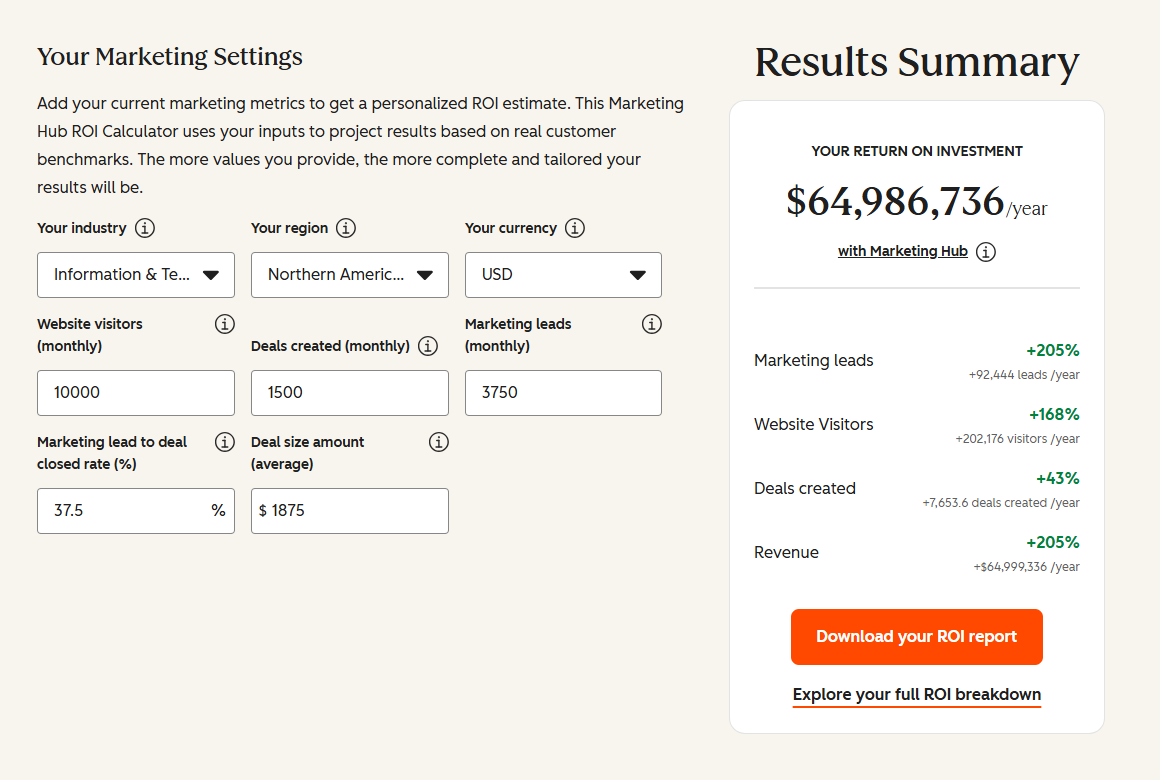
See your 12-month revenue impact with HubSpot CRM
Enter your current numbers — visitors, leads, deal size — and get a personalized projection based on real HubSpot customer benchmarks.
Ready to Connect Your Fintech Stack to HubSpot the Right Way?
If your core banking system, loan origination platform, or compliance tools still don’t talk to HubSpot, you’re either doing manual workarounds or living with data you can’t fully trust. We’ve connected over 300 platforms and processed more than 20 billion records annually as a HubSpot Diamond Solutions Partner, and most fintech integration projects we scope complete within eight weeks of kickoff.
Learn more about how we approach financial services integrations on our Banking and Finance industry page, or see our HubSpot integration process to understand how a project like this actually runs from discovery to launch.


Table of Contents
- What is HubSpot fintech integration?
- Build Compliance Into the Architecture, Not as a Bolt-On
- Decide Native Connector vs. Custom Integration Before You Scope Anything Else
- Unify Your Data Before You Automate Anything
- Score Behavior, Not Just Demographics
- Automate Client-Facing Workflows That Actually Need Automation
- What Breaks When You Skip the Integration Step
- Align Sales and Marketing With Shared SLAs
- Implementation Timeline: What to Actually Expect
- Frequently Asked Questions
- Ready to Connect Your Fintech Stack to HubSpot the Right Way?