












Explore this article with AI:

Most guides on HubSpot CRM for marketing read like a guided tour of HubSpot’s pricing page. This isn’t one of those.
We’re a HubSpot Diamond Solutions Partner with custom integration accreditation. We’ve built the data layer that makes HubSpot CRM useful for marketing teams at 300+ companies. So this guide skips the feature parade and goes after what actually matters: how to use HubSpot CRM for marketing at mid-market scale, what the platform handles cleanly, where it breaks, and what has to be true underneath for any of it to deliver real revenue.
We’ll cover the marketing tools bundled with the free CRM, the real cost of upgrading to Marketing Hub, the workflow most teams set up first, and the integration problem that quietly kills more HubSpot marketing programs than any feature gap. If you’re a CMO, head of demand gen, or marketing operations lead trying to figure out whether HubSpot is the right foundation for your marketing engine, this is for you.
Free estimator
Know what your HubSpot project costs before the first call.
Select your services and get a transparent price range in minutes. No sales call needed to get a number.
Connect HubSpot to your ERP, billing platform, or database field mapping, custom logic, and support included.
Pipelines, workflows, email templates, and reporting configured for how your team actually works.
Live, role-based sessions with recordings and written guides built around a custom plan for your team.
HubSpot Partner
Client retention
Platforms integrated
What HubSpot CRM Is for Marketers
HubSpot CRM is a contact and customer data platform that ships with marketing, sales, service, and content tools built into the same database. For marketing teams, that database becomes the single source of truth that powers email campaigns, lead nurturing workflows, audience segmentation, and revenue attribution.
The thing that separates HubSpot from sales-only CRMs like Salesforce or Pipedrive: HubSpot was designed from day one to align marketing and sales around the same contact record. When marketing captures a lead through a form, sales sees the entire engagement history before the first call. When sales updates a deal stage, marketing’s automation can react. There’s no Frankenstein integration tying the two worlds together. They were born together. That said, HubSpot still has to talk to Salesforce or other sales platforms in plenty of mid-market stacks, which is its own conversation.
The free tier of HubSpot CRM gives marketing teams real tools, not a stripped-down demo. Forms, landing pages, basic email, simple contact lists, and a contact database that holds up to 1 million records. That’s enough to run lightweight marketing for a small business indefinitely.
The catch comes when you need automation, lead scoring, attribution, or smart content. Those live in Marketing Hub, and Marketing Hub has a pricing structure that surprises a lot of marketing leaders. We’ll get to that in a minute.
The Marketing Tools That Come With HubSpot CRM
Free HubSpot CRM includes a working set of marketing tools, not a teaser. You get forms (with progressive profiling on paid tiers), landing pages with templates, ad management for Google and Meta, basic email marketing capped at 2,000 sends per month, simple contact lists, and a chatflow builder. For a five-person company doing inbound marketing, that’s a real platform.
Where the line gets drawn is automation. The free CRM doesn’t give you workflow automation. It doesn’t give you lead scoring, manual or predictive. It doesn’t give you smart content, A/B testing, or attribution beyond first touch. It doesn’t give you SEO recommendations inside the CMS. For any of that, you’re in Marketing Hub territory.
Here’s what the tier jump actually looks like:
| Tier | Approx. Price (Annual Billing) | Marketing Contacts Included | Key Marketing Features |
| Free | $0 | 1,000 | Forms, landing pages, basic email (2k/mo cap), simple lists, ad management |
| Marketing Hub Starter | ~$15/seat/mo + contact tier | 1,000 (add-ons available) | Email marketing, basic automation, basic reporting, conversational bots |
| Marketing Hub Professional | ~$890/mo (3 seats, 2k contacts) | 2,000 (scales) | Workflows, smart content, A/B testing, lead scoring, SEO tools, campaign reporting |
| Marketing Hub Enterprise | ~$3,600/mo (5 seats, 10k contacts) | 10,000 (scales) | Custom objects, multi-touch attribution, predictive scoring, behavioral events |
Two things to know about that pricing.
First, “Marketing Contacts” is its own pricing model and it bites. HubSpot lets you store up to a million contacts in your CRM, but you only pay marketing pricing on the contacts you actively market to. Lifecycle stages and Marketing Contact toggles control this. Teams that don’t manage this setting carefully wake up to five-figure overage bills after a big import.
Second, the gap from Starter to Professional is real. Around $15 per seat per month to roughly $890 per month is not a small upgrade. For a three-person marketing team that needs workflow automation, you’re committing to about $10K per year before contacts. We see a lot of mid-market companies stuck on Starter trying to MacGyver workflows out of static lists and sequences, then jumping to Pro the day someone asks for attribution data.
For the Enterprise tier, the unlock is custom objects, behavioral event triggers, multi-touch attribution, and predictive lead scoring. These matter for B2B marketing teams running complex programs (account-based marketing, channel partner programs, product-led growth with usage data). Most mid-market marketing teams we work with land on Marketing Hub Professional plus the right integrations. Professional gives you the workflow muscle. The integrations make sure the data inside those workflows actually reflects your customer. That second half is what most teams underestimate, and it’s exactly what our HubSpot integration services exist for.

Turn HubSpot Into A Real-Time SMS Engine with
Message IQ

Two-Way Conversations

Shared Team Inbox

Automation Triggers

Advanced Reporting

Compliance Tools
-
98%
SMS read within 3 min -
78%
Buy from first responder -
21×
More likely to qualify
3–5 min avg response
$45–$50 ROI / $1

*MessageIQ is an IntegrateIQ product – built natively for HubSpot by the same team.
How to Actually Use HubSpot CRM for Marketing
A working HubSpot marketing motion runs on five connected steps. None of them are exotic. The execution is what separates teams getting compounding returns from teams running expensive newsletters.
- Capture leads through every channel. Build forms for high-intent pages (demo, pricing, contact). Build pop-ups for medium-intent pages (blog posts, resource pages). Add a chatbot that qualifies and routes. Connect every form, pop-up, and chat conversation to the same HubSpot contact record. The mistake here: marketing teams build 14 forms with overlapping fields and end up with duplicate contacts and broken segmentation. Decide on a master field schema before you build form #1.
- Segment with smart lists, not static. A static list is a snapshot. A smart list updates automatically based on contact properties, engagement data, or lifecycle stage. Smart lists are the foundation for personalized email, dynamic content, and workflow enrollment. The mistake here: marketers default to static lists because they’re faster to set up, then wonder why their campaigns underperform. Smart lists need real contact properties to filter on, which brings us to the data problem we’ll cover next.
- Score leads to find revenue. Marketing Hub Professional gives you manual lead scoring, where you decide what “hot” means and assign points. Enterprise adds predictive scoring, where HubSpot’s model picks up on patterns you can’t see. Manual scoring works fine until you have more than around 5,000 active leads. After that, predictive earns its keep because human-set rules don’t keep up with shifting buyer behavior.
- Nurture with workflows. A workflow is HubSpot’s automation engine. It enrolls contacts based on a trigger (form fill, list membership, page view, custom event), runs a series of actions (send email, update property, create task, branch on behavior), and exits when goals are hit. The basic nurture workflow: enroll on demo request, send a sequence of three educational emails over 10 days, branch on open or click, hand off to sales when a high-intent action happens. Workflows are where Marketing Hub Professional starts paying for itself.
- Attribute revenue back to marketing. Multi-touch attribution shows you which marketing touchpoints contributed to closed-won deals, weighted by position in the journey. This sits in Marketing Hub Enterprise, but it’s the answer to “is marketing actually generating pipeline.” Without it, you’re guessing.
This sequence is the standard mid-market marketing motion. It works as long as your contact records are accurate, your properties are filled in, and the data flowing into HubSpot reflects what’s actually happening with the customer. That last condition is the one that breaks.
Where HubSpot CRM Hits Its Limit for Marketing
The constraint that defines whether your investment in HubSpot pays off: HubSpot Marketing Hub can only personalize, score, and attribute the data it can see.
Three failure modes show up over and over again.
Failure mode 1: The data is somewhere else
Most mid-market companies have customer data scattered across NetSuite, Shopify, Magento, custom databases, and legacy CRMs they haven’t fully retired. Order history sits in the e-commerce platform. Subscription status sits in the billing system. Service tickets sit in Zendesk. HubSpot Marketing Hub doesn’t know about any of it unless something pushes it in. So your “lapsed customer” segment can’t fire because HubSpot doesn’t know who’s lapsed. Your high-LTV nurture can’t fire because HubSpot doesn’t know LTV.
Failure mode 2: The native connector ships a subset
HubSpot’s App Marketplace has 2,000+ apps. Most are perfectly fine for the basics. The trouble starts when your business needs more than the basics. A native NetSuite connector might sync 10 standard fields but ignore your custom revenue category. A Shopify connector might sync orders but not abandoned cart line items. Your segmentation breaks at the edges where the connector wasn’t designed to go.
Failure mode 3: Lifecycle stages get corrupted by multiple writers
In a properly built HubSpot setup, lifecycle stage is sacred. It controls whether a contact sits in marketing’s universe or sales’ universe, whether they get marketed to (and counted as a Marketing Contact), and which automations they’re eligible for. When more than one system writes to that field with different rules, lifecycle stages flip back and forth, and Marketing Contacts overage bills follow.
These aren’t HubSpot’s fault. HubSpot is doing exactly what it’s built to do: act on the data it has. The fix lives in the integration layer underneath. Done right, the integration syncs the right fields in the right direction with conflict resolution rules and audit logging, so HubSpot has the data it needs to actually run the marketing programs you’re paying it to run.
We’ve moved 20 billion records through these integrations in the past year and 7 million fields sync daily through the live ones. The pattern that breaks the data problem is consistent: real custom integration work on the platforms that matter, native connectors for the ones where they’re enough, and a clean field map that nobody fudges.

Native Connector vs Custom Integration: When You Need Each
Both options have a place. Picking the right one for each system in your stack saves money and saves the marketing program from quiet decay.
| Use a Native Connector When… | Use a Custom Integration When… |
| The system holds standard, predictable fields | Custom objects or non-standard fields are involved |
| One-way sync covers the use case | Real-time, two-way sync is required |
| Volume sits under ~100K records (batch sync is fine) | More than ~50 fields per object need to move |
| The vendor maintains the connector and ships fixes | Sync logic needs business rules or transformations |
| You can live with the field set the connector exposes | You need full error handling, retry logic, and audit trail |
A few real examples from our work. A B2B SaaS company syncing Stripe subscription events into HubSpot to drive churn-risk nurture: native connector covered 80% of cases but missed seat changes, which were the actual churn signal. We rebuilt it as a custom integration. A multi-warehouse e-commerce brand running ABM campaigns based on order history across nine entity codes: the native Shopify connector ignored entity codes entirely, so we built custom. A staffing firm pushing Avionté placement data into HubSpot for re-engagement campaigns: pure custom build, no native option exists.
The decision usually isn’t “all native” or “all custom.” Most stacks we build use 60 to 70 percent native connectors for the standard systems (Gmail, Slack, Calendly, simple form tools) and custom for the systems holding the data marketing actually depends on (CRM, ERP, e-commerce, billing, service).
If marketing is going to commit to HubSpot as the source of truth, that decision frame has to happen before the first workflow gets built, not after the first quarter of attribution reports comes back wrong.
What Implementation Looks Like
Eight weeks is a typical timeline for a mid-market HubSpot CRM marketing setup with the integration layer included. Here’s what the weeks usually look like on our projects (the longer view lives on our HubSpot integration process page).
Weeks 1–2: Discovery and data audit
We map every system that holds customer data, every field that has to flow into HubSpot, and every conflict that has to get resolved. Marketing leads, sales leads, and operations leads sit in these sessions because field decisions made now show up in workflows for years.
Weeks 3–5: Integration build and test
Engineers build the connectors (custom where it counts, native where it works), set up field mappings, build conflict resolution rules, and run end-to-end tests on a sandbox HubSpot portal.
Weeks 6–7: Sync go-live, workflow setup, lifecycle stage mapping
Data starts flowing into the live HubSpot portal. Marketing operations builds the smart lists, lead scoring rules, and core nurture workflows on top of clean data. Lifecycle stage logic gets locked down so Marketing Contacts pricing stays predictable. If you’re also moving off another CRM at the same time, this is when the CRM data migration piece happens.
Week 8: Training and handoff
The marketing team gets walkthroughs on the workflows, attribution dashboards, and how to add new fields without breaking the integration. Documentation gets handed over. From there, our HubSpot onboarding team can stay involved as long as the team needs hands-on support.
We’ve shipped this exact pattern for 300+ HubSpot integrations and our client retention sits at 98.5%. The number that matters most: marketing teams running on a properly built setup don’t spend the first quarter debugging data. They spend it shipping campaigns.
A Real Outcome
RealGreen is a field service management platform serving lawn care and pest control companies. They needed marketing campaigns inside HubSpot to react in real time to operational data living inside RealGreen (job statuses, customer service interactions, route assignments). A native connector didn’t exist.
We built the integration. Marketing campaigns now react to live operational events from RealGreen, which means cancellation-risk nurture fires when a customer’s account hits the patterns that historically precede churn, not weeks later when manual reporting catches up. Full case study here: HubSpot RealGreen integration for lawn care marketing.
The pattern repeats across verticals. Marketing programs that depend on operational data only work as well as the integration layer underneath them.
Frequently Asked Questions
Is HubSpot CRM free for marketing?
Yes. HubSpot CRM has a free tier that includes forms, landing pages, basic email marketing (capped at 2,000 sends per month), ad management, simple contact lists, and chat. The free tier supports up to 1 million contacts. Paid Marketing Hub tiers add automation, lead scoring, smart content, A/B testing, and attribution.
What’s the difference between HubSpot CRM and HubSpot Marketing Hub?
HubSpot CRM is the underlying contact and customer data platform, and it’s free. Marketing Hub is the paid marketing software that sits on top of the CRM and adds workflow automation, lead scoring, advanced email, attribution, and SEO tools. You can use the CRM without Marketing Hub, but you can’t use Marketing Hub without the CRM underneath.
Can HubSpot replace Marketo or Mailchimp?
For most mid-market companies, yes. Marketing Hub Professional and Enterprise cover the workflow automation, segmentation, and attribution that Marketo handles, with simpler setup. Mailchimp is mostly an email tool, so Marketing Hub Starter or Pro is a clear upgrade. The honest exception: very large enterprises running highly complex multi-channel orchestration sometimes need Marketo or Salesforce Marketing Cloud’s depth in specific areas. For everyone else, HubSpot wins on usability and total cost of ownership. Our HubSpot vs Marketo comparison goes deeper on the tradeoffs.
How does HubSpot CRM handle lead scoring for marketing?
Marketing Hub Professional includes manual lead scoring, where you set rules and assign points based on contact properties, engagement, or behavior. Marketing Hub Enterprise adds predictive lead scoring, where HubSpot’s model identifies patterns in your closed-won data and scores accordingly. Manual scoring works for most teams up to about 5,000 active leads. Above that, predictive earns its cost.
Does HubSpot CRM integrate with my existing marketing tools?
HubSpot’s App Marketplace has 2,000+ native integrations covering most popular tools. The native integrations work well for standard use cases. For systems holding business-critical data with custom fields, custom objects, or specific sync logic (most ERPs, custom databases, complex e-commerce setups), a custom integration usually delivers better data quality and downstream campaign performance.
How long does it take to implement HubSpot for marketing?
A basic setup with no integrations can run in two to four weeks. A full mid-market implementation with custom integrations to ERP, e-commerce, and other operational systems typically runs eight weeks. Enterprise implementations with multiple custom integrations and complex data migrations can run 10 to 14 weeks. Skipping the integration phase and turning on workflows against incomplete data is the most common cause of failed HubSpot marketing programs.
How much does HubSpot Marketing Hub really cost?
Marketing Hub Starter starts around $15 per seat per month plus contact tier costs. Marketing Hub Professional starts around $890 per month for 3 seats and 2,000 marketing contacts. Marketing Hub Enterprise starts around $3,600 per month for 5 seats and 10,000 marketing contacts. The most-missed cost is the Marketing Contacts overage. Teams that don’t manage their lifecycle stage logic carefully can see annual bills jump by tens of thousands when their contact database grows.
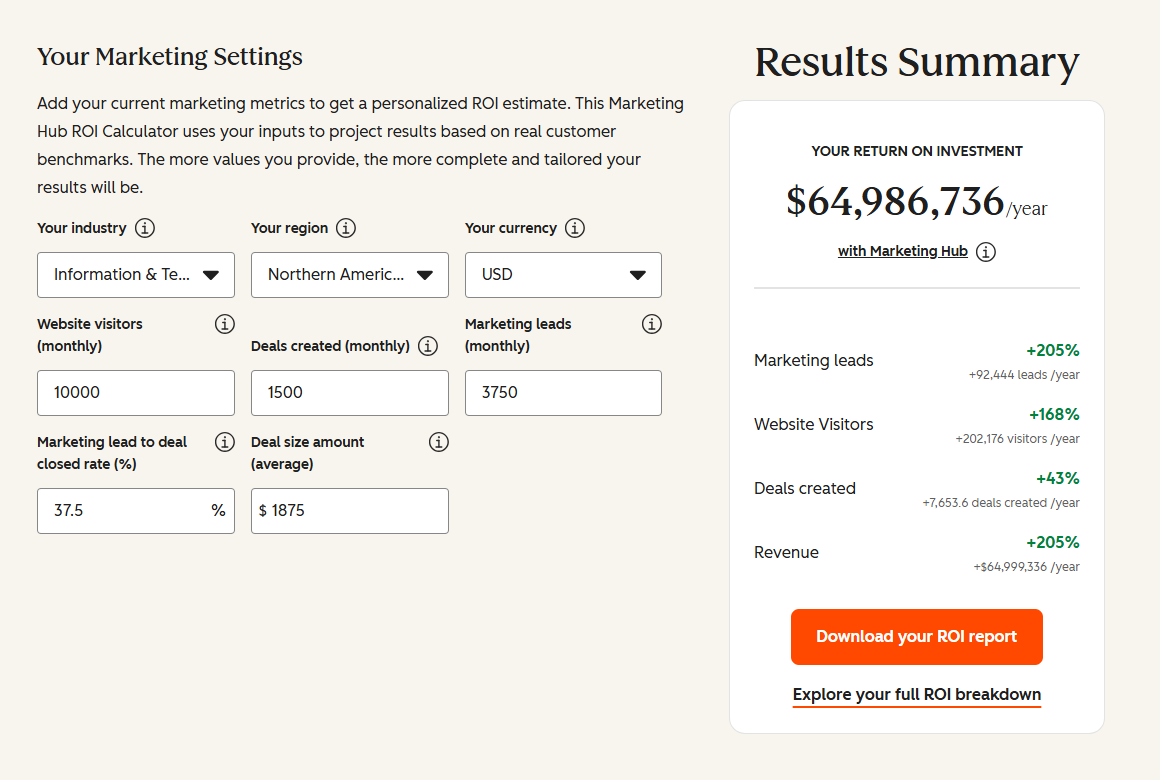
See your 12-month revenue impact with HubSpot CRM
Enter your current numbers — visitors, leads, deal size — and get a personalized projection based on real HubSpot customer benchmarks.
Ready to Make HubSpot Your Marketing Source of Truth?
If your marketing team is staring at HubSpot trying to figure out where the customer data should live, the answer is HubSpot. The harder question is what has to happen for the data to actually get there. We’ve answered it for 300+ HubSpot integrations and we ship complete builds in eight weeks.
See exactly how we approach HubSpot integration for marketing teams: Our HubSpot integration process.

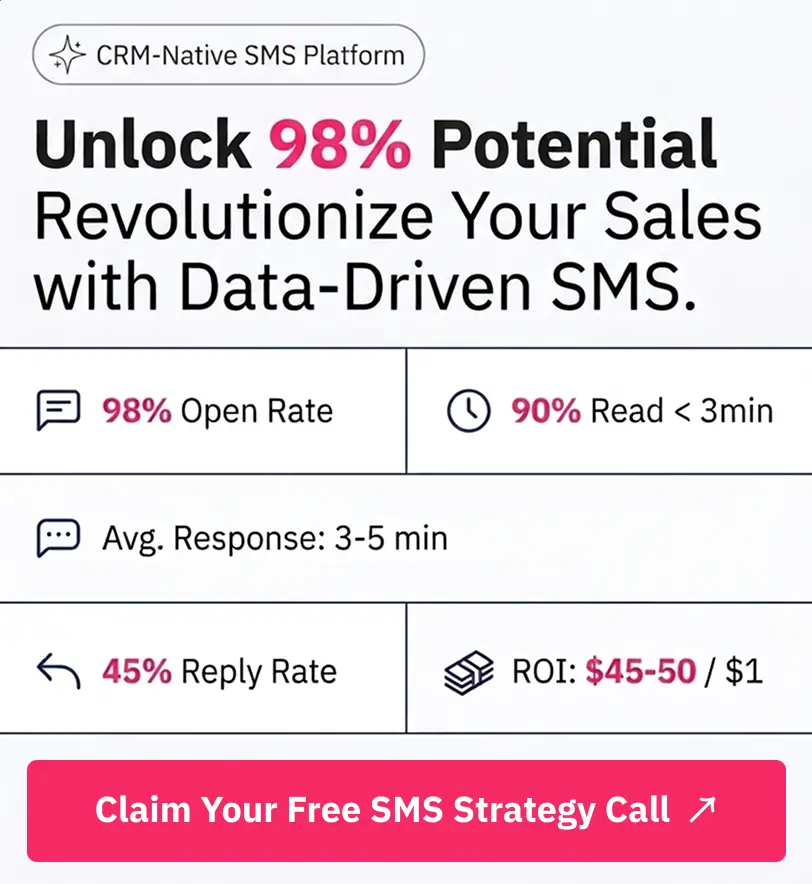
Table of Contents
- What HubSpot CRM Is for Marketers
- The Marketing Tools That Come With HubSpot CRM
- How to Actually Use HubSpot CRM for Marketing
- Where HubSpot CRM Hits Its Limit for Marketing
- Native Connector vs Custom Integration: When You Need Each
- What Implementation Looks Like
- A Real Outcome
- Frequently Asked Questions
- Ready to Make HubSpot Your Marketing Source of Truth?