

Explore this article with AI:

Construction companies hear about HubSpot constantly. Marketing agencies recommend it. Software review sites rank it. HubSpot’s own sales team pitches it. And yet, most construction professionals who sign up end up staring at a generic CRM dashboard wondering how any of this applies to tracking bids, coordinating subcontractors, or managing the handoff from estimating to operations.
That gap between HubSpot’s potential and construction’s reality is exactly where things go wrong. The platform can absolutely work for construction companies. We’ve seen it firsthand through our custom integration work with construction suppliers and manufacturers, including a Northwest construction supplier that unified their entire sales data flow through HubSpot and Epicor. But making it work requires construction-specific configuration that goes well beyond the default setup.
This guide covers how to actually set up HubSpot for construction companies: the pipeline stages you’ll need, the custom properties worth creating, the integrations that connect HubSpot to your project management and accounting tools, and the honest limitations you should know about before committing. We wrote this for operations leaders, VPs of Sales, and CTOs at construction companies who want practical guidance, not vendor marketing.
Free estimator
Know what your HubSpot project costs before the first call.
Select your services and get a transparent price range in minutes. No sales call needed to get a number.
Connect HubSpot to your ERP, billing platform, or database field mapping, custom logic, and support included.
Pipelines, workflows, email templates, and reporting configured for how your team actually works.
Live, role-based sessions with recordings and written guides built around a custom plan for your team.
HubSpot Partner
Client retention
Platforms integrated
Why Construction Companies Choose HubSpot Over Industry-Specific CRMs
HubSpot wins the construction CRM conversation for one simple reason: it does marketing, sales, service, and operations in a single platform. Construction-native tools like Buildertrend, Procore, and JobNimbus dominate project management. Followup CRM owns bid tracking for commercial contractors. But none of them give you the full picture from the first website visit through the signed contract, into project delivery, and back out to warranty service and referral marketing.
That full-lifecycle view matters because construction sales cycles are long. A commercial GC might spend 6 to 18 months nurturing a relationship before winning a bid. During that time, the prospect interacts with marketing content, attends an event, gets follow-up emails, has discovery calls, receives a site visit, and goes through estimating. If your CRM only tracks the deal stage and ignores everything that happened before the bid, you’re flying blind on attribution and relationship history.
HubSpot also scales in ways that construction-specific tools can’t. A five-person residential remodeling crew can start with the free CRM and add hubs as they grow. A 200-person commercial GC can run enterprise-tier Sales Hub with custom objects, advanced reporting, and API-level integrations. That flexibility matters because construction companies rarely stay the same size, and switching CRMs mid-growth is painful.
The tradeoff is real, though. Buildertrend gives you project scheduling, selections management, and client portals out of the box. Procore handles RFIs, submittals, and progress billing natively. JobNimbus owns roofing-specific workflows with inspection documentation and insurance claim tracking. HubSpot handles none of those things on its own. It handles the customer relationship side brilliantly, and it connects to the tools that handle the rest. That connection piece is where we’ve built our reputation, having integrated 300+ platforms with HubSpot across industries, including construction suppliers and manufacturers.
How to Configure HubSpot for Construction Pipelines and Properties
The default HubSpot deal pipeline ships with generic stages like ‘Appointment Scheduled‘ and ‘Contract Sent.’ These mean nothing to a construction company. Your pipeline needs to reflect how construction projects actually move from first contact to signed contract and handoff to operations.
Construction Pipeline Template
Here’s a pipeline structure we’ve seen work across residential and commercial construction companies:
- New Lead: Contact details captured from a web form, phone call, referral, or networking event. Entry criteria: name, email or phone, project type, and source.
- Qualified Lead: Budget, location, timeline, and scope align with your capabilities. You’ve confirmed this through an initial phone conversation.
- Site Visit Scheduled: Discovery meeting or walkthrough booked. Photos, measurements, and scope documentation happen here.
- Estimate In Progress: Takeoff, vendor quotes, labor calculations, and pricing underway. This is where estimating teams take ownership.
- Bid Submitted: Proposal or tender delivered to the client. The clock starts on follow-up sequences.
- Negotiation: Scope, price, timeline, or payment terms under discussion. Change orders may already be part of the conversation.
- Contract Signed: Deal won. Handoff to operations, project management, and scheduling begins.
- Lost / On Hold: Project cancelled, delayed indefinitely, or awarded to a competitor. Capture the loss reason.
Each stage should have clear entry criteria so your team knows exactly when to move a deal forward. Vague stages like ‘In Progress’ create messy pipelines where deals sit for months without anyone knowing their true status.
Construction-Specific Custom Properties
HubSpot’s default properties cover the basics: company name, contact info, deal amount. Construction companies need more. Here are the custom properties worth creating on day one:
- Job Type (dropdown): Residential New Build, Residential Remodel, Commercial New Build, Commercial Tenant Improvement, Specialty Trade
- Estimated Project Value (currency): Separate from deal amount if your bid price differs from the total project value
- Project Address (text): The job site address, distinct from the client’s business address
- Square Footage (number): Critical for estimating and comparing job profitability
- Permit Status (dropdown): Not Started, Application Submitted, Under Review, Approved, Expired
- Insurance Carrier (text): Especially important for restoration and roofing contractors
- Subcontractor Count (number): Tracks project complexity
- Project Start Date (date): Scheduled start, distinct from contract signed date
- Warranty Expiration (date): Triggers automated follow-up sequences for post-project service
- Lead Source Detail (dropdown): Referral, Website, Google Ads, Houzz, HomeAdvisor, Angi, Networking, Drive-by
For companies tracking inspections, permits, or change orders as independent entities, HubSpot custom objects open up a whole new layer. You can create a ‘Job Site’ custom object that associates with multiple contacts (homeowner, architect, GC) and multiple deals (phases of work). Or create an ‘Inspection’ object that tracks inspection type, date, pass/fail status, and inspector notes. Custom objects require Operations Hub Professional or Enterprise, but they transform HubSpot from a generic CRM into a construction-specific data model.

Turn HubSpot Into A Real-Time SMS Engine with
Message IQ

Two-Way Conversations

Shared Team Inbox

Automation Triggers

Advanced Reporting

Compliance Tools
-
98%
SMS read within 3 min -
78%
Buy from first responder -
21×
More likely to qualify
3–5 min avg response
$45–$50 ROI / $1

*MessageIQ is an IntegrateIQ product – built natively for HubSpot by the same team.
HubSpot Construction Integrations: Connecting Procore, Buildertrend, and Your Back Office
A CRM that lives in isolation creates more problems than it solves. Construction companies run on a stack of specialized tools, and HubSpot needs to talk to all of them. The question is how.
Three integration methods exist, and each has a place in a construction tech stack:
Method 1: Native HubSpot Marketplace Apps
HubSpot’s App Marketplace includes connectors for some construction-adjacent tools. Buildertrend offers a native integration that syncs lead data from HubSpot into Buildertrend for job conversion. The sync currently flows one direction (HubSpot to Buildertrend), which means you can transfer contacts and deal information when a lead converts to a job. Setup takes minutes through Buildertrend’s Company Settings. QuickBooks Online has a well-supported native integration for syncing invoices, payments, and financial data directly with HubSpot deals.
Native apps work best for simple, high-volume data syncs where you’re moving contacts, companies, or basic deal data between two platforms. They’re low-maintenance and require minimal technical expertise.
Method 2: iPaaS Tools (Zapier, Make)
Procore connects to HubSpot through Zapier, and the most common workflow creates new Procore projects automatically when a HubSpot deal reaches a specific stage. This works for basic sales-to-operations handoffs. Zapier also handles simpler automations like creating HubSpot contacts from Procore worker records or updating deal stages based on Procore project status changes.
iPaaS tools fit when you need point-to-point connections between two specific platforms with moderate data volumes. They struggle with complex field mapping, error handling at scale, and bi-directional syncs where data conflicts can occur.
Method 3: Custom API Integrations
When you need real-time bi-directional sync, complex field mapping, or connections to ERP systems like Sage, NetSuite, or Dynamics 365, custom API integrations become necessary. This is the approach we take at Integrate IQ for construction clients who need their estimating software, accounting system, and project management platform all feeding clean data into HubSpot.
Our Epicor integration for a Northwest construction supplier demonstrates this well. The client needed real-time inventory and pricing data flowing from Epicor into HubSpot so sales reps could quote accurately without switching platforms. A native app couldn’t handle the data complexity. A Zapier workflow would’ve hit rate limits within days. The custom integration processes the data reliably, and it’s part of the 20 billion+ records we move through our integrations annually.
Integration Method Comparison for Construction
| Criteria | Native App | iPaaS (Zapier/Make) | Custom API |
| Setup Time | Minutes to hours | Hours to days | 4 to 8 weeks |
| Data Complexity | Basic fields only | Moderate mapping | Complex transforms, custom objects |
| Sync Direction | Usually one-way | Bi-directional possible | Full bi-directional with conflict resolution |
| Error Handling | Limited | Basic retry logic | Custom error handling, alerting, logging |
| Best For | Buildertrend lead sync, QuickBooks invoices | Procore project creation, simple automations | ERP sync, multi-system architecture, high volume |
| Cost Range | Free to $50/mo | $20 to $200/mo | Project-based (scoping required) |

What HubSpot Can’t Do for Construction Out of the Box
Honesty builds more trust than a feature checklist. Here’s what HubSpot doesn’t do natively, and why that’s not necessarily a dealbreaker:
- No built-in estimating or takeoff tools. You’ll keep using your estimating software (RSMeans, STACK, Bluebeam, PlanSwift) and feed results into HubSpot deal records through integration or manual entry.
- No project scheduling or Gantt charts. Procore, Buildertrend, Microsoft Project, and Primavera own this space. HubSpot tracks the deal. Your PM tool tracks the project.
- No progress billing or AIA billing. Construction accounting lives in Sage, QuickBooks, NetSuite, or Viewpoint. HubSpot can reflect payment milestones through deal properties, but it won’t generate G702/G703 forms.
- No RFI or submittal management. These workflows belong in Procore, PlanGrid, or Autodesk Construction Cloud. HubSpot tracks the client relationship around the project, not the project documentation itself.
- No lien waiver or retainage tracking. Specialized construction accounting handles this. HubSpot can store the status as a custom property, but the actual document workflow lives elsewhere.
None of these gaps make HubSpot wrong for construction. They make HubSpot one piece of a larger stack. The CRM handles client relationships, lead nurturing, sales pipeline, and post-project follow-up. Specialized tools handle project execution. Integration connects them.
The companies that struggle with HubSpot in construction are the ones that expect it to replace Procore or Buildertrend. The companies that succeed use HubSpot for what it’s built for and connect it to everything else.
When to Choose a Custom Integration vs. a Native Connector
This decision comes down to five factors. Walk through them before committing to any integration approach:
- Data volume: If you’re syncing fewer than 100 records per day between two platforms, a native app or Zapier handles it fine. If you’re processing thousands of records daily across multiple systems, custom API integration prevents bottlenecks and rate limit issues.
- Field mapping complexity: Simple name-and-email syncs work with any method. But when you need to map construction-specific fields like permit status, subcontractor associations, or multi-phase project data between an ERP and HubSpot, you need custom logic.
- Sync frequency: If near-real-time data matters (sales reps quoting from live inventory or pricing data), custom integrations with webhook-driven updates outperform scheduled batch syncs from iPaaS tools.
- Error handling requirements: When a sync fails in Zapier, you get a notification. When a sync fails in a custom integration, you get detailed logging, automatic retry logic, and alerting that tells your team exactly which records failed and why.
- Long-term cost of ownership: Zapier at $200/month for 3 years costs $7,200. A custom integration project costs more upfront but runs at near-zero marginal cost once deployed. For high-value construction integrations, the break-even point often arrives within 12 to 18 months.
At Integrate IQ, we scope every construction integration project during a discovery phase that maps your actual data flows before recommending an approach. We’ve maintained a 98.5% client retention rate because we recommend the right method, even when that method doesn’t involve us. Sometimes a native app or Zapier workflow genuinely fits. When it doesn’t, we build custom integrations that typically go live within 8 weeks of kickoff.

Implementation Timeline: What to Expect When Setting Up HubSpot for Construction
Most HubSpot setups for construction companies follow a predictable timeline when done properly. Rushing any phase creates problems that compound later.
Weeks 1 to 2: Discovery and Workflow Mapping. Map your actual sales process from lead intake through handoff to operations. Document every pipeline stage, identify the custom properties you need, and audit your existing tools for integration requirements. This is the phase most companies skip, and skipping it is the #1 reason CRM setups fail in construction. Building the CRM around how you wish things worked instead of how they actually work guarantees low adoption.
Weeks 3 to 4: Pipeline Build, Data Migration, and Custom Object Setup. Configure your pipeline stages, create custom properties, set up custom objects if needed, and import your existing contacts and deals. Clean your data before importing. Messy data from old spreadsheets or a previous CRM poisons everything downstream, from list segmentation to reporting accuracy.
Weeks 5 to 6: Integration Configuration and Testing. Connect HubSpot to your project management software, accounting system, and any other tools in your stack. Test each integration with real data. Verify that field mappings are correct, sync timing meets your needs, and error handling catches edge cases.
Weeks 7 to 8: Team Training, Go-Live, and Iteration. Train your team on the exact workflows they’ll use daily. Show them how updating a deal stage triggers downstream actions. Let them see real-time data flowing from integrations. Go live with a small team first, gather feedback, and iterate before rolling out company-wide.
This 8-week timeline matches what we deliver at Integrate IQ across integration projects. Some simpler setups finish faster. Complex multi-system integrations with ERP connections might extend to 10 or 12 weeks. But 8 weeks covers most construction companies moving from disconnected tools to a unified HubSpot-centered stack.
Frequently Asked Questions About HubSpot for Construction
Is HubSpot a good CRM for construction companies?
HubSpot works well for construction companies that need marketing, sales, and service management in one platform, especially when they have a multi-tool tech stack to integrate. It excels at lead nurturing, pipeline visibility, and automation. For companies that primarily need project management with light CRM features, a construction-specific tool like Buildertrend or Procore might fit better.
Can HubSpot track construction bids and proposals?
Yes. You can configure deal pipelines with construction-specific stages (Site Visit, Estimate In Progress, Bid Submitted, Negotiation, Contract Signed) and attach custom properties for project value, job type, and bid deadline. HubSpot tracks every interaction from initial inquiry through contract signing, and automated sequences handle bid follow-up reminders.
Does HubSpot integrate with Procore or Buildertrend?
Buildertrend offers a native HubSpot integration that syncs lead and contact data. Procore connects through Zapier for basic project creation from deal stages. For deeper integrations involving bi-directional sync, complex field mapping, or ERP connections, custom API integrations provide the reliability and data depth that construction companies require.
How much does HubSpot cost for a construction company?
HubSpot’s free CRM covers basic contact and deal management. Starter plans begin at $20/month per seat for individual hubs. Professional tiers (where you get custom properties, advanced automation, and reporting) start at $100/month per seat. Most construction companies we work with run Professional or Enterprise tiers across Sales and Marketing hubs. Integration costs are separate and depend on complexity.
How long does it take to set up HubSpot for construction?
A proper implementation, including pipeline configuration, custom properties, data migration, integration setup, and team training, takes 6 to 8 weeks for most construction companies. Rushing the process leads to low adoption and messy data. IntegrateIQ’s standard delivery timeline for integration projects is 8 weeks from kickoff.
Can HubSpot replace construction project management software like Procore?
HubSpot handles customer relationships, sales pipelines, and marketing automation. It doesn’t replace project scheduling, RFI management, progress billing, or field documentation tools. The strongest construction tech stacks use HubSpot for the CRM layer and connect it to Procore, Buildertrend, or similar tools for project execution through integrations.
What custom properties should a construction company create in HubSpot?
Start with Job Type, Estimated Project Value, Project Address, Square Footage, Permit Status, Subcontractor Count, Project Start Date, Warranty Expiration, and Lead Source Detail. Expand from there based on your specific workflows. Residential contractors may need Insurance Carrier and Claim Number fields. Commercial GCs may need Bid Bond Status and Retainage Percentage.
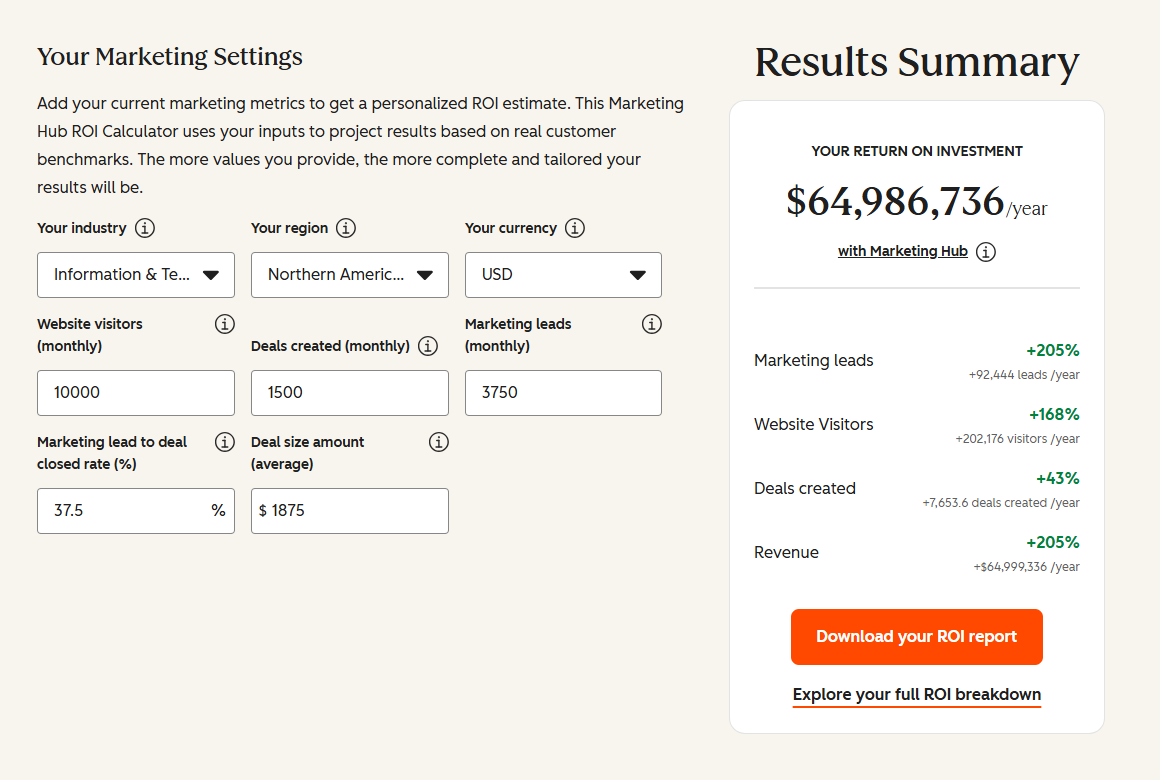
See your 12-month revenue impact with HubSpot CRM
Enter your current numbers — visitors, leads, deal size — and get a personalized projection based on real HubSpot customer benchmarks.
Your Construction Tech Stack Should Actually Talk to Each Other
If you’re running HubSpot alongside Procore, Buildertrend, Sage, QuickBooks, or any combination of construction tools, and data still lives in silos, that’s the problem we solve.
We’re a HubSpot Diamond Solutions Partner with custom integration accreditation. We’ve connected 300+ platforms to HubSpot, processed over 20 billion records through our integrations, and we’ve done it specifically for industries with complex data needs, including construction suppliers and manufacturers.
Most integration projects go live within 8 weeks. We’ll scope your specific needs, recommend the right integration method (native, iPaaS, or custom API), and build the data architecture that makes HubSpot actually work for your construction business.
See how our integration process works: https://integrateiq.com/our-hubspot-integration-process/
Or start a conversation about your stack: https://integrateiq.com/contact-us/


Table of Contents
- Why Construction Companies Choose HubSpot Over Industry-Specific CRMs
- How to Configure HubSpot for Construction Pipelines and Properties
- HubSpot Construction Integrations: Connecting Procore, Buildertrend, and Your Back Office
- What HubSpot Can't Do for Construction Out of the Box
- When to Choose a Custom Integration vs. a Native Connector
- Implementation Timeline: What to Expect When Setting Up HubSpot for Construction
- Frequently Asked Questions About HubSpot for Construction
- Your Construction Tech Stack Should Actually Talk to Each Other

