
Explore this article with AI:
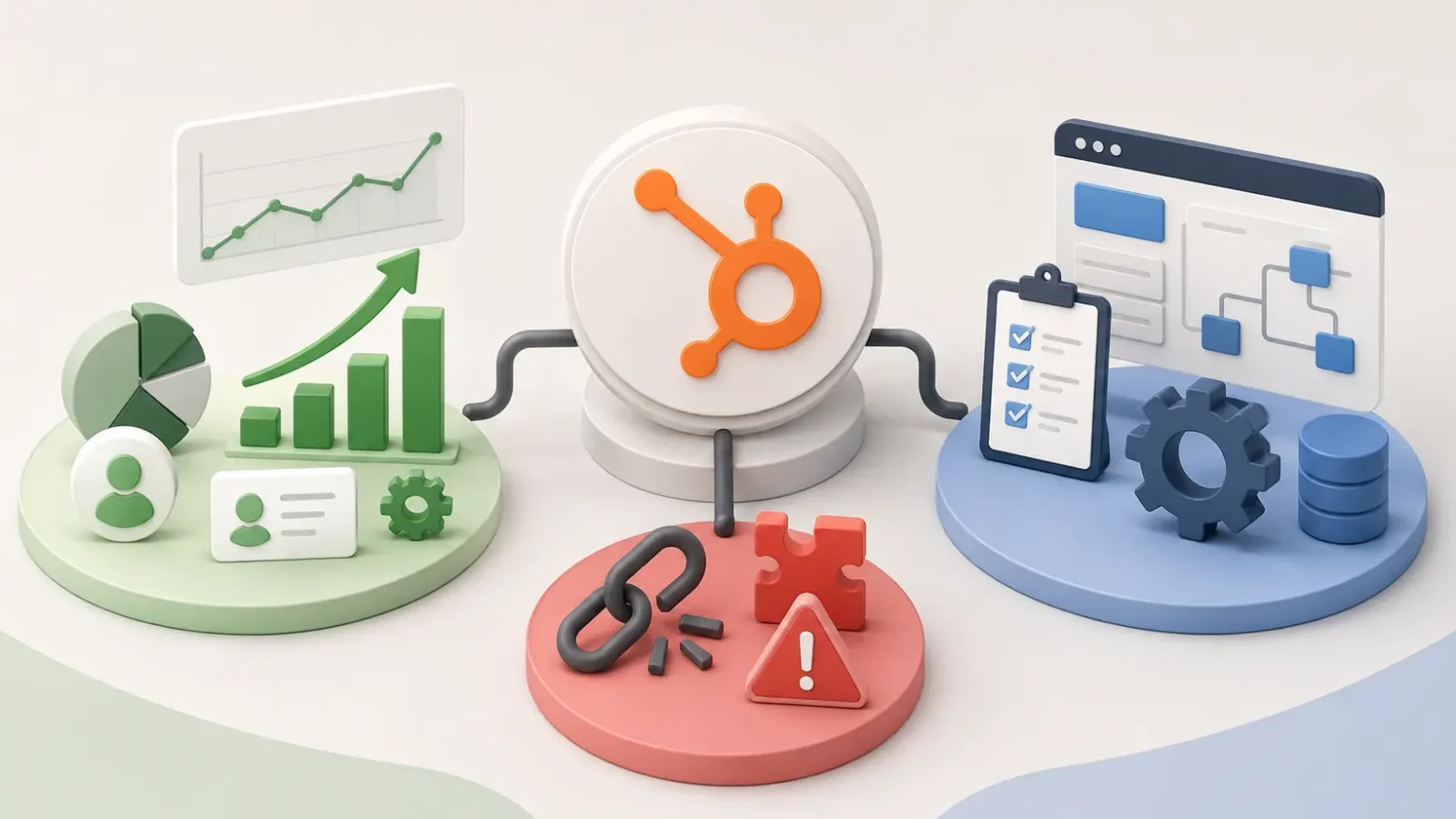
A B2B sale rarely looks like the funnel diagrams in CRM marketing decks. There are seven people in the buying committee. The cycle runs nine months. Marketing hands sales a “qualified” lead that’s actually a procurement contact running a vendor RFP, and three weeks later the deal stalls because the original champion left for a new role. The CRM that’s supposed to help instead becomes the place where context goes to die.
This is the gap HubSpot for B2B is supposed to close, and most of the time it does. But “HubSpot works for B2B” hides a lot of configuration nuance that decides whether your portal turns into a revenue engine or a $30,000-a-year reporting graveyard.
We’re a HubSpot Diamond Solutions Partner with custom integration accreditation. We’ve built integrations for 300+ platforms and processed over 20 billion records annually for B2B teams running long sales cycles, multi-stakeholder buying committees, and tech stacks that span everything from NetSuite to Snowflake. So this isn’t another “10 reasons HubSpot is great for B2B” article. It’s an honest look at what the platform does well for B2B companies, where it falls short, and how we configure it so it actually fits the way B2B sells.
What is HubSpot for B2B? HubSpot for B2B refers to the configuration and use of HubSpot’s Smart CRM and connected hubs (Marketing, Sales, Service, Operations, Content, Commerce) to support business-to-business sales motions characterized by long sales cycles, multiple decision-makers, and high-value deals. It centralizes lead capture, lifecycle management, pipeline forecasting, and revenue attribution in a single system that both marketing and sales teams use as their source of truth.
Free estimator
Know what your HubSpot project costs before the first call.
Select your services and get a transparent price range in minutes. No sales call needed to get a number.
Connect HubSpot to your ERP, billing platform, or database field mapping, custom logic, and support included.
Pipelines, workflows, email templates, and reporting configured for how your team actually works.
Live, role-based sessions with recordings and written guides built around a custom plan for your team.
HubSpot Partner
Client retention
Platforms integrated
Why B2B Companies Choose HubSpot (and Where the Hype Misses)
Most B2B teams choose HubSpot for three reasons: the marketing-and-sales tooling lives in the same database, the UX doesn’t require a full-time admin team, and the platform scales from a 10-person startup to a 500-person mid-market organization without a forced migration.
That’s the case for HubSpot. Here’s where it gets oversold.
HubSpot ties firmographic data (company size, industry, revenue band) to behavioral signals (page views, content downloads, email opens) at the contact and company level. For B2B, that pairing is the foundation of every useful lead scoring model. You can prioritize prospects who are both qualified by fit and showing intent, which is the difference between marketing handing sales a list of email opens and marketing handing sales a list of accounts ready to buy.
The native attribution tools answer the question that matters: which campaigns are actually creating pipeline. Multi-touch attribution across long B2B sales cycles is built in, not a $30,000 add-on. Account-based marketing becomes manageable because contacts roll up to company records and you can coordinate outreach across teams from one view.
Where the hype outpaces reality:
- HubSpot’s product analytics for B2B SaaS is thin. If your motion needs deep funnel analysis tied to in-product behavior, you’ll need Amplitude or Mixpanel feeding HubSpot through a custom integration.
- Custom reporting works for most B2B use cases but hits walls at enterprise scale or when you need to blend HubSpot data with warehouse data. Teams running serious analytics push raw data to BigQuery or Snowflake.
- Native connectors are fine for simple syncs and break under the kind of bi-directional, real-time, multi-object integration that mid-market and enterprise B2B actually requires.
The correct mental model: HubSpot is an excellent B2B CRM and marketing platform out of the box. It becomes a great one with intentional architecture and the right integrations.

The HubSpot Hubs Mapped to a B2B Motion
HubSpot is six hubs sitting on a shared database. For B2B, the configuration of each hub matters more than which ones you buy.
- Marketing Hub is the engine for lead capture, lead scoring, ABM target lists, multi-touch attribution, and lifecycle email automation. For B2B specifically, it’s where you build nurture programs that account for nine-month sales cycles and stakeholders who go dark for six weeks at a time.
- Sales Hub runs deal pipelines, sales sequences, meeting links, quote generation, and forecasting. The B2B win comes from custom deal stages that map to your real qualification milestones plus contact-to-deal associations that surface every stakeholder on a single deal record.
- Service Hub handles tickets, knowledge bases, and post-sale customer health. For B2B, it’s where renewals, expansion, and NPS feedback live. If you’re not tracking customer health signals here, you’re flying blind on retention.
- Operations Hub is the most underrated hub for B2B. Programmable automation, data quality automations, custom data sync, and webhooks make it the backbone of a clean RevOps setup. If your portal feels like duct tape, the answer usually involves Operations Hub.
- Content Hub powers the website, blog, SEO, and gated assets. For B2B teams running content-led demand generation, it consolidates the CMS into the same platform as the CRM, which kills attribution gaps between content engagement and pipeline.
- Commerce Hub is HubSpot’s CPQ, billing, and payments solution. It fits B2B teams running self-serve or hybrid pricing motions. For complex enterprise contracts with custom legal review, you’ll still want a dedicated CPQ tool integrated with HubSpot rather than replacing your existing process with Commerce Hub.
The hubs you actually need depend on your motion. Most mid-market B2B teams we work with run Marketing Hub Professional, Sales Hub Professional, Operations Hub, and either Service Hub or Content Hub depending on whether they prioritize retention or demand generation.

Turn HubSpot Into A Real-Time SMS Engine with
Message IQ

Two-Way Conversations

Shared Team Inbox

Automation Triggers

Advanced Reporting

Compliance Tools
-
98%
SMS read within 3 min -
78%
Buy from first responder -
21×
More likely to qualify
3–5 min avg response
$45–$50 ROI / $1

*MessageIQ is an IntegrateIQ product – built natively for HubSpot by the same team.
How to Configure HubSpot for a Real B2B Sales Cycle
This is where most HubSpot for B2B implementations live or die. The platform ships with sensible defaults that fit a 30-day SMB sales cycle. B2B doesn’t.
Lifecycle Stages Beyond MQL and SQL
HubSpot’s default lifecycle stages (Subscriber, Lead, MQL, SQL, Opportunity, Customer, Evangelist) work as a starting point, but B2B almost always needs more granularity. We typically build something closer to this:
- Subscriber: opted into something, no qualification yet
- Lead: provided contact info, fits ICP at the firmographic level
- MQL (Marketing Qualified Lead): meets fit and intent thresholds based on lead scoring
- SAL (Sales Accepted Lead): sales has reviewed and accepted the handoff
- SQL (Sales Qualified Lead): sales has confirmed BANT or equivalent qualification
- Opportunity: active deal with budget, authority, and timing confirmed
- Customer: closed-won
- Evangelist: references, case study participants, or active expansion
Each stage needs explicit entry and exit criteria. SAL exists because the MQL-to-SQL handoff is where most B2B leakage happens. Sales blames marketing for low-quality leads; marketing blames sales for not following up. SAL forces sales to actively accept a lead within an SLA, which surfaces the real disagreement and creates accountability.
Lead Scoring That Reflects Buying Committees
A score that just totals up email opens and page views misses everything that matters in B2B. We build scoring models with three dimensions:
- Fit (firmographics): company size, industry, geography, tech stack, revenue band
- Intent (behavior): pricing page views, demo requests, multiple decision-makers from the same company engaging in a short window, content topic clusters
- Role (buying committee position): decision-maker, influencer, end user, or unknown
The output isn’t one score. It’s a fit score and a behavior score that you visualize on a 2×2. Top-right quadrant gets sales attention. Top-left (high fit, low behavior) gets ABM-style outreach. Bottom-right (low fit, high behavior) gets nurture but not a sales touch. Bottom-left gets disqualified. This is the kind of nuance HubSpot can absolutely support, but won’t build for you.
Deal Pipelines for Long, Complex Cycles
Default deal stages (Appointment Scheduled, Qualified to Buy, Presentation Scheduled, Decision Maker Bought-In, Contract Sent, Closed Won) are too vague for most B2B motions. Each stage needs:
- A real milestone the sales team has to verify, not a feeling
- Historical conversion rates to the next stage
- Expected time-in-stage benchmarks
- Required deal properties (champion identified, technical buy-in confirmed, procurement engaged)
Most B2B teams need multiple pipelines: one for new business, one for expansion, one for renewals. Each has different stages, different KPIs, and different sales motions. Trying to run them all in one pipeline is the fastest way to kill your forecast accuracy.
Workflows That Adapt to How B2B Buyers Actually Move
B2B buyers don’t follow a linear journey. One prospect binges your product pages and goes dark for two months. Another reads three compliance articles and books a demo the same day. If your workflows treat every lead the same, you’ll burn the high-intent buyers and pester the slow-moving ones until they unsubscribe.
Smart B2B workflows in HubSpot use:
- Branching logic based on firmographic and behavioral triggers, not just form fills
- Suppression rules tied to deal stage (don’t send marketing emails to active opportunities)
- Internal sales notification workflows for high-intent signals (pricing page visit + decision-maker title + recent demo no-show)
- Re-engagement paths that wake up after deal-loss to nurture the account back to opportunity
The classic B2B mistake is building 200 workflows that all overlap. A clean RevOps setup has fewer workflows, each with strict entry and exit criteria, and clear ownership.

Account-Based Marketing in HubSpot for B2B
HubSpot supports ABM natively through target account lists, company-level scoring, account-based reports, and integrations with LinkedIn Ads. For mid-market B2B teams running 100 to 1,000 target accounts, that’s enough to run a real ABM motion.
The setup looks like this. You define your ICP at the company level using firmographic properties (revenue, employee count, industry, technographic signals). You build a target account list. You assign company-level account owners. You create dashboards that report at the account level, not just the contact level, showing engagement across all stakeholders within a target company. You sync that target list to LinkedIn Matched Audiences and Google Customer Match for ad targeting that actually reaches the buying committee.
Where HubSpot ABM falls short: if you need predictive intent data, deep third-party signal enrichment, or AI-powered account prioritization across millions of companies, dedicated ABM platforms like Demandbase or 6sense outperform native HubSpot. Most teams don’t need that depth until they’re past $50M ARR with a true enterprise motion. For everyone else, HubSpot’s ABM is enough, and you keep the data inside the system you actually use.
Multi-Touch Attribution for Long B2B Sales Cycles
Direct answer: HubSpot supports multi-touch attribution natively across linear, U-shaped, W-shaped, and time-decay models. For B2B teams running cycles longer than 60 days, this is one of the platform’s strongest features, and it’s included, not a separate purchase.
To make attribution actually work for B2B, you need:
- Disciplined UTM tagging on every campaign, every paid ad, every email link
- Source tracking properties set on contact and deal records
- Offline conversion sync from LinkedIn Ads and Google Ads back into HubSpot, so paid ad platforms learn from actual closed-won data instead of last-click form fills
- Custom attribution reports that map touchpoints to deals over your full sales cycle window
Where it breaks: at enterprise scale or when your funnel involves heavy product-led signals (free trial activations, in-app behavior, usage-based qualification), HubSpot’s native attribution starts to lose fidelity. The fix is pushing raw event data to a warehouse like BigQuery or Snowflake and running attribution models in a BI layer that reads from both HubSpot and product data. That’s a custom integration job, but it’s the cleanest answer for B2B SaaS teams that need real attribution depth.
HubSpot for B2B SaaS Specifically (PLG vs Sales-Led)
HubSpot supports both product-led growth and sales-led B2B SaaS motions. The configuration is sharply different, and most teams that struggle with HubSpot for SaaS are running PLG logic on a sales-led portal architecture (or vice versa).
For sales-led B2B SaaS, configuration looks traditional: MQL/SQL pipeline, demo booking workflows, proposal automation through Sales Hub or an integrated CPQ, lifecycle stages tied to sales activity, attribution measured against demo-to-close conversion.
For PLG, the model inverts. The lifecycle is tied to product events, not marketing forms. Signup-to-activation is the critical funnel stage. Lead scoring uses in-product behavior (feature adoption, team invites, workspace creation) pulled into HubSpot through a custom integration with your product database or a tool like Segment. Marketing Contacts strategy becomes critical because product signups can flood HubSpot with billable contacts overnight (more on that in the pricing section).
For hybrid B2B SaaS, the architecture has to support both motions in one portal. We typically build dual lifecycle paths with shared scoring properties and separate deal pipelines for self-serve expansion versus enterprise upgrades. This is the configuration most product-led B2B SaaS companies actually need by Series B.
HubSpot Pricing Reality for B2B Teams
Pricing for HubSpot is layered, and the published list price is rarely what mid-market B2B teams actually pay. Here’s what to plan for.
Tier overview:
- Free tools: basic CRM, useful for a 5-person team validating product-market fit
- Starter: from around $15 per seat per month; thin on automation, fine for sub-$2M ARR teams
- Professional: Marketing Hub Pro starts around $800/month, Sales Hub Pro from around $90 per seat per month, full Customer Platform Professional bundles starting north of $1,000/month
- Enterprise: six-figure annual contracts; needed for complex permissioning, advanced reporting, custom objects at scale
The Marketing Contacts billing trap. This is the single most expensive HubSpot mistake B2B teams make. By default, every contact created from forms, integrations, and chat flows gets flagged as a “Marketing Contact,” which counts against your billable contact tier. For PLG SaaS companies syncing product signups into HubSpot, this can multiply your bill 3x to 10x without a single new dollar of value. The fix is auditing every integration’s Marketing Contacts toggle and turning it off for product telemetry, user account syncs, and gated content forms that don’t need email marketing.
What mid-market B2B teams actually pay. Vendr’s published HubSpot deal data shows median ACV around $26,250 per year across 709 deals, with Professional tier deals typically negotiating 20–30% off list. Working with a Diamond Solutions Partner often waives the onboarding fee entirely (a $1,500 to $6,000 line item) and unlocks additional concessions on Marketing Contacts and seat counts.
Negotiation levers worth asking for: waived onboarding, additional Marketing Contacts at no charge, free Core or View-Only seats, written renewal-uplift caps, and Net 60 or Net 90 payment terms. The HubSpot for Startups program is worth knowing about even if you don’t qualify; it gives 90% off Year 1 to pre-Series A companies under $2M raised affiliated with one of 4,000+ approved VCs or accelerators.
Where HubSpot Falls Short for B2B (and How to Fix It)
Every CRM has limits. Pretending HubSpot doesn’t is how teams end up six months in, frustrated, and blaming the platform for what’s actually a configuration or integration gap. Here’s the honest list.
Native connectors break under complex bi-directional sync. The HubSpot Salesforce native connector is fine if you’re syncing contacts and deals one-way. It struggles with custom object sync, real-time bi-directional updates, and complex field mapping. Same story with the native NetSuite connector, the native QuickBooks connector, and most of the other “native” integrations in the marketplace. For mid-market B2B with custom data models, the right answer is a HubSpot integration service built around your actual schema, not the marketplace default.
Custom objects work but have UI limits at scale. HubSpot supports custom objects (subscriptions, projects, properties, vehicles, anything that doesn’t fit Contact/Company/Deal/Ticket), and they’re powerful. But the UI for managing custom object records is thinner than the native objects. If your B2B model relies heavily on custom objects, expect to invest in custom views, dashboards, and permissions to make the experience usable for sales reps.
Product analytics gap for B2B SaaS. HubSpot tracks marketing behavior well. It doesn’t track in-product behavior. PLG teams need a custom integration between Amplitude, Mixpanel, or PostHog and HubSpot, with product events feeding lead scoring and lifecycle automation in real time. We’ve built this dozens of times. It’s a common pattern but not a native one.
Marketing Contacts billing model penalizes PLG. Already covered above, but worth repeating: if you’re running a PLG B2B SaaS motion, you need an explicit strategy for which contacts become Marketing Contacts and which don’t. Get it wrong and your HubSpot bill grows faster than your revenue.
Attribution depth limited at enterprise scale. Native attribution covers most B2B teams. For multi-product, multi-region enterprise B2B with attribution windows over 12 months and dozens of channels, you’ll want raw event data flowing into BigQuery or Snowflake for analysis in Looker, Tableau, or Hex.
For each of these, the fix is the same shape: a custom integration or extension built around how your B2B actually operates, layered onto HubSpot’s foundation. That’s where we live as a Diamond Partner.
Native HubSpot Apps vs iPaaS vs Custom Integration for B2B Tech Stacks
Most B2B teams need HubSpot to talk to Salesforce, NetSuite, Stripe, BigQuery, Slack, their product database, and three or four marketing tools. There are three ways to get there, and the right answer depends on the integration.
| Approach | Best for | Limitations | Typical cost |
|---|---|---|---|
| Native HubSpot app marketplace | Simple, single-direction syncs (Slack notifications, Calendly bookings, Zoom meetings) | Breaks on complex field mapping, no error handling, limited custom logic | Free to low |
| iPaaS (Zapier, Tray.io, Make, Workato) | Mid-complexity workflows, no-code teams, cross-app automation | Latency, rate limits at scale, brittle when source schemas change, ongoing per-task costs add up | Mid (~$500 to $3,000/month at scale) |
| Custom integration | Bi-directional real-time sync, complex object models, business-critical data flows, multi-system workflows | Higher upfront investment, requires engineering or partner build | Higher upfront, lower total cost of ownership |
Decision rule. If your sync is bi-directional, business-critical, and involves more than two custom objects or any complex transformation logic, custom is the right call. We typically deliver these as 8-week projects from kickoff to go-live, with bi-directional field mapping, error handling, and post-go-live support included.
If you’re syncing notifications, single-direction data flows, or cross-app triggers between standardized SaaS tools, iPaaS or native apps are usually fine. The trap is using iPaaS for a business-critical sync that needs error handling, retries, and audit logs. Zapier is great until your billing data goes out of sync for three days and nobody noticed.
What a Real B2B HubSpot Implementation Looks Like (8-Week Timeline)
Most agencies promise “HubSpot setup in two weeks.” That’s a portal turn-on, not an implementation. A real B2B HubSpot implementation, one that fits your sales motion, integrates with your tech stack, and gives you usable data on day one, is about 8 weeks from kickoff. Here’s what that actually involves.
- Week 1, Discovery and data audit. We map your current sales motion, lifecycle, deal stages, integrations, and data sources. We audit existing data quality and identify what gets migrated, cleaned, or left behind.
- Week 2, Architecture. Lifecycle stage design, custom property planning, deal pipeline structure, lead scoring model, ABM target list strategy, attribution model selection.
- Weeks 3 and 4, Build and integration scoping. Portal configuration, custom object setup, integration architecture for Salesforce, NetSuite, billing systems, product data, BI layer.
- Weeks 4 to 6, Integration build. Bi-directional sync, field mapping, error handling, real-time vs batch sync logic, retry behavior, audit logging.
- Week 7, UAT and training. End-to-end testing with real data, sales team training on the new workflows, marketing team training on lifecycle stages and lead scoring.
- Week 8, Go-live and tuning. Production cutover, real-time monitoring of integration health, post-go-live tuning of scoring thresholds and workflow logic.
After go-live, post-launch support is included rather than sold separately. We hit this 8-week timeline consistently. It’s a real commitment backed by a 98.5% client retention rate and 7 million fields synced daily across the systems we manage. See our HubSpot integration process for the full breakdown.
HubSpot for B2B Migrations (From Salesforce, Pipedrive, Zoho)
A growing share of mid-market B2B teams migrate to HubSpot from Salesforce, Pipedrive, or Zoho, usually because the existing CRM became expensive, complex, and underused. The migration question isn’t “can we move?” It’s “how do we move without losing six years of pipeline data, attribution history, and process knowledge?”
What gets ported cleanly: contacts, companies, deals (with stage history), activities, notes, and core custom properties. What gets rebuilt: workflows, automation rules, lead scoring models, custom reports, and integrations. What needs strategic decisions: attribution history (you usually can’t carry it forward perfectly), permission structures, and team-based access.
The risks are real. Data integrity issues during migration. Downtime windows during cutover. Attribution discontinuity that breaks reporting for the first quarter post-migration. Sales team adoption resistance if the new system doesn’t match their existing muscle memory.
The way to de-risk is staged cutover, parallel running for 30 days, and a clean field-mapping plan documented before a single record moves. Compare the two platforms in detail at our HubSpot vs Salesforce comparison before making the call. For the actual migration work, our CRM migration services cover Salesforce-to-HubSpot, Pipedrive-to-HubSpot, and Zoho-to-HubSpot moves with the data integrity and downtime guardrails B2B teams need.
FAQ: HubSpot for B2B
Is HubSpot good for B2B companies?
Yes, especially mid-market B2B teams with long sales cycles, multi-stakeholder buying committees, and a need for tight marketing-sales alignment. HubSpot’s combination of behavioral and firmographic data, native attribution, and accessible UX makes it one of the strongest B2B CRM platforms in the market for companies under roughly $200M ARR.
Is HubSpot better than Salesforce for B2B?
It depends on company size and complexity. HubSpot wins for sub-$50M ARR B2B teams that value ease of adoption, bundled marketing-and-sales tooling, and lower total cost of ownership. Salesforce wins for highly customized enterprise B2B with complex permissioning, multi-cloud architecture, and large admin teams supporting the platform.
How much does HubSpot cost for a B2B company?
Starter plans begin around $15 per seat per month, Professional Customer Platform bundles start around $1,000 per month, and most mid-market B2B teams land at $20,000 to $30,000 per year in ACV. Working with a Diamond Solutions Partner typically waives onboarding fees and unlocks 20–30% off list pricing.
Can HubSpot handle long B2B sales cycles?
Yes. With custom lifecycle stages, multiple deal pipelines, branching workflow logic, and multi-touch attribution that supports cycles over 12 months, HubSpot is built for long B2B cycles. The configuration matters more than the tier. Even Marketing Hub Professional supports cycles of 6 to 12 months when set up correctly.
Does HubSpot work for B2B SaaS?
Yes, including product-led growth, sales-led, and hybrid motions. Configuration differs sharply between them. PLG SaaS requires product event sync, careful Marketing Contacts management, and lifecycle stages tied to in-product behavior. Sales-led SaaS uses traditional MQL/SQL pipelines with demo and proposal automation.
What integrations does B2B HubSpot need?
Most B2B teams integrate HubSpot with another CRM (Salesforce is common during transitional periods), an ERP or accounting system (NetSuite or QuickBooks), Stripe for billing, BigQuery or Snowflake for analytics, Slack for sales notifications, and a product analytics tool like Amplitude or Mixpanel for B2B SaaS.
How long does HubSpot implementation take for B2B?
A clean B2B implementation runs about 8 weeks from kickoff with a Diamond Partner, including data migration, lifecycle architecture, integration build, UAT, and post-go-live tuning. Faster timelines exist but typically skip the integration work that makes HubSpot actually fit a B2B motion.
What’s the biggest mistake B2B teams make with HubSpot?
Treating Marketing Contacts as “all contacts.” The Marketing Contacts billing model defaults to flagging every new contact as billable, which can multiply your HubSpot bill 3x to 10x for B2B SaaS teams syncing product signups. Audit every integration’s Marketing Contacts toggle before going live.
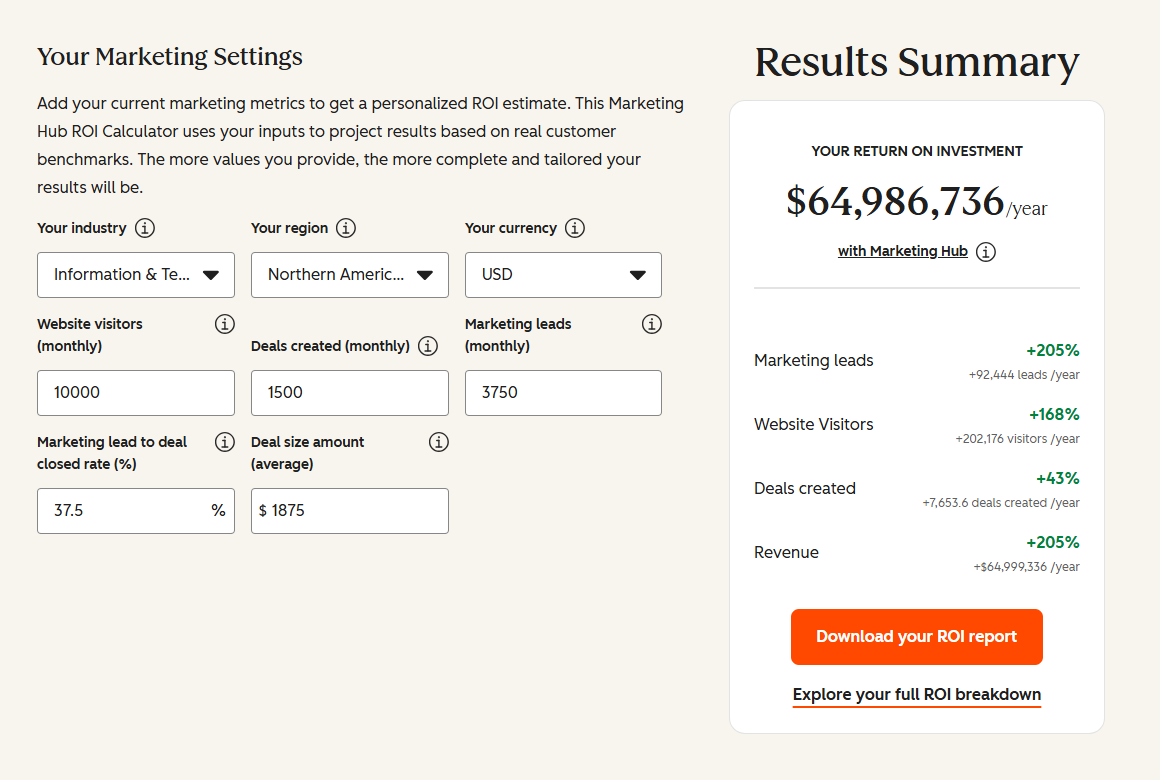
See your 12-month revenue impact with HubSpot CRM
Enter your current numbers — visitors, leads, deal size — and get a personalized projection based on real HubSpot customer benchmarks.
Make HubSpot Actually Fit Your B2B Motion
If you’re trying to make HubSpot fit a B2B motion that’s already in flight (long cycles, buying committees, complex tech stack, attribution that needs to survive a 9-month deal), the platform itself isn’t the problem. The configuration is.
We’re a HubSpot Diamond Solutions Partner with custom integration accreditation. We build B2B HubSpot implementations as 8-week projects with bi-directional sync, real-time field mapping, error handling, and post-go-live support included. 300+ platforms integrated. 98.5% client retention. The 8-week delivery isn’t a sales promise. It’s how we work.
Walk through our HubSpot integration process to see exactly what an 8-week build looks like, or start a conversation with our team about the specific gaps in your current B2B HubSpot setup.

Table of Contents
- Why B2B Companies Choose HubSpot (and Where the Hype Misses)
- The HubSpot Hubs Mapped to a B2B Motion
- How to Configure HubSpot for a Real B2B Sales Cycle
- Account-Based Marketing in HubSpot for B2B
- Multi-Touch Attribution for Long B2B Sales Cycles
- HubSpot for B2B SaaS Specifically (PLG vs Sales-Led)
- HubSpot Pricing Reality for B2B Teams
- Where HubSpot Falls Short for B2B (and How to Fix It)
- Native HubSpot Apps vs iPaaS vs Custom Integration for B2B Tech Stacks
- What a Real B2B HubSpot Implementation Looks Like (8-Week Timeline)
- HubSpot for B2B Migrations (From Salesforce, Pipedrive, Zoho)
- FAQ: HubSpot for B2B
- Make HubSpot Actually Fit Your B2B Motion