

Explore this article with AI:

If you’re running sales on HubSpot, you’ve already figured this out: HubSpot doesn’t calculate commissions. It tracks your deals, pipeline stages, and closed revenue beautifully. But the moment you ask it to apply a tiered rate, split a commission across two reps, or trigger a payout based on payment rather than deal close, you’re on your own.
Commission tracking software that integrates with HubSpot connects your CRM’s deal data closed amounts, deal owners, pipeline stages, and product line items directly to a commission calculation engine.
The result: payouts calculate automatically, without a spreadsheet, without manual exports, and without the disputes that come from everyone working off different numbers.
This is a real problem at scale. According to research cited by QuotaPath, 80% of companies have paid commissions incorrectly due to human error, clawback miscalculations, and discrepancies between systems. That’s not a rounding error for a 20-person sales team, it’s hours of RevOps time every pay period and a slow erosion of rep trust.
We’ve built commission integrations across 300+ platforms as a HubSpot Diamond Solutions Partner with custom integration accreditation, and we’ve processed over 20 billion records annually. Here’s what we’ve learned about which solution actually fits your situation.
Free estimator
Know what your HubSpot project costs before the first call.
Select your services and get a transparent price range in minutes. No sales call needed to get a number.
Connect HubSpot to your ERP, billing platform, or database field mapping, custom logic, and support included.
Pipelines, workflows, email templates, and reporting configured for how your team actually works.
Live, role-based sessions with recordings and written guides built around a custom plan for your team.
HubSpot Partner
Client retention
Platforms integrated
Why HubSpot Doesn’t Calculate Commissions On Its Own
HubSpot tracks deal revenue and pipeline data with a level of accuracy most CRMs can’t match. The gap isn’t in the data it’s in the calculation logic. Applying commission tiers, manager overrides, split percentages, clawbacks, and accelerators to that deal data requires conditional business rules that HubSpot’s core CRM simply wasn’t built to handle.
The workaround the HubSpot community lands on first is a calculated deal property. You create a formula field on the deal record that multiplies the deal amount by a flat commission rate and adds a status dropdown (paid/unpaid). For a single sales rep on a flat 8% rate, that works fine. The moment you add a second tier, a second rep, or a payment-triggered payout, it falls apart.
Operations Hub gives you more flexibility with custom-coded workflow actions, but it still doesn’t solve the fundamental problem: HubSpot has no native commission calculation engine. For anything beyond simple flat rates, you’re engineering a workaround on top of a CRM.
The fallback that most teams land on is a spreadsheet. Prof. Ray Panko at the University of Hawaii found that 88% of Excel spreadsheets contain formula errors of 1% or more. That’s not just inconvenient it’s a real financial risk when those errors show up in commission payouts.
Commission Tracking Software That Connects to HubSpot: What the Marketplace Offers
The HubSpot App Marketplace has a solid set of dedicated commission tools. They connect to HubSpot via OAuth or Private App Token, pull deal data on a scheduled sync, and give reps a dashboard to see their earnings. For straightforward commission plans, these apps handle the job well.
Here’s how the main players stack up:
| Tool | HubSpot Sync Depth | Best-Fit Company Size | Starting Price | Key Limitation |
| QuotaPath | Deep, UI extensions embed directly in HubSpot deal records | SMB to mid-market | Free tier; paid from ~$15/user/mo | No internal calculations; all logic must be built in HubSpot first |
| ElevateHQ | OAuth sync; 30-min to 2-hr frequency | Growing sales teams | Custom pricing | Complex tiered rollups require workarounds |
| Visdum | HubSpot-certified native integration | SaaS-focused SMB to mid-market | Custom pricing | Built specifically for SaaS; less flexible for other revenue models |
| Commissionly | API + Zapier | SMB | ~$15/user/mo | Zapier dependency adds fragility for high-volume teams |
| Palette (PaletteHQ) | 1-click OAuth connection | Mid-market | Custom pricing | Limited support for HubSpot custom objects |
What all of these tools share: they authenticate against the standard HubSpot API, read from the Deals object using standard field mappings, and calculate commissions based on plan rules you configure inside their interface. Rep visibility into forecasted earnings is a genuine strength reps can see what they’ll make on open deals, which actually moves behavior.
The limitations become apparent when your commission plan doesn’t fit a standard template. If you need custom HubSpot objects, payment-triggered commission events, or multi-system data, you’ve outgrown what these apps can reliably handle. More on that in a moment. For internal linking context, our HubSpot Stripe integration and HubSpot QuickBooks integration show how payment data connects to CRM deal records when commission calculation depends on actual payment events.

Turn HubSpot Into A Real-Time SMS Engine with
Message IQ

Two-Way Conversations

Shared Team Inbox

Automation Triggers

Advanced Reporting

Compliance Tools
-
98%
SMS read within 3 min -
78%
Buy from first responder -
21×
More likely to qualify
3–5 min avg response
$45–$50 ROI / $1

*MessageIQ is an IntegrateIQ product – built natively for HubSpot by the same team.
When Commission Tracking Software Isn’t Enough: Signs You Need a Custom Integration
Marketplace apps handle the 80% case. The other 20% where deals are complex, plans are tiered, or data lives across multiple systems is where custom integration work pays for itself. Here’s the honest breakdown of when you’ve hit the ceiling.
Tiered Commission Rollups Across Team Hierarchies
When an AE’s commission triggers an SDR credit and a manager override on the same deal, marketplace apps typically force you to build the calculation logic inside HubSpot using workflow actions which is fragile and hard to audit. A custom integration reads the deal data and passes it to your commission engine with full hierarchical context intact.
Split Commissions Across Multiple Reps
Split deals require custom HubSpot properties to track each rep’s ownership percentage. Most marketplace apps read the deal owner and stop there. A custom integration maps those split-percentage properties explicitly and ensures each rep’s commission engine record reflects the correct portion.
Payment-Triggered Commissions
If your commission policy pays on cash received rather than deal close, your HubSpot CRM isn’t the trigger your payment system (Stripe, Xero, QuickBooks) is. That requires a multi-system integration that reads payment events, cross-references them with HubSpot deal data, and passes the combined record to your commission engine. No marketplace app handles this out of the box. Our HubSpot Xero integration and HubSpot Stripe integration are common building blocks for this architecture.
HubSpot Custom Objects in Your Deal Structure
If your HubSpot instance uses custom objects to model subscription tiers, product bundles, or service lines, standard marketplace apps can’t read them. They’re built against the standard Deals API. Custom integrations specifically map your object schema and maintain those relationships through every sync.
ASC-606 Compliance Requirements
For companies that need commission expense recognized over the contract period rather than at point of sale, the integration needs to pass contract duration, start date, and schedule data not just deal amount. This is an audit trail requirement that marketplace apps don’t address. Finance buyers at public companies or those preparing for an audit will recognize this gap immediately.
Multi-System Commission Data
When commission data lives across HubSpot, an ERP, a billing platform, and possibly a payroll system, you need an integration architecture not a point-to-point connector. This is the territory where a HubSpot Salesforce integration or an ERP sync feeds into the commission calculation as a unified data flow.
Custom Integration vs. Commission Tracking Software: How to Decide
The decision isn’t about scale it’s about plan complexity and data architecture. A 5-person sales team with a tiered rollup structure needs a custom integration. A 100-person team on a flat percentage rate may be perfectly served by QuotaPath. Use this framework:
| Scenario | Native App | Custom Integration |
| Flat % commission on closed-won deals | Yes ,this is exactly what marketplace apps do well | Overkill |
| Tiered commissions with accelerators | Possible with workarounds | Cleaner and more reliable |
| Split commissions across multiple reps | Limited, most apps read deal owner only | Required for accurate splits |
| Commission triggered by payment, not deal close | Not supported | Required |
| HubSpot custom objects in deal structure | Not supported | Required |
| ASC-606 commission expense recognition | Not supported | Required |
| Multi-system data (HubSpot + ERP + billing) | Not supported | Required |
| Manager override / rollup commissions | Partial with manual config | Preferred |
A quick cost-of-ownership check: marketplace apps run roughly $30-50/user/month. For a 25-rep team, that’s $9,000-$15,000 annually for a tool that may still require manual reconciliation on edge cases. Custom integrations typically run $10,000-$25,000 to build, with minimal ongoing cost. The math often favors the custom build once you have more than 15-20 reps and any plan complexity.

How We Build Commission Tracking Integrations on HubSpot
The architecture for a reliable HubSpot commission integration has three layers: the HubSpot data layer, a middleware transformation layer, and the commission system receiving end. Here’s how each piece works.
Sync Trigger: Webhook vs. Scheduled Polling
Marketplace apps typically poll HubSpot on a schedule every 30 minutes to 2 hours. That lag matters when a rep closes a deal at 4:45 PM and wants to know their commission before end of day. Custom integrations use HubSpot webhooks to trigger a real-time sync the moment a deal stage changes to Closed Won. The webhook fires, the middleware picks it up, transforms the deal data against your commission plan rules, and writes the result to your commission system in seconds.
Field Mapping: Where Most Integrations Break
Field mapping is the unglamorous part of any integration, and it’s where most problems live. Commission calculations depend on specific deal properties deal amount, close date, deal owner, product line items, and any custom properties you’ve added. We spend meaningful time in discovery mapping every HubSpot field to its commission system counterpart, and we document what happens when those fields are empty or mismatched.
One specific failure mode worth calling out: deal amount edits after close. Reps sometimes go back and correct a deal amount post-close, which triggers another webhook event. Without proper deduplication logic in the middleware, that fires another commission calculation. We handle this with idempotency checks each sync event gets a unique ID, and the system won’t process the same event twice. Our blog on field mapping and data transformation covers this in more depth.
Error Handling and Audit Logging
Commission data is financially sensitive. Every sync event gets logged what data came in, what transformation rules applied, what went out the other side. When a calculation looks wrong, the audit log tells you exactly what happened. We also build alerting for sync failures so the RevOps team knows within minutes if a webhook stops firing or an API credential expires.
We sync 55 million fields daily across client integrations. The infrastructure is built for reliability, not just functionality.
Commission Integration Use Cases by Industry
Commission structures vary significantly by industry, and the integration architecture changes with them. Here are three scenarios we see frequently.
SaaS Companies: Commission on Recurring Revenue
SaaS commission plans typically split between new ARR and expansion revenue, with different rates for each. The HubSpot deal amount represents the initial contract, but the commission engine needs to know the subscription duration, renewal terms, and whether the deal is new logo or expansion. This requires the integration to pull additional deal properties or connect HubSpot to the billing system (usually Stripe or Chargebee) to pass complete contract context. Monthly residual commissions add another layer: the commission system needs recurring payment events, not a one-time deal close signal.
Staffing and Recruiting: Split Commissions Across Roles
A staffing agency placement deal typically credits both the account manager (who owns the client relationship) and the recruiter (who filled the role). HubSpot’s standard deal model has one owner. Firms handling this correctly add custom properties for recruiter attribution and split percentages. The integration then reads both the deal owner and the recruiter property, and posts separate commission records to each rep’s account in the commission system. Marketplace apps won’t read that second custom property the integration needs to be purpose-built for the data model.
Financial Services: ASC-606 and Commission Expense Recognition
For companies subject to ASC-606, commission expense can’t be recognized entirely at the point of sale it gets amortized over the customer contract period. The integration needs to pass contract duration and schedule data to the commission system so it can generate the correct amortization schedule. This is a finance requirement, not a sales one, but it affects the integration architecture significantly. The deal record in HubSpot needs to carry contract term data, and the commission system needs to write that schedule back somewhere accessible for audit purposes.
What the Integration Process Looks Like: An 8-Week Timeline
We deliver commission integrations in 8 weeks from project kickoff. That’s a firm timeline because we’ve done enough of these to know where the time actually goes. Here’s the breakdown:
- Weeks 1-2 — Discovery and Scoping: We map every HubSpot deal property to its commission variable counterpart, document your commission plan logic in full, define the sync triggers, and identify any edge cases (split deals, clawbacks, multi-system data sources). You need three things ready before this starts: clean, consistent deal data in HubSpot; a fully documented commission plan; and confirmed access credentials for both systems.
- Weeks 3-4 — Architecture Design: We design the middleware layer, write the field mapping rules, define error handling logic, and set up a sandbox environment that mirrors your production setup. We test against a sample of historical deal data before a single line of production code runs.
- Weeks 5-6 — Build and Test: API connections built, webhooks configured, sync tested against full historical data. Edge cases get stress-tested here what happens when a deal gets edited post-close, when the API hits a rate limit, when a field comes in empty.
- Week 7 — UAT: Your RevOps lead, Finance rep, and at least one sales manager validate the outputs against known historical commissions. If it doesn’t match what they’d calculate manually, we fix it before go-live.
- Week 8 — Go-Live, Monitoring, and Handoff: We push to production, configure alerting for sync failures, and hand off documentation that your team can actually use. You’re not dependent on us to explain what’s happening inside the integration.
For more detail on how we scope and manage integration projects, see IntegrateIQ’s integration process. Our 98.5% client retention rate across 300+ platform integrations reflects how that process holds up post-go-live.
Frequently Asked Questions About HubSpot Commission Tracking Integration
Does HubSpot have built-in commission tracking?
HubSpot doesn’t include native commission calculation. You can create calculated properties on deal records for simple flat-rate plans, but any plan with tiers, splits, clawbacks, or manager overrides needs either a third-party commission app or a custom integration built against HubSpot’s API. Operations Hub gives you more flexibility with custom-coded workflows, but it still won’t replace a proper commission engine.
What’s the difference between a commission tracking app and a custom HubSpot commission integration?
Commission tracking apps like QuotaPath or ElevateHQ connect to HubSpot via OAuth and pull deal data using standard field mappings they’re designed for the common case. Custom integrations are purpose-built connections that handle complex plan logic, read HubSpot custom objects, pull data from multiple systems, and enforce compliance requirements that marketplace apps can’t support. If your plan fits a standard template, use a marketplace app. If it doesn’t, you need something built for your specific data model.
How does commission data sync from HubSpot to commission software?
Marketplace apps authenticate via OAuth and pull deal data on a scheduled sync, typically every 30 minutes to 2 hours. Custom integrations use HubSpot webhooks to trigger real-time syncs when a deal stage changes so the moment a deal closes, the commission engine fires. Webhook-based sync eliminates the lag between deal close and commission calculation, which matters for rep visibility and payout accuracy.
Can a custom HubSpot integration handle split commissions?
Yes, and it handles them reliably in a way marketplace apps typically don’t. Split commissions require the integration to read custom deal properties split percentages, secondary rep attribution and pass separate commission records for each party to the commission system. The integration maps those custom HubSpot properties explicitly rather than just reading the default deal owner field.
What does it cost to build a custom HubSpot commission tracking integration?
Custom commission integrations typically run $10,000-$25,000 depending on plan complexity, number of data sources, and compliance requirements. Compare that to $30-50/user/month for a marketplace app for a 20-rep team, that’s $7,200-$12,000 annually for a tool that may still require manual reconciliation on edge cases. The custom build often pays for itself within 18-24 months while eliminating the ongoing workarounds.
How long does a custom HubSpot commission integration take to build?
We deliver commission integrations in 8 weeks from project kickoff. That covers discovery and scoping, architecture design, build and testing, user acceptance testing with your RevOps and Finance teams, and go-live. The timeline assumes you have clean HubSpot deal data and a fully documented commission plan ready at kickoff those two inputs drive how smooth the first two weeks go.
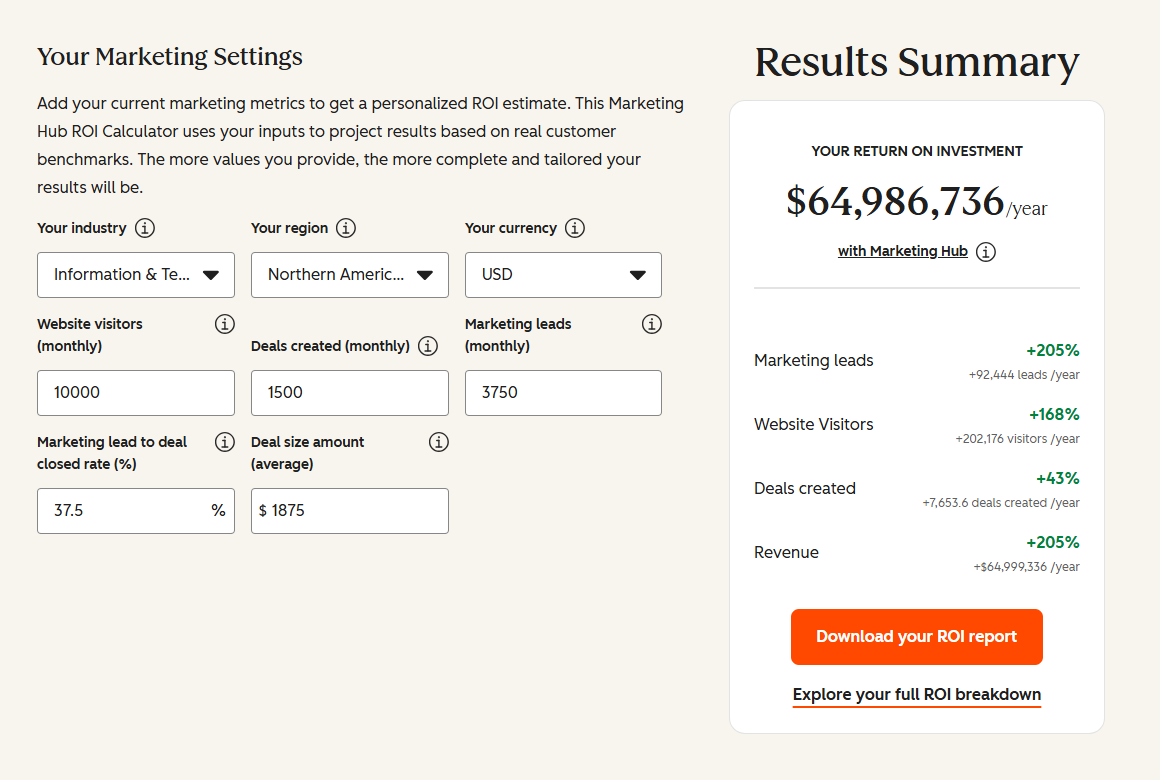
See your 12-month revenue impact with HubSpot CRM
Enter your current numbers — visitors, leads, deal size — and get a personalized projection based on real HubSpot customer benchmarks.
Ready to Connect HubSpot to Your Commission System?
If your RevOps or Finance team is still spending hours each pay period reconciling HubSpot deal data with commission spreadsheets chasing down split discrepancies, handling clawback disputes, and manually cross-referencing closed deals against what reps think they’re owed that’s time and trust you’re burning every cycle.
We build commission integrations that eliminate that reconciliation work entirely. As a HubSpot Diamond Solutions Partner with custom integration accreditation, we’ve delivered 300+ integrations across complex enterprise data environments, and we deliver commission integrations in 8 weeks from kickoff.
Start with our integration process overview to understand how we scope and build. Or if you’re ready to talk through your specific commission structure, schedule a discovery call and we’ll tell you within 30 minutes whether a marketplace app handles your use case or whether you need something built.

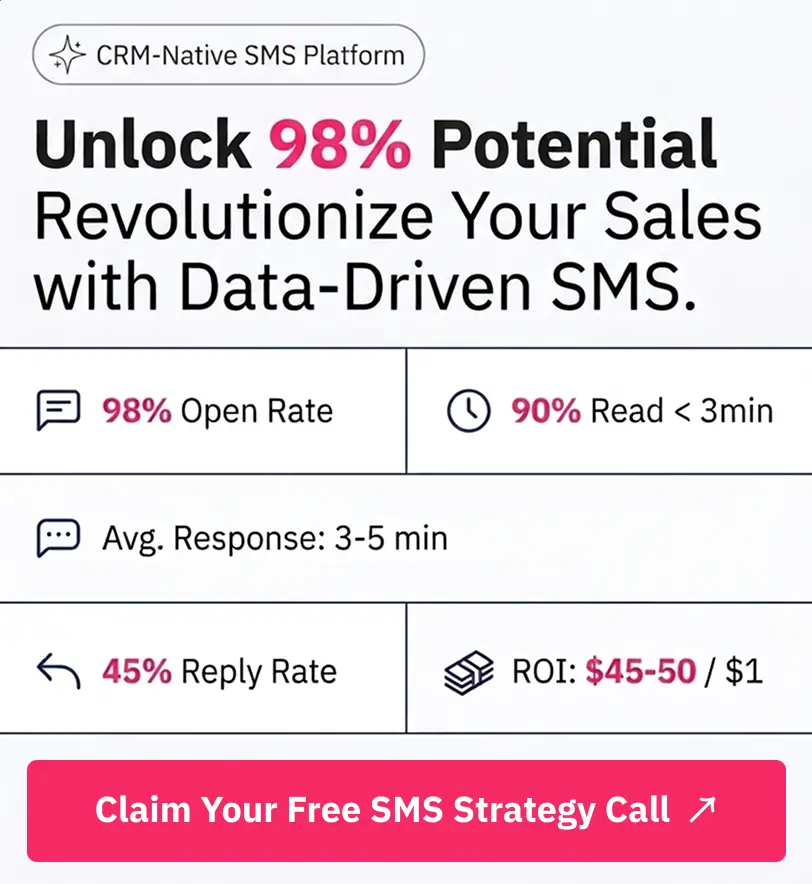
Table of Contents
- Why HubSpot Doesn't Calculate Commissions On Its Own
- Commission Tracking Software That Connects to HubSpot: What the Marketplace Offers
- When Commission Tracking Software Isn't Enough: Signs You Need a Custom Integration
- Custom Integration vs. Commission Tracking Software: How to Decide
- How We Build Commission Tracking Integrations on HubSpot
- Commission Integration Use Cases by Industry
- What the Integration Process Looks Like: An 8-Week Timeline
- Frequently Asked Questions About HubSpot Commission Tracking Integration
- Ready to Connect HubSpot to Your Commission System?

