












Explore this article with AI:

The ROI of CRM integration measures the net financial return from connecting your CRM to the other systems your business runs on, weighed against what it costs to build and maintain that connection. It’s a different number from “CRM ROI,” which measures the return on the CRM software itself. Most guides on this topic blur the two together, and that’s where budget requests go wrong.
If you’re building a business case for a HubSpot integration project, or trying to prove the value of one you already shipped, you need a formula that isolates integration-specific gains: eliminated manual entry, faster reporting, fewer sync errors. This guide gives you that formula, current industry benchmarks, and a worked example so you can plug in your own numbers.
Free estimator
Know what your HubSpot project costs before the first call.
Select your services and get a transparent price range in minutes. No sales call needed to get a number.
Connect HubSpot to your ERP, billing platform, or database field mapping, custom logic, and support included.
Pipelines, workflows, email templates, and reporting configured for how your team actually works.
Live, role-based sessions with recordings and written guides built around a custom plan for your team.
HubSpot Partner
Client retention
Platforms integrated
Why This Math Matters More Now Than It Did Five Years Ago
CRM stacks connect to far more systems today than they did even three years ago: billing platforms, support tools, marketing automation, ERPs and increasingly AI-driven workflows that need clean, connected data to function at all. Industry research puts the share of business applications currently connected to each other at well under a third, and integration complexity is consistently cited as one of the top barriers to getting real value out of AI-powered CRM features.
That gap cuts both ways for your ROI case. On one hand, an unconnected CRM leaves value on the table that a connected one can capture. On the other, it means more of your organization’s tools are competing for the same integration budget, so the business case needs to hold up on its own numbers rather than on a general assumption that “integration is good.”
The CRM Integration ROI Formula
CRM integration ROI is calculated as (Gains from integration minus Cost of integration) divided by Cost of integration, expressed as a percentage or a multiple.
The hard part is naming the gains accurately. Split them into two buckets.
Hard benefits (directly measurable in dollars or hours):
- Hours saved from eliminated manual data entry
- Reduction in duplicate-record cleanup time
- Faster deal cycles from real-time data visibility between systems
- Fewer support tickets caused by out-of-sync records
Soft benefits (real value, harder to price):
- Better forecast accuracy from unified data
- Higher rep confidence in the numbers they’re working from
- Shorter onboarding time for new hires who only need to learn one source of truth
Most teams stop at hard benefits because they’re easier to defend to finance. That undersells the case. A credible model puts a conservative dollar estimate on at least one soft benefit too, usually forecast accuracy or reduced churn from faster response times to customer issues.

Turn HubSpot Into A Real-Time SMS Engine with
Message IQ

Two-Way Conversations

Shared Team Inbox

Automation Triggers

Advanced Reporting

Compliance Tools
-
98%
SMS read within 3 min -
78%
Buy from first responder -
21×
More likely to qualify
3–5 min avg response
$45–$50 ROI / $1

*MessageIQ is an IntegrateIQ product – built natively for HubSpot by the same team.
What Goes Into the Cost Side
Integration costs get underestimated more often than gains get overestimated. A full accounting includes:
- Build cost: development or configuration hours, whether you’re using a native connector or a custom-built integration
- Data migration: cleaning and mapping historical records before the first sync runs
- Training: time spent getting teams to actually adopt the new workflows
- Ongoing maintenance: monitoring, error handling, and updates whenever either system changes its API
That last line item is where a lot of ROI models fall apart after year one. A connector that works fine at launch can break silently when HubSpot or the connected platform pushes an API update, and the cost of catching and fixing that rarely shows up in the initial budget. We’ve written a fuller breakdown of how to budget for a system integration project if you want to build this out before presenting your model.
A simple way to structure the cost side for a leadership presentation:
| Cost Category | One-Time or Ongoing | Typical Share of Year-One Budget |
| Build or configuration | One-time | 50 to 65% |
| Data migration and cleanup | One-time | 10 to 20% |
| Training and change management | One-time | 5 to 10% |
| Ongoing monitoring and maintenance | Ongoing (annual) | 10 to 20% |
Budgeting maintenance as a fixed annual line item, rather than an afterthought, is one of the simplest ways to keep an ROI projection honest past the first year.
How to Present CRM Integration ROI to Leadership
The framing matters as much as the math. A few rules that hold up across finance and executive audiences:
- Lead with the business outcome, not the technology. Talk about shorter sales cycles and fewer lost deals, not API capabilities or sync frequency.
- Show a range, not a single number. A conservative-to-optimistic range signals you’ve stress-tested your assumptions instead of picking the number that makes the case look best.
- Separate one-time build cost from ongoing cost. Blending them makes year-one ROI look artificially worse and year-two ROI look artificially better.
- Name the risk if you do nothing. The cost of staying disconnected, in lost deals, duplicate work and bad reporting, is often the most persuasive line in the whole presentation.
Industry Benchmarks for CRM Integration ROI
| Benchmark | Figure | Source | Context |
| Average CRM return | $3.10 per $1 spent | Nucleus Research, cited 2026 | Down from $8.71 in 2014, reflecting more complex modern tech stacks |
| API-led connectivity return | $5.45 per $1 spent | Forrester Total Economic Impact, 2019 | Requires high API reuse across systems; lower for one-off point integrations |
| Typical CRM payback period | 12 to 13 months | Aggregated industry studies | Covers the full CRM implementation, not integration alone |
| Time to see integration-specific gains | 2 to 3 months | Practitioner-reported data | Returns accelerate once teams fully adopt the new workflow |
Treat the older Nucleus Research figures as directional rather than current. Modern CRM stacks connect to far more systems than they did a decade ago, and each additional connection point changes both the cost and the gain side of the equation.
Native Connector vs. Custom-Built Integration: Which Delivers Better ROI?
The short answer: it depends on how complex your data model is and how long you plan to run the integration, not just on upfront price.
| Factor | Native Connector | Custom-Built Integration |
| Upfront cost | Lower | Higher |
| Setup time | Days | Weeks (a typical custom build runs 8 weeks from kickoff) |
| Handles custom objects and fields | Limited | Full support |
| Error handling | Basic, often fails silently | Built-in monitoring and alerts |
| Best fit | Standard objects, small teams, low complexity | Multiple data objects, complex field mapping, growing revenue operations |
| Long-term maintenance cost | Rises as workarounds accumulate | Predictable, scoped upfront |
Use a native connector when you’re syncing a small number of standard objects, like basic Contacts and Deals, and don’t expect the setup to get more complex. Move to a custom-built integration once you’re mapping Custom Objects, Line Items, or Products across systems, or after a native connector’s silent failure has already cost you a bad sync incident.
This tradeoff is the piece most ROI guides skip entirely, and it’s usually what determines whether your ROI holds up in year two rather than just at launch.
Worked Example: HubSpot and NetSuite Integration ROI
Here’s how the formula plays out with real numbers. Take a 40-person sales team spending roughly 25 minutes a day manually re-entering deal data between HubSpot and NetSuite.
That’s close to 10 hours of rep time lost per week across the team, or about 520 hours a year. At a blended fully-loaded cost of $45 an hour, that’s $23,400 in recovered rep time alone, before counting deals affected by stale reporting.
Add duplicate-record cleanup: roughly 4 hours a week of operations time at $35 an hour, or $7,280 a year.
Total hard benefit: $30,680 a year.
A custom-built HubSpot-NetSuite integration covering this level of complexity typically runs between $15,000 and $30,000, delivered in about 8 weeks. Using the higher end of that range as a conservative assumption:
ROI = ($30,680 minus $22,500) divided by $22,500 = roughly 36% in year one, before factoring in any soft benefits like forecast accuracy. Because build cost is a one-time expense, year-two ROI typically climbs well past 100% once only maintenance costs remain.
This is the kind of company-specific math that generic CRM ROI benchmarks can’t give you. Run your own numbers with our ROI calculator to see where your team lands.
What Kills CRM Integration ROI
- Poor data quality going in. Syncing dirty data just duplicates the mess across two systems instead of cleaning it up.
- Low adoption. Reps who route around the integration by keeping their own spreadsheets erase the time savings you budgeted for.
- Treating integration as a one-time project. Skipping a maintenance budget means the sync degrades quietly until someone notices bad data in a board deck.
Implementation Timeline: What to Expect
A realistic custom integration build follows four phases:
- Discovery and scoping (weeks 1 to 2): map every data object, field, and edge case that needs to sync between systems before writing any code.
- Field mapping and build (weeks 3 to 6): build the bi-directional sync logic, including error handling for records that fail validation.
- Testing and error resolution (weeks 6 to 7): run real data through the integration and fix mismatches before go-live.
- Go-live and training (week 8): switch teams over and train them on the new workflow so adoption doesn’t stall in month one.
We deliver on an 8-week timeline as a scoped commitment, not a sales estimate, because the biggest threat to integration ROI is a project that drags past its original scope.
Frequently Asked Questions
What’s a good ROI for CRM integration?
Benchmarks suggest a return of $3 to $5 for every dollar spent is realistic for a well-scoped project, with higher multiples possible when API reuse spans multiple integrations. Anything below breakeven within 18 months usually points to a data quality or adoption problem, not a bad integration.
How long does it take to see ROI from CRM integration?
Most teams see measurable time savings within 2 to 3 months of go-live, with full payback commonly landing between 12 and 13 months depending on build complexity and how quickly teams adopt the new workflow.
Is a native connector or custom integration better for ROI?
Native connectors deliver faster, cheaper ROI for simple, standard-object syncs. Custom-built integrations cost more upfront but hold their ROI over time when you’re mapping complex or custom data objects, since they don’t accumulate the workaround costs a native connector does.
What’s the difference between CRM ROI and CRM integration ROI?
CRM ROI measures the return on the CRM software itself, including adoption and productivity gains. CRM integration ROI isolates the return specifically attributable to connecting that CRM to other systems, like eliminated manual entry and faster cross-system reporting.
How much does a custom HubSpot integration cost?
Cost depends on the number of data objects and the complexity of the field mapping, but custom builds commonly run in the five-figure range with delivery around 8 weeks from kickoff.
What’s the biggest risk to CRM integration ROI after launch?
Low adoption and unmaintained data quality. An integration that technically works but that reps route around, or that nobody monitors for sync errors, will erode its own ROI within a year even if the initial build was solid.
Should I include soft benefits like forecast accuracy in my ROI calculation?
Yes, but conservatively. Include at least one soft benefit with a defensible dollar estimate rather than leaving it out entirely, since hard benefits alone often understate the real case for integration. Avoid stacking multiple soft benefits without clear assumptions behind each, since that’s what makes finance teams distrust an ROI model.
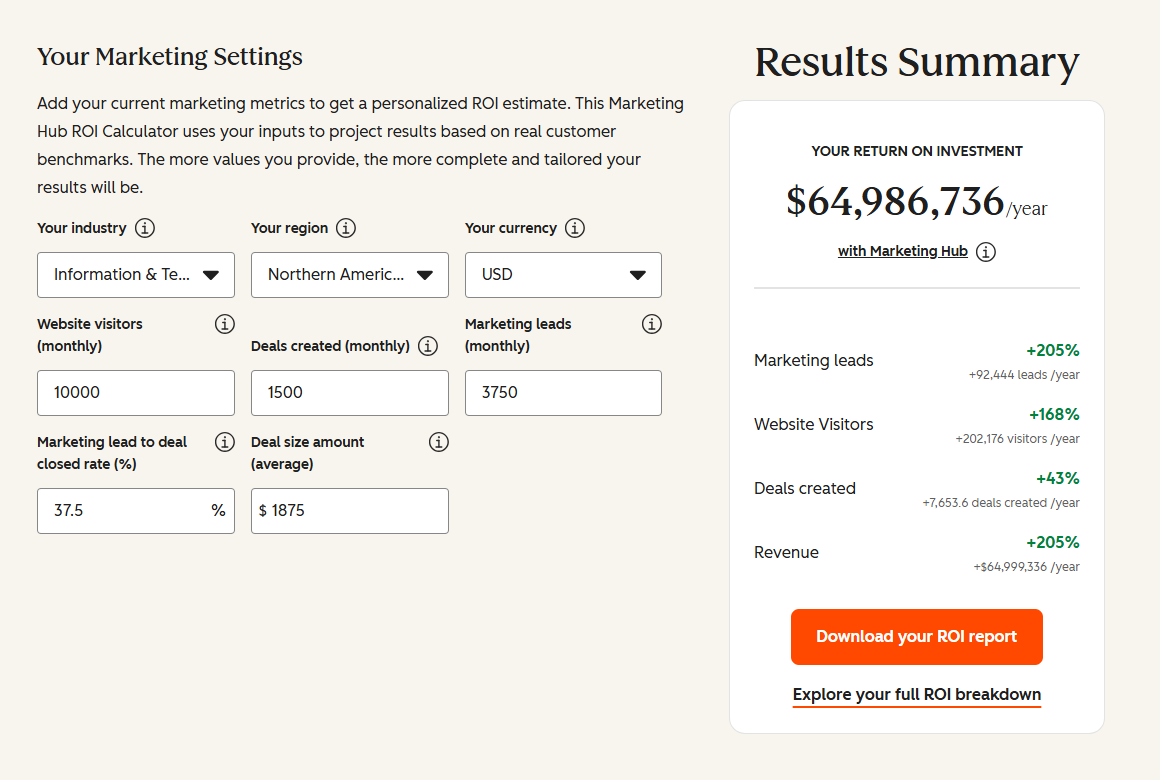
See your 12-month revenue impact with HubSpot CRM
Enter your current numbers — visitors, leads, deal size — and get a personalized projection based on real HubSpot customer benchmarks.
Putting Your ROI Case Together
If you’re weighing a native connector against a custom build, the numbers above only get you so far. Every stack has different data objects, different volumes, and different failure points, and that’s what actually moves the ROI figure. As a HubSpot Diamond Solutions Partner with custom integration accreditation, we’ve scoped this exact tradeoff for teams processing over 20 billion records a year across 300+ connected platforms, and we hold a 98.5% client retention rate because the integrations we build keep working past year one.
Start with our ROI calculator to model your own numbers, or talk to us about your HubSpot integration project and we’ll walk you through what an honest 8-week build looks like for your specific data.
Calculate Your Integration ROI

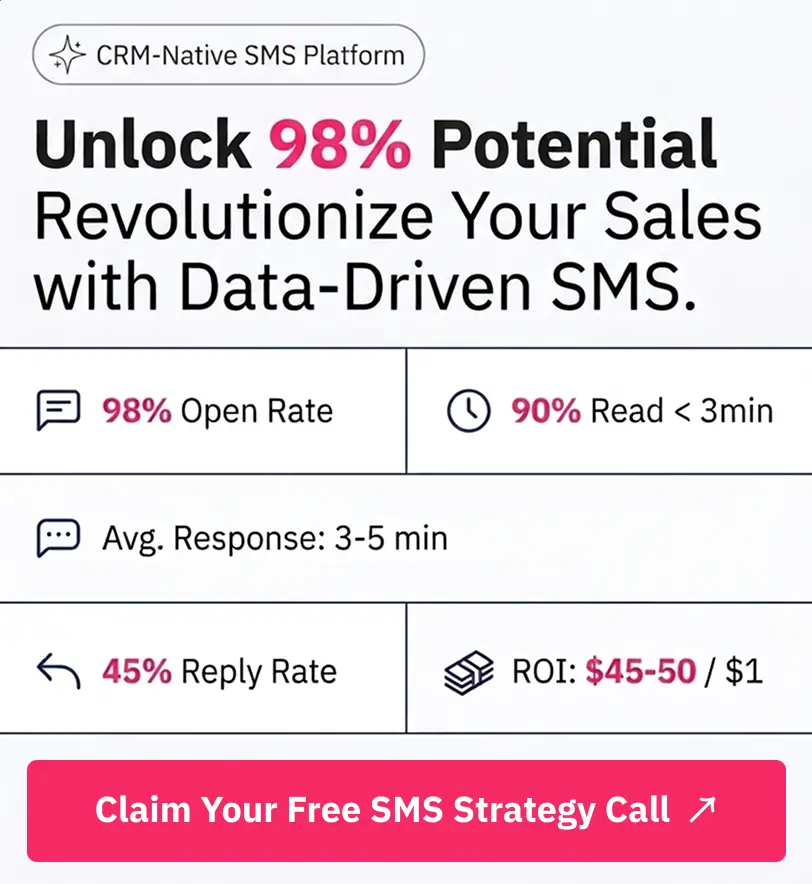
Table of Contents
- Why This Math Matters More Now Than It Did Five Years Ago
- The CRM Integration ROI Formula
- What Goes Into the Cost Side
- How to Present CRM Integration ROI to Leadership
- Industry Benchmarks for CRM Integration ROI
- Native Connector vs. Custom-Built Integration: Which Delivers Better ROI?
- Worked Example: HubSpot and NetSuite Integration ROI
- What Kills CRM Integration ROI
- Implementation Timeline: What to Expect
- Frequently Asked Questions
- Putting Your ROI Case Together