










Explore this article with AI:
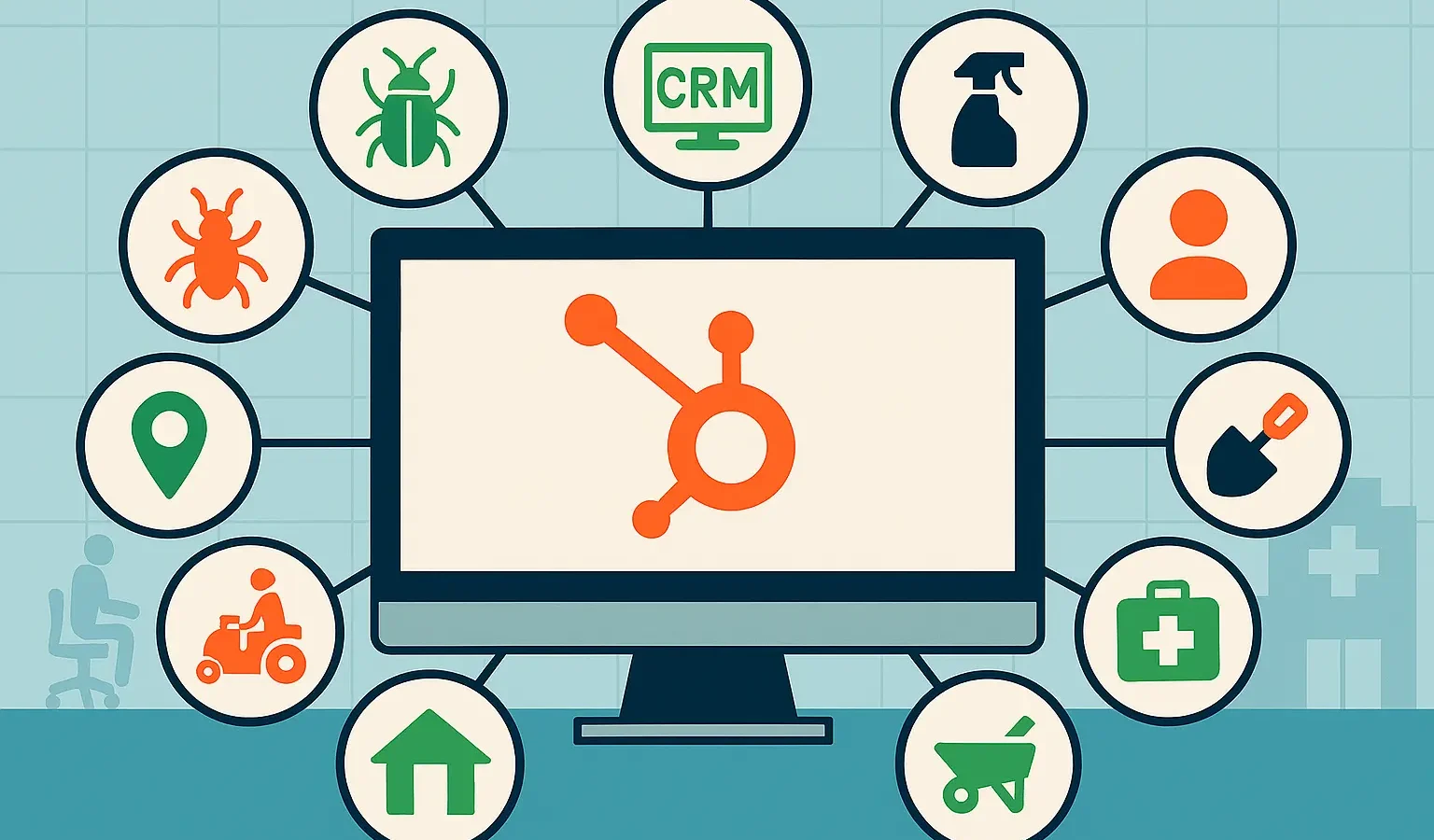
Your field service software knows your routes cold. It knows which technician is 4 stops into their day, what chemicals went on which property, and when your customer’s annual contract expires. What it doesn’t know is the lead who submitted a form on your website at 10pm last Tuesday, or the customer who went quiet after year two and is about to churn to your competitor. That’s the gap that costs lawn care and pest control businesses real revenue.
Choosing the right CRM for lawn care and pest control comes down to understanding a critical distinction: most platforms marketed as CRMs in this industry are actually Field Service Management (FSM) systems. They’re excellent at dispatching, route optimization, and chemical tracking. They’re not built for lead nurturing, marketing automation, or pipeline visibility. After integrating 300+ platforms into HubSpot and working hands-on with lawn care operators and pest control companies, we know exactly where that line sits. That distinction holds whether you’re evaluating a CRM for lawn care business specifically or a combined lawn and pest control platform.
This list ranks the 10 best CRM options for lawn care and pest control businesses in 2026, from pure growth platforms to industry-specific field tools. For each, we’ll tell you what it does well, where it falls short, and how it fits into a stack that actually supports business growth.
Free estimator
Know what your HubSpot project costs before the first call.
Select your services and get a transparent price range in minutes. No sales call needed to get a number.
Connect HubSpot to your ERP, billing platform, or database field mapping, custom logic, and support included.
Pipelines, workflows, email templates, and reporting configured for how your team actually works.
Live, role-based sessions with recordings and written guides built around a custom plan for your team.
HubSpot Partner
Client retention
Platforms integrated
What to Look For in a CRM for Lawn Care and Pest Control
A generic CRM checklist won’t help you here. The criteria that matter in this vertical are specific. Here’s what to evaluate before you commit.
Integration with Your Field Service Software
Most lawn care and pest control operations already run a field tool: RealGreen, PestPac, Briostack, FieldRoutes, or Jobber. Your CRM needs to talk to it. If the two systems don’t share data, you’re flying blind on whether a lead ever became a customer, which marketing channel drove your best jobs, and which accounts are overdue for a renewal call.
Recurring Contract and Seasonal Renewal Automation
This industry runs on recurring revenue. A CRM that can’t trigger an automated re-engagement sequence when a contract comes up for renewal isn’t a growth tool. Look for configurable workflow triggers tied to contract end dates, service intervals, and seasonal start windows.
Chemical Application and Compliance Tracking
For pest control specifically, compliance documentation isn’t optional. State-specific reporting, WDI (Wood-Destroying Insect) reports, and chemical usage logs require a system that tracks them at the account and property level. Pure CRMs don’t do this natively; it’s where vertical FSM tools earn their place.
Lead-to-Job Pipeline Visibility
From the moment a prospect fills out a quote request to the day a technician closes the job, you need to see every step. Lost in the gap between “web inquiry” and “booked job” is where most lawn care and pest control businesses bleed revenue. A CRM with deal pipeline stages built for service sales solves this.
Mobile Access for Field Technicians
Your team isn’t at a desk. The CRM or FSM your field staff uses needs a mobile-first experience that surfaces customer history, allows job updates, and captures upsell opportunities without requiring a laptop.
Marketing Automation for Seasonal Campaigns
Spring pre-emergent season. Fall overseeding. Winter pest dormancy outreach. This industry has natural campaign windows that a CRM should be able to automate. Targeted email and SMS sequences tied to service history or geographic triggers drive renewal and upsell without manual outreach.
1. HubSpot:-Best CRM for Lawn Care and Pest Control Companies That Want to Grow
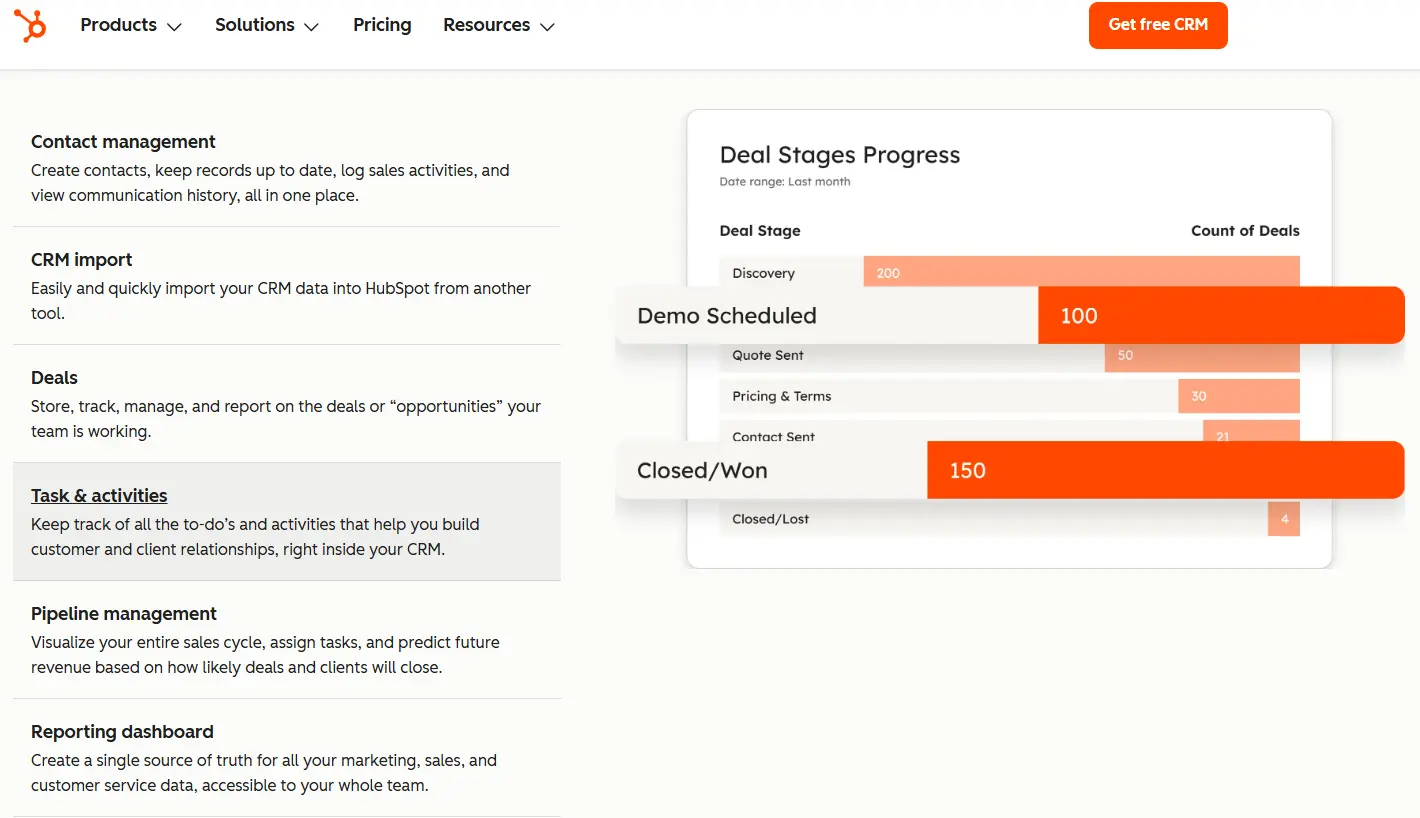
HubSpot isn’t a field service tool. It won’t optimize your routes or log chemical applications. What it does is everything a field service tool can’t: convert a web lead into a booked estimate, track that customer’s lifetime value across every interaction, and automate the renewal outreach that keeps them from going to your competitor next season. As a HubSpot Diamond Solutions Partner, we’ve built the integrations that connect HubSpot directly to the tools your field team already uses.
Why it’s the #1 pick for this vertical comes down to the stack: Sales Hub gives you a visual deal pipeline from first web inquiry to signed contract. Marketing Hub runs your seasonal campaigns, review request sequences, and win-back automations. Operations Hub is what powers the data sync between HubSpot and tools like RealGreen and Briostack, so your CRM always knows what’s happening in the field without manual entry. Service Hub manages contract renewals, customer portals, and ticket-level service tracking.
Vertical-specific strengths:
- Lead capture from web forms, paid ads, and call tracking feeds directly into a deal pipeline no manual import from your FSM
- Automated seasonal campaign sequences: spring pre-emergent, fall prep, and renewal windows can all be scheduled and triggered by service history
- Contract renewal workflows: trigger re-engagement emails and SMS 60/30/7 days before a contract end date
- Integration with RealGreen, Briostack, FieldRoutes, and ServiceTitan means field data syncs back to the customer record automatically
- Marketing attribution: know which ad campaign generated which closed jobs not just which leads
The honest limitation: HubSpot’s pricing scales with contacts and features, and for very small operations (1-2 techs, under 500 contacts), the professional tier can feel steep before the ROI is obvious. It also requires a real setup investment someone has to configure pipelines, build workflows, and map fields correctly. That’s not a HubSpot problem, it’s a reality of any serious CRM implementation.
Pricing: Free CRM with unlimited users and contacts. Starter plans from $15/seat/month. Professional (where the automation lives) from $90/seat/month. Enterprise from $150/seat/month.
Integrate IQ note: We’ve migrated lawn care and pest control businesses from RealGreen, PestPac, and Jobber to HubSpot and built the two-way data sync that makes both systems work together. See how that process works on our lawn care and pest control industry page, or read the full story of how we streamlined operations for a RealGreen client.

Turn HubSpot Into A Real-Time SMS Engine with
Message IQ

Two-Way Conversations

Shared Team Inbox

Automation Triggers

Advanced Reporting

Compliance Tools
-
98%
SMS read within 3 min -
78%
Buy from first responder -
21×
More likely to qualify
3–5 min avg response
$45–$50 ROI / $1

*MessageIQ is an IntegrateIQ product – built natively for HubSpot by the same team.
2. RealGreen:-Best FSM for Established Lawn Care Operations
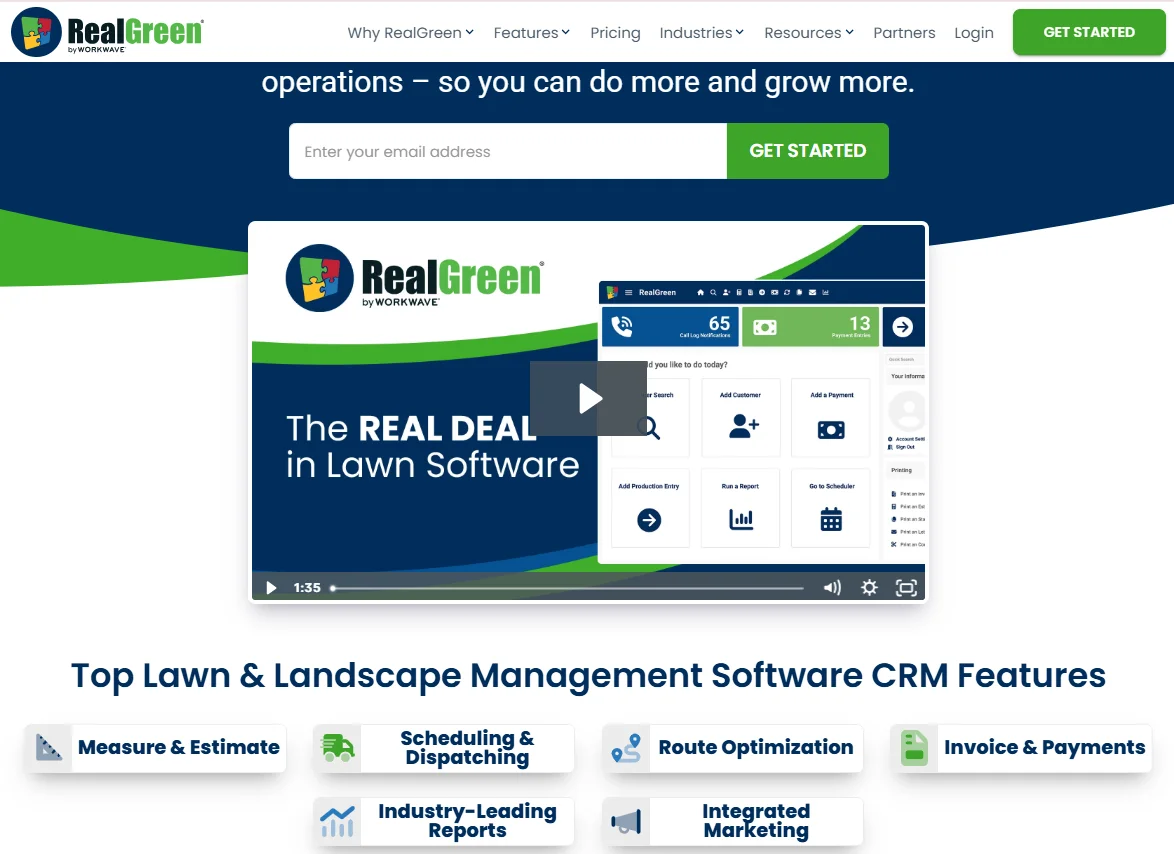
RealGreen is the industry standard in lawn care and pest control field management, and for good reason. Built specifically for this vertical, it handles the operational complexity that no general CRM comes close to matching: route density optimization, aerial measurement for accurate estimates, mobile field upsell from technician devices, and automated marketing triggers based on customer service history. If you’re running a lawn care or pest control operation doing $2M+ in annual revenue, RealGreen is almost certainly already in your stack.
Vertical-specific strengths:
- Measurement Assistant creates accurate property estimates from aerial data in seconds
- Route optimization for dense service areas reduces drive time and increases jobs per day
- Mobile Live lets technicians view routes, enter production data, and upsell services from the field
- Automated Marketing Assistant sends triggered emails and letters based on customer events
- Built-in reporting tracks production, revenue, and customer counts at a granular level
The honest limitation: RealGreen was built for operations, not growth marketing. The native marketing tools get the job done for basic outreach, but they lack the pipeline visibility, ad attribution, and workflow sophistication that companies scaling past $5M start to need. Sales teams often end up doing “swivel-chair” data entry between RealGreen and whatever email tool they’re using.
Pricing: Custom pricing based on account volume. Typically $200-500+/month depending on size and modules.
Integrate IQ note: We build the HubSpot RealGreen integration, syncing customer records, service history, and contract data between both systems so your field operations stay in RealGreen while your sales and marketing growth engine runs in HubSpot.
3. ServiceTitan:-Best for Enterprise Pest Control and Lawn Care Operations
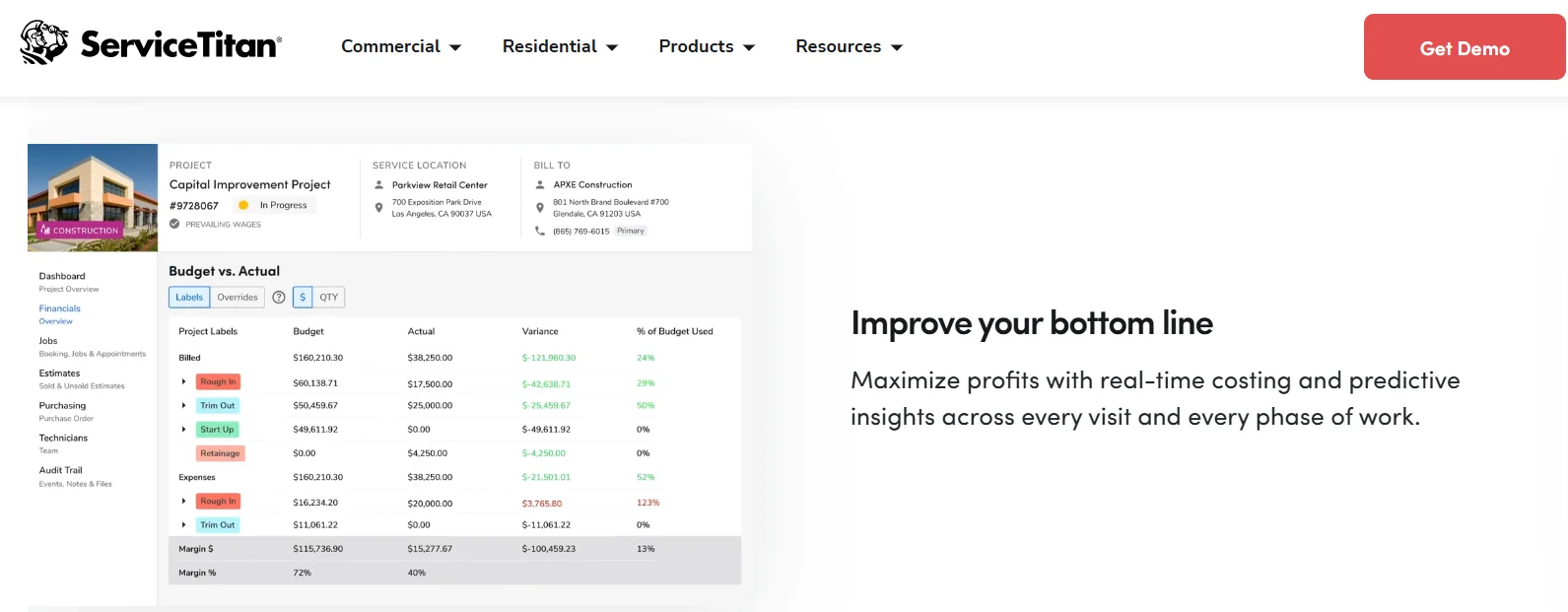
ServiceTitan is the dominant enterprise platform in field service, and its depth shows when you’re managing 20+ technicians, multiple service lines, and complex job costing. It covers the full operational picture: dispatching, quote-to-invoice, customer communication, and detailed revenue tracking by job type. Pest control and lawn care companies at the enterprise level often choose ServiceTitan precisely because it handles the operational complexity that lighter tools can’t.
Vertical-specific strengths:
- End-to-end job management from booking through invoice with full audit trail
- Revenue tracking by service type, technician, and location critical for multi-branch operations
- Integrated customer financing options for larger recurring service contracts
- FieldRoutes (ServiceTitan family) adds pest-control-specific routing and compliance workflows
- Reporting depth rivals enterprise ERPs for operations-focused owners
The honest limitation: ServiceTitan is expensive, complex, and built for scale. For companies under 15-20 technicians, the implementation cost and training overhead often exceed the operational benefit. It also lacks the marketing automation and lead nurturing capabilities of a true CRM, which means growing businesses still need a separate marketing platform.
Pricing: Enterprise contract pricing. Expect $400-700+/month as a starting point, plus onboarding fees.
4. Jobber:-Best for Small to Mid-Size Lawn Care and Pest Control Teams
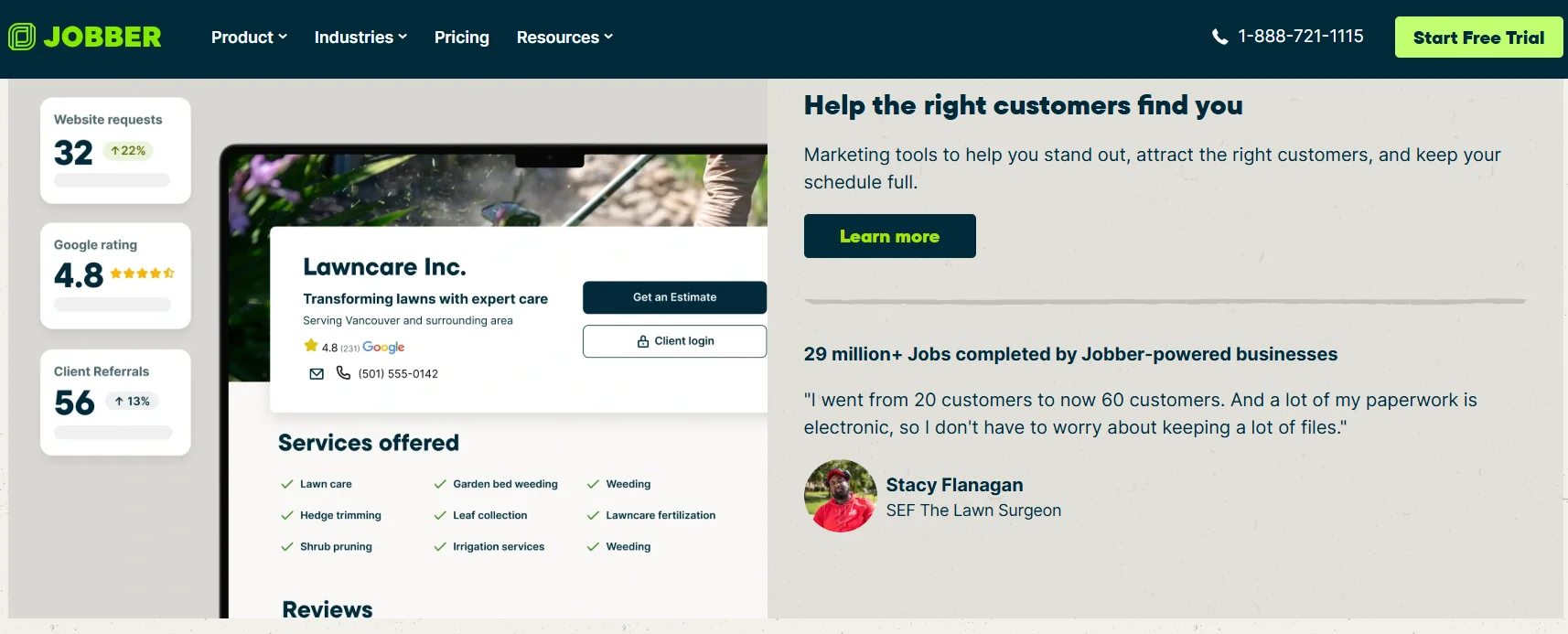
Jobber has become the go-to field service tool for small and mid-size lawn care and pest control businesses, and it earns that position through sheer usability. Setup is fast, the scheduling and payment workflow is clean, and the automated follow-up system handles review requests and post-job communications without any manual effort. If you’re running a 2-8 tech operation and need to get organized fast, Jobber is the shortest path from chaos to structure.
Vertical-specific strengths:
- Automated post-job follow-ups request reviews and customer feedback without manual send
- Instant invoicing lets you send payment requests from the field the moment a job closes
- Chemical usage and service notes stored per property for pest control compliance basics
- Client portal lets customers request quotes, view invoices, and approve jobs online
- Quote automation converts approved quotes into scheduled jobs without office touchpoints
The honest limitation: Jobber is excellent at field operations and customer communication, but it’s not a marketing platform. Lead nurturing, pipeline reporting, and campaign automation aren’t Jobber’s strengths. Growing companies consistently hit the ceiling on Jobber’s CRM capabilities around the 8-12 tech mark and need to add a dedicated marketing and sales tool.
Pricing: Core $49/month (1 user), Connect $149/month (up to 5 users), Grow $299/month (up to 15 users).
5. FieldRoutes:-Best Modern Interface for Pest Control Operations
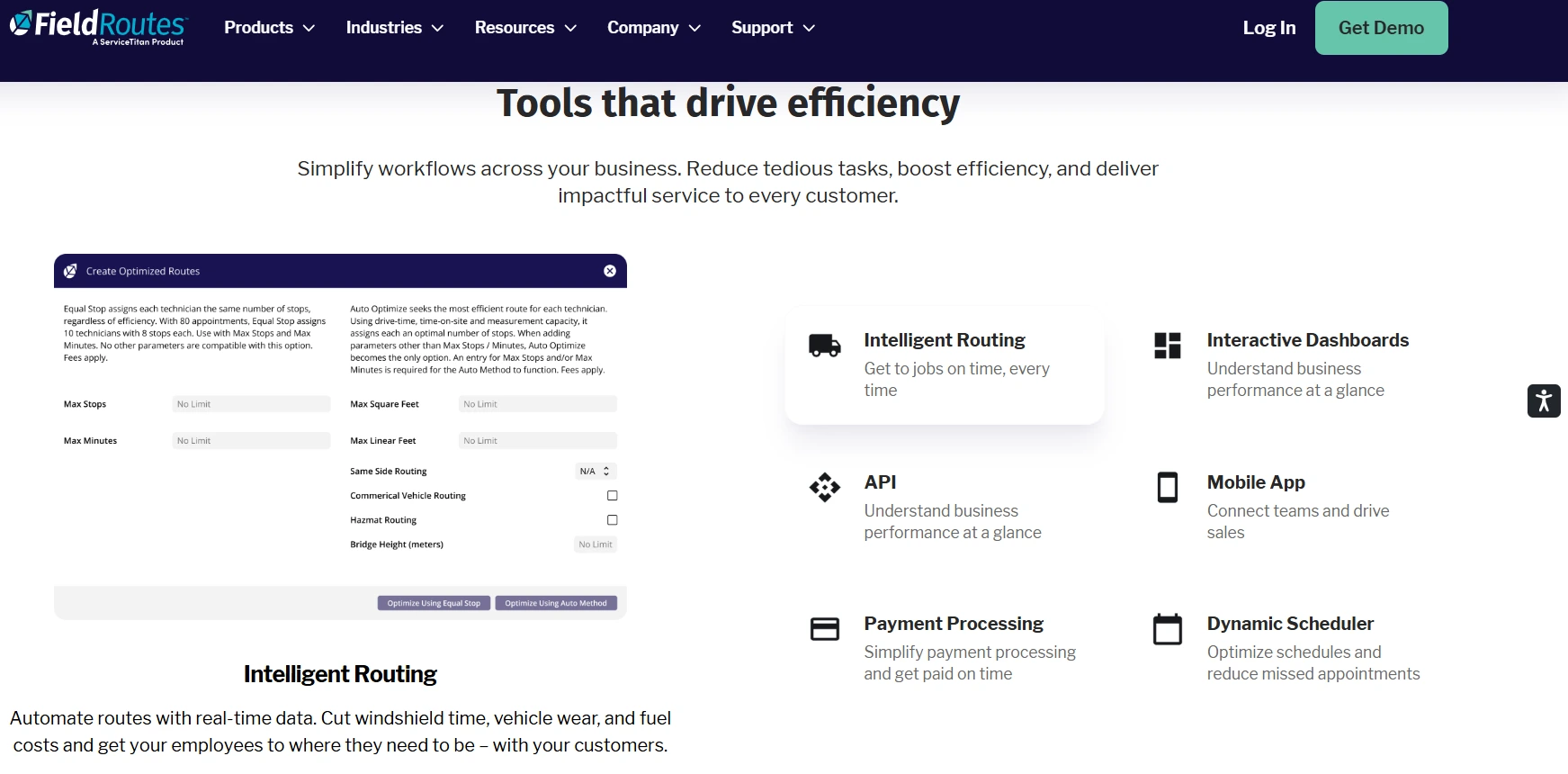
FieldRoutes (part of the ServiceTitan family) has built a strong following in pest control specifically because it combines a modern, intuitive interface with pest-control-native workflows: chemical tracking, service agreement management, automated renewal reminders, and route optimization. For pest control companies that felt stuck with dated FSM software but weren’t ready to move to full enterprise platforms, FieldRoutes hit a useful middle ground.
Vertical-specific strengths:
- Pest control-native service agreement and contract management
- Chemical application logs with technician-level tracking for compliance documentation
- Automated renewal reminders and lapsed-customer re-engagement sequences
- Route optimization built for pest control stop density and frequency
- Clean mobile interface that technicians actually use without training resistance
The honest limitation: FieldRoutes was built for pest control and shows its seams on the lawn care side. Marketing automation is limited, and for companies wanting real lead pipeline visibility or multi-channel marketing, FieldRoutes still requires a separate CRM or marketing platform to fill the gap.
Pricing: Custom pricing. Contact FieldRoutes for quotes based on account volume.
6. GorillaDesk:-Best Budget Option for Solo and Small Pest Control Operators
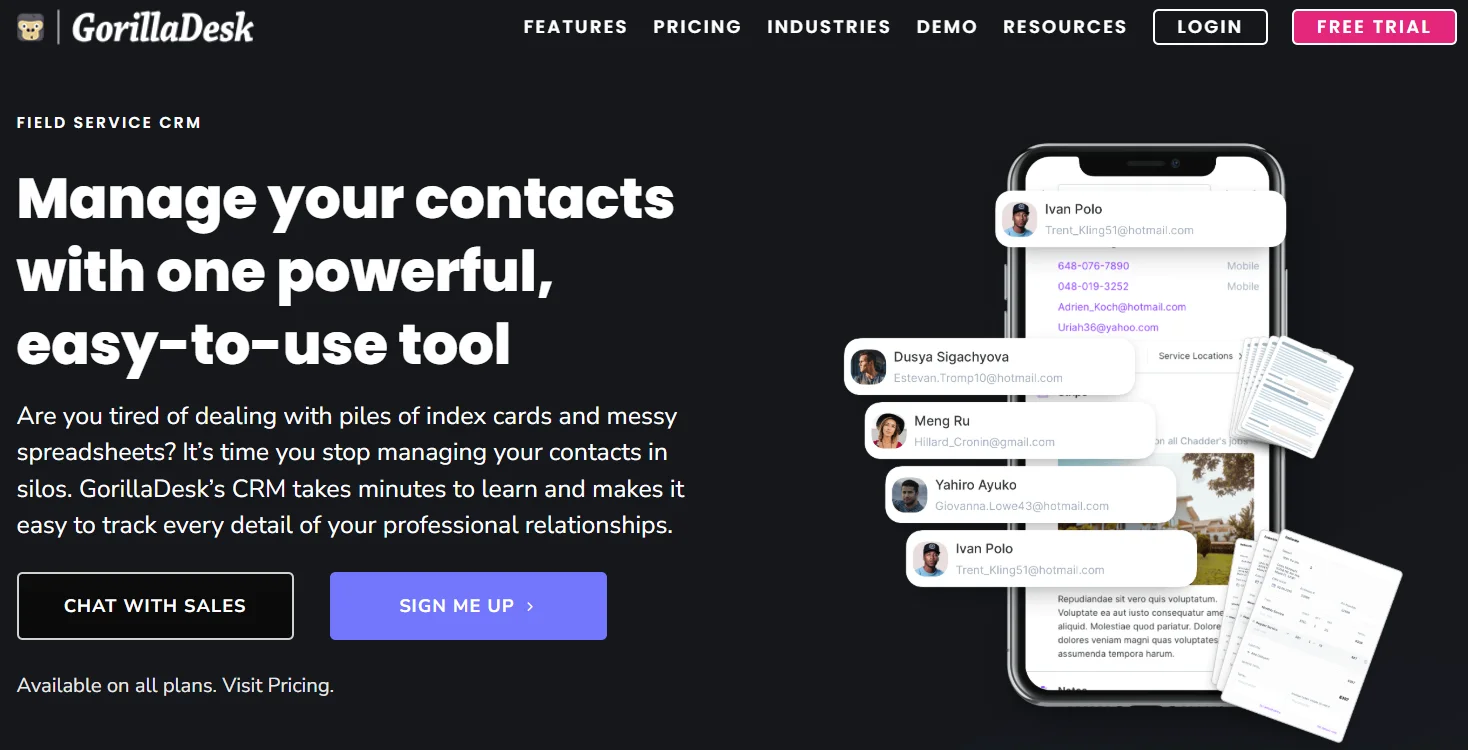
GorillaDesk built its name on a simple promise: pest control software that doesn’t require a consultant to set up. It covers the operational basics well scheduling, route management, customer records, chemical logs, and invoicing at a price point accessible to owner-operators and small teams. For a pest control business in its first few years of growth, GorillaDesk removes the operational chaos without adding financial strain.
Vertical-specific strengths:
- Pest-control-native chemical and treatment logging built into every service record
- Affordable pricing that scales by technician count rather than feature tier
- Simple scheduling and route management with minimal learning curve
- Customer communication templates for service reminders and follow-ups
- Review generation tools that automate post-service feedback requests
The honest limitation: GorillaDesk is a field operations tool, not a growth platform. Marketing automation, lead pipeline management, and integration with marketing channels are outside its scope. Lawn care coverage is also thin compared to its pest control functionality.
Pricing: Starts at approximately $49/month for one technician. Scales by tech count.
7. PestPac (WorkWave):-Best for Pest Control Compliance and Regulatory Tracking
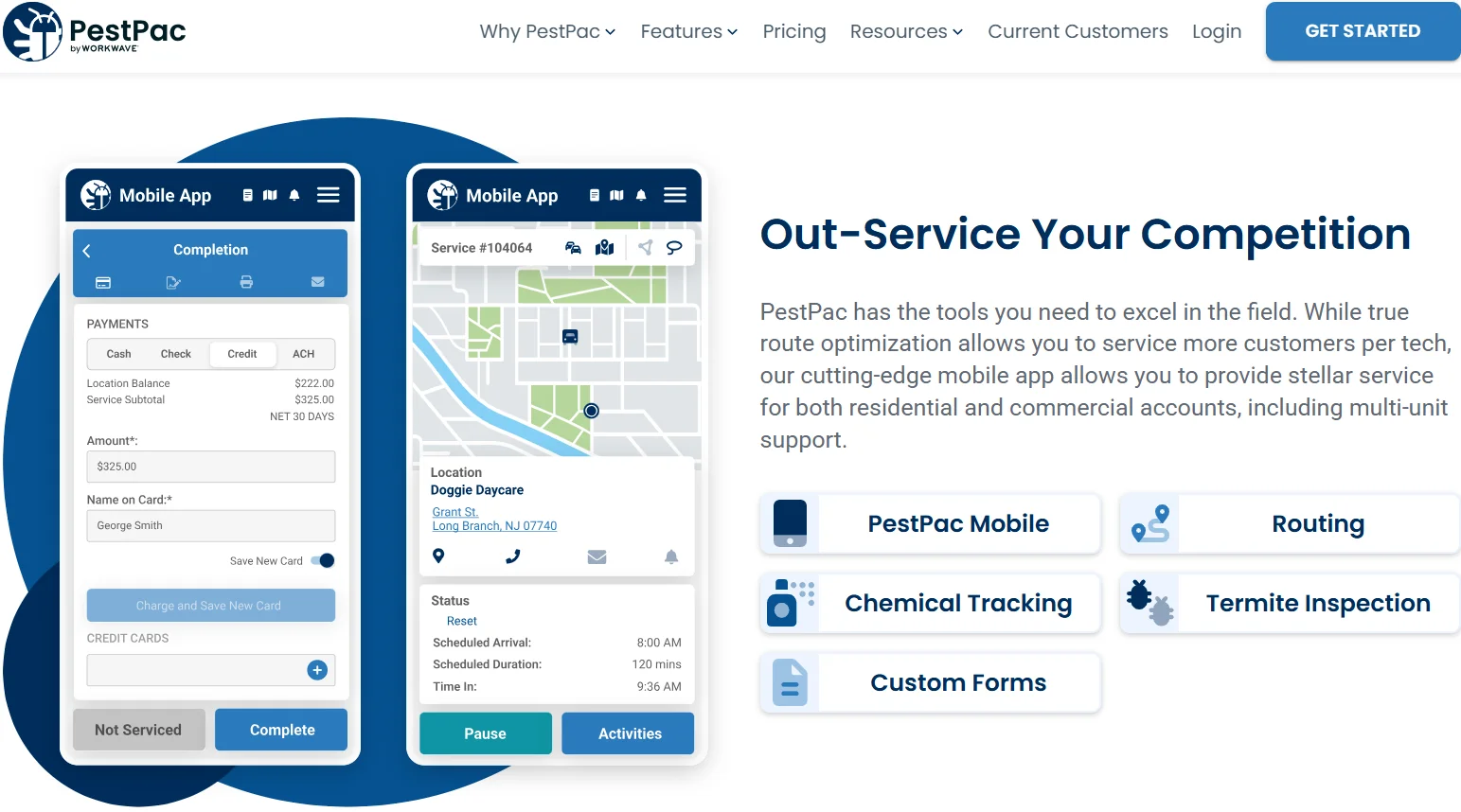
PestPac has been the compliance workhorse of the pest control industry for decades and it remains one of the most established names in pest control CRM software today. If your operation requires strict state-specific regulatory reporting, WDI (Wood-Destroying Insect) documentation, or detailed chemical usage tracking for audits, PestPac handles it with a depth that newer platforms haven’t fully matched. Enterprise pest control companies with complex compliance requirements often stick with PestPac specifically because switching carries real regulatory risk.
Vertical-specific strengths:
- WDI report generation and regulatory compliance documentation built natively
- Chemical usage tracking at the account, property, and technician level
- State-specific reporting templates for multi-state pest control operations
- Service agreement management with automated renewal triggers
- Customer communication and appointment confirmation workflows
The honest limitation: PestPac’s interface is dated, and that creates a real operational problem. Sales teams end up doing significant manual data entry because the system doesn’t flow well for prospect management or customer communication at scale. It’s a compliance and operations platform, not a growth tool.
Pricing: Enterprise custom pricing through WorkWave. Contact for a quote.
8. Briostack:-Best Modern FSM for Pest Control Teams Ready to Integrate
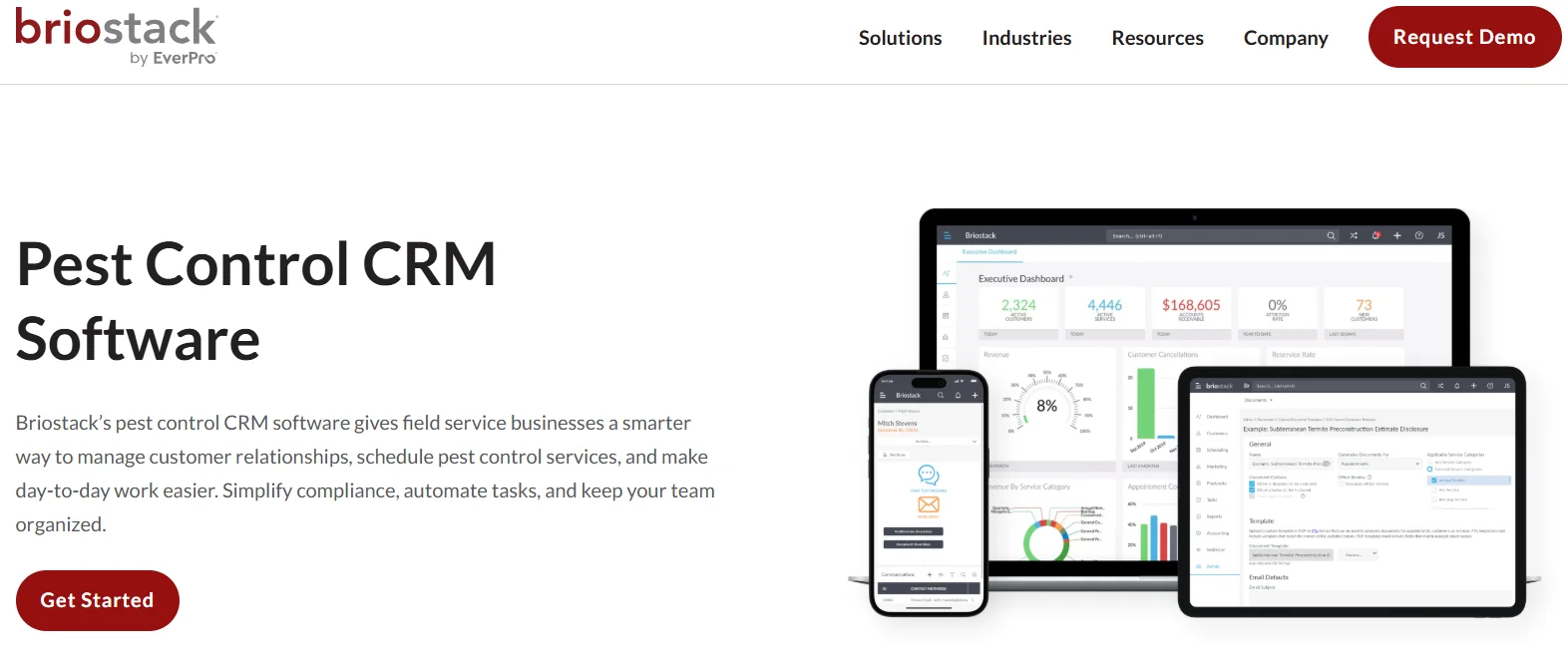
Briostack earns a spot on this list because it combines solid pest control field management with an API-friendly architecture that makes integrations actually work. The interface is cleaner than legacy platforms, the routing is solid, and for pest control companies that want to run a dedicated field tool alongside HubSpot, Briostack is one of the cleanest integration points available. We build the HubSpot-Briostack connection for clients who want both.
Vertical-specific strengths:
- Pest control-native routing and scheduling with modern mobile app experience
- Service agreement and contract management with automated renewal logic
- API architecture that enables clean two-way data sync with HubSpot
- Chemical and treatment logs stored per property for compliance
- Customer communication tools for reminders, confirmations, and follow-ups
The honest limitation: Briostack’s ecosystem is smaller than RealGreen’s or ServiceTitan’s, and lawn care functionality lags behind its pest control core. Companies running both service lines may find they need to make compromises on the lawn care side.
Pricing: Custom pricing. Contact Briostack for quotes.
Integrate IQ note: We build the HubSpot Briostack integration, connecting customer records, service history, and contract data between both platforms for pest control operators who want best-in-class tools on both sides.
9. Zoho CRM:-Best Budget General CRM for Lawn Care and Pest Control Startups
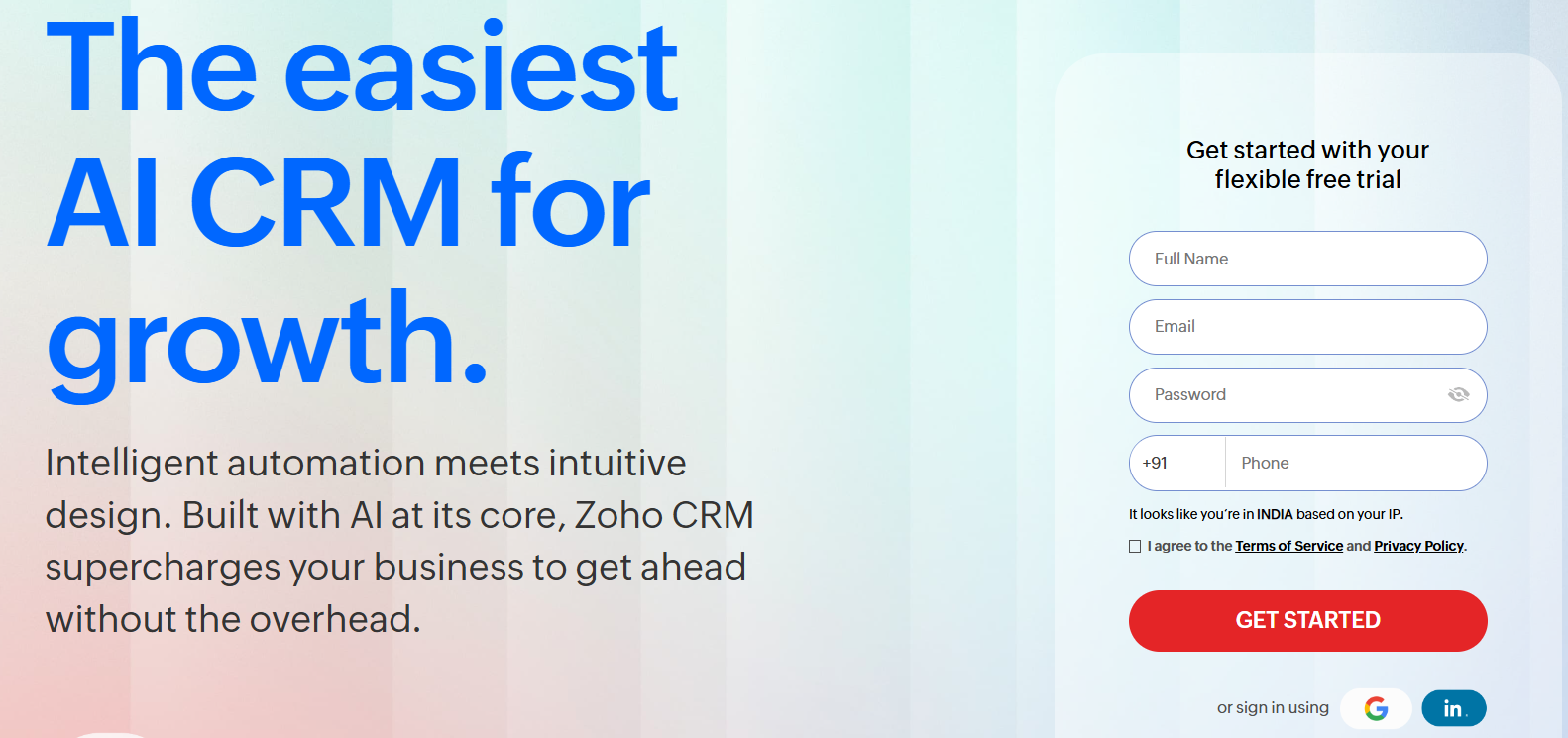
Zoho CRM earns a place on this list for one reason: it’s accessible. For a lawn care or pest control startup that needs basic contact management, a visual sales pipeline, and multichannel communication tools without a significant monthly commitment, Zoho’s free tier (up to 3 users) and affordable paid tiers remove the cost barrier. It’s not built for this vertical, but it’s configurable enough to build workflows that approximate what you need.
Vertical-specific strengths:
- Free tier supports up to 3 users with contact records, pipeline stages, and deal tracking
- Multichannel communication: email, phone, SMS, and social media in one contact record
- Customizable fields and modules that can approximate service history and property tracking
- Workflow automation available on paid tiers for follow-up and renewal sequences
- Budget-friendly scaling: Standard at $14/user/month covers most SMB needs
The honest limitation: Zoho requires significant customization to work for field service workflows, and it doesn’t integrate natively with any of the major lawn care or pest control FSM tools. You’ll end up building and maintaining custom connections or using manual workarounds.
Pricing: Free for up to 3 users. Standard $14/user/month, Professional $23/user/month, Enterprise $40/user/month.
10. Pipedrive:-Best Visual Pipeline for Owner-Operators Managing Sales
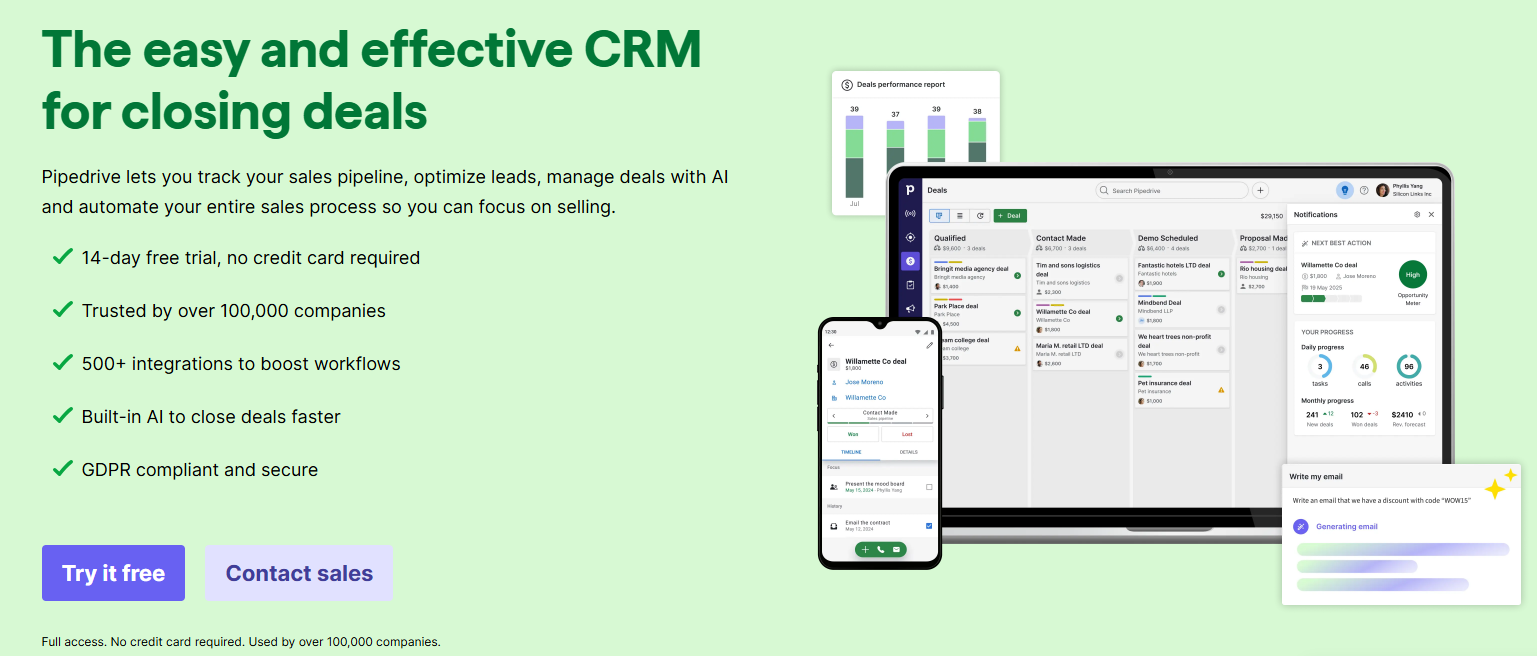
Pipedrive is a sales-focused CRM built around one thing: deal pipeline visibility. For lawn care or pest control owner-operators who handle their own sales and need a clean, visual way to track prospects from first call to signed contract, Pipedrive delivers that without complexity. It’s not a field service tool and doesn’t try to be. Where it fits is as the sales layer for small operations that haven’t yet committed to a full platform like HubSpot.
Vertical-specific strengths:
- Visual kanban-style deal pipeline makes it easy to see exactly where every prospect stands
- Automated follow-up sequences prevent leads from falling through the cracks
- Email integration logs all customer communication against the deal record automatically
- Quote management and proposal tracking for service contract sales
- Affordable entry pricing for owner-operators who don’t need a full marketing platform yet
Pipedrive’s honest limitation is straightforward: it’s a sales pipeline tool, not a field service CRM. There’s no scheduling, no chemical tracking, no technician dispatch, and no field operations functionality. It needs a separate FSM tool alongside it to run an actual lawn care or pest control operation.
Pricing: Essential $14/seat/month, Advanced $29, Professional $59, Power $69, Enterprise $99.
For a direct comparison of Pipedrive against HubSpot on sales features, see our HubSpot vs Pipedrive breakdown.
How These CRMs Compare for Lawn Care and Pest Control Businesses
| CRM | Best For | Field Service Native | Marketing Automation | HubSpot Integration | Starting Price |
|---|---|---|---|---|---|
| HubSpot | Growth, marketing, pipeline, renewals | No (integrates via IQ) | Yes, full suite | N/A (is the hub) | Free / $15/seat |
| RealGreen | Lawn care enterprise operations | Yes, lawn care & pest | Basic | Yes (IQ-built) | Custom $200+/mo |
| ServiceTitan | Enterprise field ops (20+ techs) | Yes, full enterprise | Basic | Custom | $400+/mo |
| Jobber | SMB scheduling & payments (2-15 techs) | Yes, scheduling focus | Limited | Custom/Zapier | $49/mo |
| FieldRoutes | Pest control modern FSM | Yes, pest control focus | Basic renewals | Custom | Custom |
| GorillaDesk | Solo/small pest control operators | Yes, pest control focus | Minimal | Limited | $49/mo |
| PestPac | Pest control compliance & regulatory | Yes, compliance focus | Minimal | Custom | Custom |
| Briostack | Pest control teams wanting integration | Yes, pest control focus | Basic | Yes (IQ-built) | Custom |
| Zoho CRM | Startups on a tight budget | No (general CRM) | Yes (paid tiers) | Limited | Free / $14/user |
| Pipedrive | Owner-operators managing sales pipeline | No (sales CRM only) | Basic sequences | Custom/Zapier | $14/seat |
CRM Software for Wildlife Removal Companies: Features, Service Types, and Scheduling
Wildlife removal does not fit neatly into a pest control CRM software template. A single job usually runs across several visits and several weeks, not one appointment, so the CRM has to track a case, not just a ticket.
Service types a wildlife removal CRM needs to support:
- Inspection and species identification: the first visit to confirm the animal, the entry points, and the extent of damage
- Trapping and removal: scheduled trap checks over days or weeks until the animal is caught
- Exclusion work: sealing entry points and installing barriers to stop the animal from getting back in
- Remediation and cleanup: insulation replacement, sanitization, and odor treatment after removal
- Warranty inspections: return visits that confirm the exclusion work is holding up over a guarantee period
Features that separate a wildlife-ready CRM from a generic pest control platform:
- Multi-visit job tracking that keeps a single case open across trap checks, exclusion, and cleanup instead of closing it after one visit
- Trap and equipment inventory tracking, since operators running dozens of traps across properties need to know what is deployed where
- Species and regulatory documentation, including trapping method, disposition records, and state wildlife agency reporting where it is required
- Recurring scheduling for trap checks and warranty visits, tied to the animal type and local regulations rather than a fixed interval
- Route optimization, since check-in visits are frequent and drive time adds up fast across a multi-day job
None of the platforms ranked above, HubSpot, RealGreen, ServiceTitan, Jobber, FieldRoutes, GorillaDesk, PestPac, Briostack, Zoho and Pipedrive, were purpose-built for wildlife removal. Several, particularly Jobber, GorillaDesk, and FieldRoutes, get adapted for it by pest control operators who also run a wildlife program, using general job templates that were not built with trap checks or exclusion warranties in mind. Purpose-built wildlife platforms add that job structure natively. If your business runs pest control and wildlife removal side by side, the deciding factor is whether one CRM can hold both service types without forcing wildlife jobs into a pest control template that does not fit them.
How to Choose the Right CRM for Your Lawn Care or Pest Control Business
The right answer depends on where your biggest operational gap actually sits. There is no single best CRM for lawn care business that fits every operation; the right pick depends on whether your gap is sales pipeline or field operations. Work through these questions before making a decision.
Step 1: Identify Your Primary Pain
If your biggest problem is that leads fall through the cracks and you can’t see your sales pipeline, you need a CRM-first solution: HubSpot or Pipedrive. If your biggest problem is dispatching, route density, and chemical tracking, you need a field service management platform first: RealGreen, FieldRoutes, or GorillaDesk. Most growing operations need both.
Step 2: Assess Your Team Size
Under 5 technicians: Jobber or GorillaDesk for operations, HubSpot Starter for marketing and pipeline. The combination costs less than $200/month total and covers both layers. 5 to 20 technicians: Jobber, RealGreen, or Briostack for field ops, HubSpot Professional for growth. The integration between them is where Integrate IQ comes in. Over 20 technicians: ServiceTitan or RealGreen enterprise for operations, HubSpot Enterprise for marketing and sales. You’re running two best-in-class platforms that need to talk to each other.
Step 3: Evaluate Integration Availability
Ask every vendor one question: “How does your platform send data to HubSpot?” Native integrations are rare in this vertical. App marketplace connectors are often limited in what they sync. Custom-built integrations, like the ones IntegrateIQ builds, are what make both systems work together without manual data entry or field-to-office communication gaps.
Step 4: Budget for the Stack, Not Just One Tool
The most expensive mistake lawn care and pest control businesses make in CRM selection is buying one platform and expecting it to do everything. Budget for your field tool plus your growth platform. The combined cost is almost always justified within the first renewal season once marketing automation and pipeline tracking are running.
What Switching to HubSpot Looks Like for Lawn Care and Pest Control Businesses
Switching CRMs is real work. We’re not going to minimize it. Here’s what’s actually involved when a lawn care or pest control company migrates to HubSpot, based on the implementations we’ve run.
- Audit what you have: Map every contact, company, deal, and service record in your current system. Identify what needs to move to HubSpot and what stays in your FSM tool.
- Clean the data: Migration is the moment to fix duplicate accounts, outdated contacts, and incomplete records. Moving dirty data into a new system is one of the most common and expensive mistakes we see.
- Configure HubSpot for your vertical: Set up deal pipeline stages that match your sales process (Inquiry, Estimate Sent, Contract Signed, Active Customer, Renewal Pending). Build lifecycle stage logic. Create custom properties for service type, property size, and contract value.
- Build the FSM integration: This is where IntegrateIQ does its part. We build the two-way sync between HubSpot and your field tool, mapping the specific fields that need to flow between systems: customer records, job status, service history, contract end dates.
- Migrate historical data: Import contacts, companies, deal history, and any relevant service records into HubSpot with field mapping validated before import.
- Build automations: Seasonal renewal sequences, lead nurturing workflows, post-job review requests, and re-engagement campaigns for lapsed customers.
- Train the team: Office staff on pipeline management and deal stages. Marketing on campaign workflows. Field team on what’s changing in their tools (usually nothing they stay in the FSM).
The typical timeline from kickoff to go-live is 8 weeks. Our CRM migration services page covers what that process includes in detail. For the integration-specific work, see our HubSpot integration process.
If you’re migrating from RealGreen specifically, our lawn care CRM migration guide and pest control CRM migration playbook cover the specific data objects and field mapping decisions you’ll face.
Frequently Asked Questions
Is there CRM software built for wildlife removal companies?
Not from the platforms on this list. HubSpot, RealGreen, ServiceTitan, Jobber, FieldRoutes, GorillaDesk, PestPac, Briostack, Zoho, and Pipedrive all serve lawn care and pest control, but none were designed around wildlife-specific work like trap checks, species reporting, or exclusion warranties. Pest control operators adding a wildlife removal service line typically adapt Jobber, GorillaDesk, or FieldRoutes to fit, or run a dedicated wildlife removal platform alongside their pest control CRM.
Is HubSpot good for lawn care and pest control businesses?
Yes, but with an important clarification: HubSpot is the growth layer, not the field operations layer. It handles everything from lead capture to contract renewal automation, marketing campaigns, and sales pipeline management. Paired with a field service tool like RealGreen, Briostack, or Jobber (and a proper integration between them), HubSpot gives lawn care and pest control businesses the commercial agility that FSM platforms alone can’t provide.
What’s the best free CRM for pest control or lawn care?
HubSpot’s free CRM is the strongest option at no cost. It gives you unlimited contacts, a visual deal pipeline, email integration, and contact activity tracking without a time limit or user cap. Zoho CRM’s free tier (up to 3 users) is the closest alternative. Both require customization to work well for field service workflows, but HubSpot’s free tier is more extensible and has significantly more integration options.
Can I keep using RealGreen or PestPac with HubSpot?
Yes, and for most established operations, that’s exactly the right approach. RealGreen and PestPac stay in place for field operations, routing, chemical tracking, and compliance. HubSpot handles marketing, sales pipeline, and customer lifecycle management. IntegrateIQ builds the integration that keeps both systems in sync, so customer records, job status, and contract data flow between them automatically without manual entry.
How much does a CRM cost for a lawn care or pest control business?
It depends on which layer you’re solving for. A field service tool (RealGreen, Jobber, GorillaDesk) runs $50-500+/month depending on company size. A growth CRM (HubSpot) runs $0-150/seat/month depending on the hubs and features you need. Most mid-size operations run a combined stack in the $300-800/month range. The ROI case usually comes down to the revenue recovered from automated renewals and systematic lead follow-up, which typically exceeds the cost within the first season.
What’s the difference between a field service tool and a CRM?
A field service management (FSM) tool handles scheduling, dispatch, routing, chemical tracking, and job management. A CRM (customer relationship management) platform handles lead capture, sales pipeline, marketing automation, and customer lifecycle tracking. In lawn care and pest control, most “CRMs” marketed to the industry are actually FSM tools. True CRM functionality lives in platforms like HubSpot. Growing businesses need both, connected.
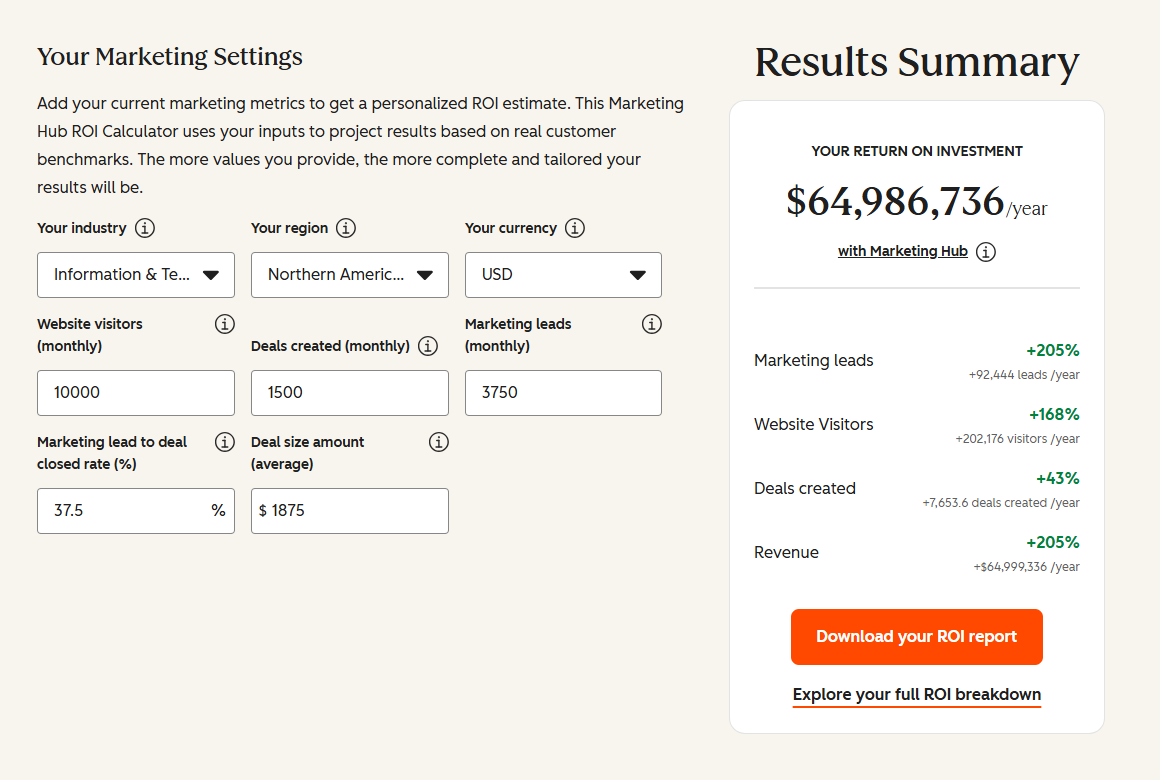
See your 12-month revenue impact with HubSpot CRM
Enter your current numbers — visitors, leads, deal size — and get a personalized projection based on real HubSpot customer benchmarks.
Ready to Build a CRM Stack That Actually Grows Your Business?
If you’re running a lawn care or pest control operation that’s outgrown its current CRM, or you’re tired of manually bridging the gap between your field tool and whatever you’re using to track leads, you already know what the problem is. The field side is handled. It’s the commercial side that’s leaking.
We’ve integrated HubSpot with RealGreen, Briostack, FieldRoutes, and Jobber for lawn care and pest control companies across the country. We’ve migrated customer databases, built renewal automation sequences, and connected ad spend tracking to field revenue. The process takes 8 weeks from kickoff to go-live, and your field team doesn’t touch a thing.
As a HubSpot Diamond Solutions Partner with custom integration accreditation, 300+ platforms integrated, and 98.5% client retention, Integrate IQ handles the hard parts of the transition so you don’t have to.
Start with our HubSpot integration process overview to understand what the build looks like, or go directly to our CRM migration services page if you’re ready to scope the work.

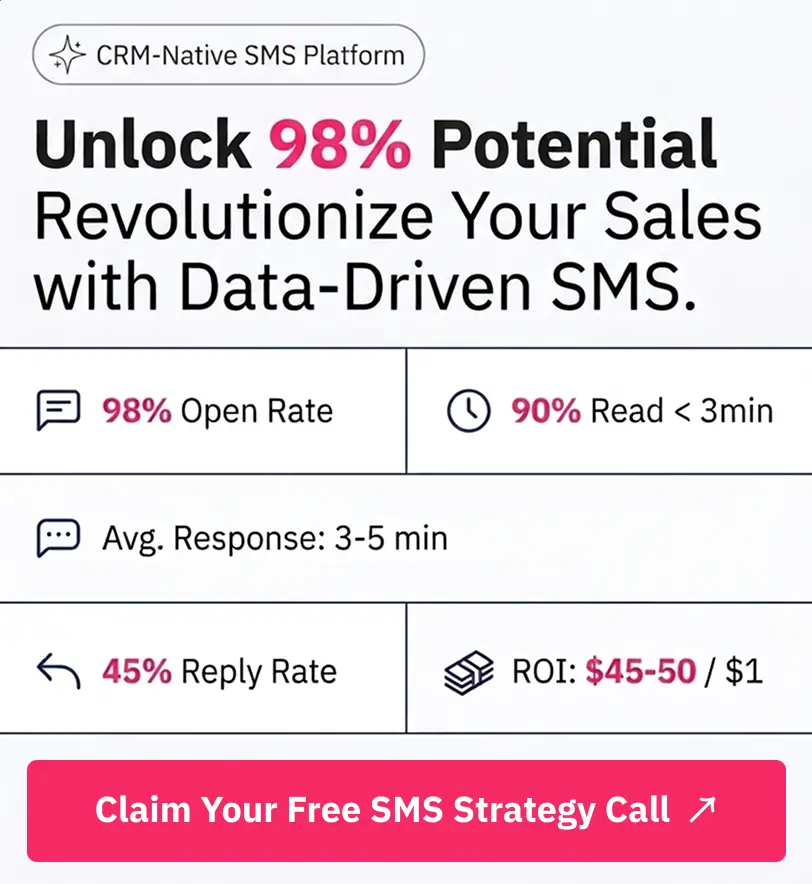
Table of Contents
- What to Look For in a CRM for Lawn Care and Pest Control
- 1. HubSpot:-Best CRM for Lawn Care and Pest Control Companies That Want to Grow
- 2. RealGreen:-Best FSM for Established Lawn Care Operations
- 3. ServiceTitan:-Best for Enterprise Pest Control and Lawn Care Operations
- 4. Jobber:-Best for Small to Mid-Size Lawn Care and Pest Control Teams
- 5. FieldRoutes:-Best Modern Interface for Pest Control Operations
- 6. GorillaDesk:-Best Budget Option for Solo and Small Pest Control Operators
- 7. PestPac (WorkWave):-Best for Pest Control Compliance and Regulatory Tracking
- 8. Briostack:-Best Modern FSM for Pest Control Teams Ready to Integrate
- 9. Zoho CRM:-Best Budget General CRM for Lawn Care and Pest Control Startups
- 10. Pipedrive:-Best Visual Pipeline for Owner-Operators Managing Sales
- How These CRMs Compare for Lawn Care and Pest Control Businesses
- CRM Software for Wildlife Removal Companies: Features, Service Types, and Scheduling
- How to Choose the Right CRM for Your Lawn Care or Pest Control Business
- What Switching to HubSpot Looks Like for Lawn Care and Pest Control Businesses
- Frequently Asked Questions
- Ready to Build a CRM Stack That Actually Grows Your Business?